


|
| |
Mineral Information |

|
Mineral Information |
|
 |

|
 |
Azurite
|
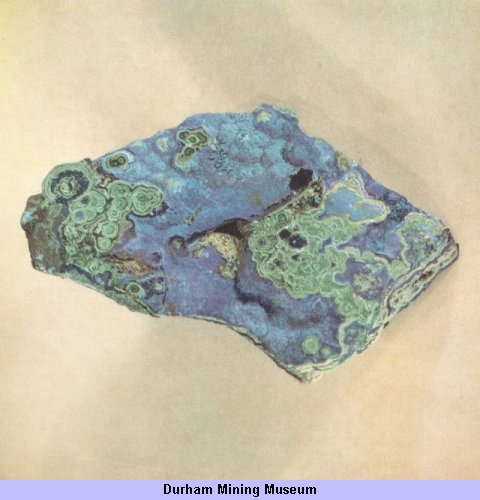
The specimen depicted also shows green Malachite, and comes from the Burro-Burra locality of S. Australia.
|
Synonyms
|
| |
 Chessylite ; Blue Copper carbonate ; Blue spar ; Chessy copper. Azurite is named in allusion to its blue colouration. Chessy is a well-known locality for this mineral near Lyons in France.
|
Composition
|
| |
Cu3(CO3)2(OH)2 a basic carbonate of copper CuO = 69.24 per cent, CO2 = 25.53 per cent., H2O = 5.23 per cent. Cu = 5.53 per cent.
|
Crystallography
|
| |
Monoclinic ; prismatic.
|
| |
a : b : c = 0.8565 : 1 : 1.7688. β = 92°25'. Twinning rare. Twin planes, {101}, {102}, {001}. Many of the crystal forms of the monoclinic system found in azurite.
|
|
|
| |
a, front or orthopinacoid {100} ; b, side or clinopinacoid {010} ; c, basal pinacoid {001} ; m, prism {h, k, O}; l, f, p, clinodomes {O k l} ; δ, γ, η, θ, orthodomes {h O l} ; h, pyramid {111}; k, pyramid {111}.
|
Habit
|
| |
A common form is in modified prisms; often tabular ; earthy or massive forms are also frequent. Slightly undulating and striated faces common. Aggregates, rhomboidal. lenticular or crudely spherical also occur.
|
Physical Properties
|
| |
Specific gravity, 3.77 ; Hardness, 3½-4 ; Lustre, vitreous, nearly adamantine ; Colour, characteristically azure blue, but light and dark blue varieties are known ; Streak, blue, somewhat paler than the colour of the mineral itself; Cleavage {001} perfect, {100} moderate, occasionally traces of cleavage {110} Fracture, conchoidal; Brittle; Transparent to sub-translucent. Fusibility, 3.
|
Optical Properties
|
| |
Pale blue by transmitted light. Pleochroic in blue with absorption Z > Y > X, distinct only in thick sections.
|
|
|
| |
Optic axial plane and X are normal to 010 ; Z Λ C = + 12.5°. Biaxial positive ; 2 V = 68°. Dispersion ρ > γ, horizontal.
|
| |
Nx = 1.730; Ny = 1.758; Nz = 1.838; Nz-Nx = 0.108.
|
Alteration
|
| |
Pseudomorphs of malachite after azurite resulting from alteration have been frequently recorded especially from Chessy, France ; Bisbee, Arizona and Tsumeb, South West Africa. The reverse process resulting in azurite after malachite is relatively uncommon. A change to cuprite and native copper is rare.
|
Tests and Diagnosis
|
| |
On heating to about 410° C., water is lost leaving tenorite, the black oxide of copper. Distinguished from malachite (green) by its azure-blue colour. Soluble in dilute acids, ammonia, and in hot concentrated solutions of NaHCO3. Slowly decomposes in boiling water with evolution of CO2.
|
Occurrence
|
| |
Azurite occurs as a secondary mineral in the upper oxidised parts of copper ore deposits, and is formed principally by the action of carbonated waters on other copper minerals. Alternatively, it may be produced by the action of solutions of copper sulphate or chloride on limestone ; azurite can, in fact, be produced artificially by the action of cupric nitrate or sulphate on calcite. Malachite, like other secondary copper minerals, is a very common associate of azurite, as seen in the illustration opposite. Azurite has been reported from many parts of the world, but the celebrated localities for fine mineralogical specimens are Chessy, Tsumeb, and Bisbee.
|
Source: "Mine & Quarry Engineering", December 1953,
from a copy held in the National Mining Museum Scotland, Newtongrange, Midlothian.
|
|





 Contains public sector information licensed under the
Open Government Licence v3.0.

