


 |

|

|

|
|
 |
 |
|||
| Mine & Quarry Engineering | August, 1944 |
Conclusion
What of the future ? Before entering on to a few general problems, let us consider the underground mining of Frodingham ironstone on a large scale.
The ore is of poor quality and must be mined cheaply. No doubt there will be large quantities of water to be handled. Immediately over the ironstone is 90 ft. of loose, wet clay. Loading must be mechanical and possible machines are the Eimco-Finlay, the Gardner-Denver, the Conway (this is the machine now in use at Frodingham — see Fig. 9), the Joy loader, the Thew, and types of scraper loader.
Various methods of working are being discussed after studying those in use in Lorraine, America and Germany. In passing, the German Dogger ore, 8 ft. thick, is mined very considerably with longwall faces. Underground at Frodingham the ore will probably be over 20 ft. thick, but it may be possible to have separate lifts with a "middling."
Without wishing to enter into pure economics, the following factors have a definite relationship with iron ore mining in Britain
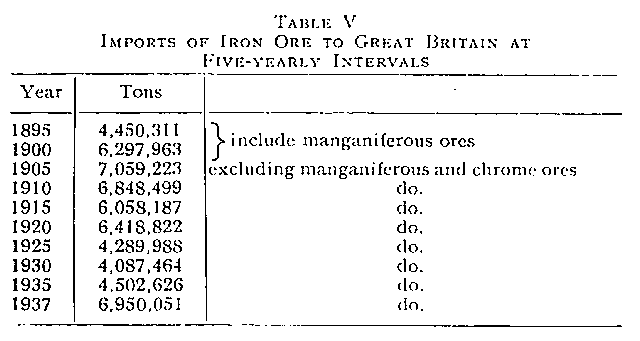
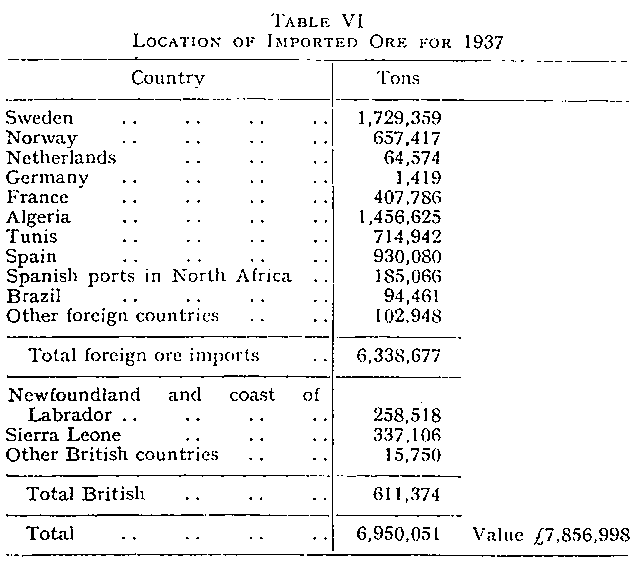
Tables 5 and 6 show the import of Empire and foreign ores to Britain. One is immediately struck by the large amount of imported ore in view of our own large reserves.
Much has been said recently about excessive taxation of the mining industry and its effect upon future development. Certain localities have had to pay excessive royalties. For instance, in Cumberland, certain royalties were once a quarter of the selling price. This, together with the wayleaves (a much smaller item), and the very cheap labour abroad probably accounted for the fact that iron ore from abroad could be taken to West Coast blast-furnaces as cheaply as could the ore in the immediate neighbourhood. Railway freightage has often been an item of considerable importance. Some time ago the cost per ton of Northamptonshire ore delivered by rail at Middlesbrough was 10s., with a mine cost of 3s. 6d. Jurassic ores cannot bear heavy transport costs and this has probably been the reason for their lack of development at a time when Britain started large scale importation of foreign ores. An interesting comparison is that, in 1890, 45-ton ore wagons were in use in America and the freight cost was 1s. 7d. per truck mile (less than ½d. per ton mile) as against 4d. per ton mile charged for west coast hematites to Barrow. Even when furnaces are situated quite close to the main ore field, odd mines lie farther away, with a resultant increase in cost to the furnace. The geographical positions of the ores by no means coincide with the centres of the steel markets and decisions concerning the site of the blast furnace and steel plants may be settled without especial consideration of the mining of Britain's own ores. One or two recent cases of placing new steel plants in derelict areas will mean an increase in cost per ton of the British ores to the furnaces thereby probably favouring the use of foreign ones. Coastal steel-works use a high percentage of foreign ores in peace time, due to the cheap rate of water transport and cheap foreign labour. A number of English firms own iron ore mines abroad.
Developments in blast-furnace technique have enabled metallurgists to overcome difficulties with our own ores — such as the refractory nature of the Cumberland ores and the heterogenity of Frodingham ores. In the latter cases bedding and mixing plants have been installed. Sinter plants now use up large quantities of fines which were previously wasted.
In the last war, increased outputs were obtained from our own ores by the advent of excavating machinery in opencast work and large development underground. Again, in this war, there has been a great increase in home ore production and great technical developments. Between the wars, however, there were very large imports.
It is surprising that until 1939 our maximum home production was between the years 1876 to 1884. Then came a drop and a considerable increase in the importation of foreign ores. Until 1890 Great Britain produced more iron ore than any other country. In 1930 U.S.A. produced five times as much as Great Britain and France four times as much.
Mining costs, both surface and underground, are tending to increase in Britain, and one wonders how this will affect the production of our own ores in years to come.
This survey is not complete and there are other factors involved. However, an appended bibliography will enable the reader to enlarge on various phases.
The author's thanks are due to various companies for enabling some of the information to be published and to Mr. W. Barnes, formerly of Ruston-Bucyrus Limited, for the photographs of the quarries.
REFERENCES AND BIBLIOGRAPHY
- J. D. Kendall "The Iron Ores of Great Britain and Ireland," 1893
- British Regional Geologies:
- S. W. England,
- Bristol and Gloucester,
- Midland Valley of Scotland.
- Special Reports on the Mineral Resources of Great Britain (Memoirs of the Geological Survey)
- Vol. VIII Iron Ores — Hematites of West Cumberland, Lancashire and the Lake District. 1924, pp. 38-43.
- Vol. IX Iron Ores — Sundry unbedded ores of Durham, East Cumberland, North Wales, Derbyshire, Isle of Man, Bristol district, Somerset, Devon and Cornwall.
- Vol. X Iron Ores — Hematites of the Forest of Dean and South Wales. 2nd Edition.
- Vol. XI Iron Ores of Scotland, 1920.
- Vol. XII Iron Ores — Bedded ores of the lias oolite and later formations in England. Lamplugh, Webb and Pringle, 1920.
- Vol. XIII Iron Ores — Pre-carboniferons and carboniferous bedded ores of England and Wales. Sir A. Strahan.
- Vol. XXIX Iron Ores — Bedded ores of England and Wales. Petrography and Chemistry. A. F. Hallimond, 1925.
- J. D. Kendall: "Hematite Deposits of West Cumberland." Transactions of the North of England Institute of Mining and Mechanical Engineers. Vol. XXVIII, 1879, pp. 109-154.
- W. Macdonald: "West Cumberland Hematite Deposits." Iron and Coal Trades Review. Vol. 110, 1924, p. 434, and "Whitehaven News," 28.12.39 and 4.1.40.
- E. E. L. Dixon: "The Origin of Cumberland Hematite." Summary of Progress, Part II (Memoirs of the Geological Survey), 1928, pp. 23-32.
- F. J. Stephens: "Iron Deposits of the West of England." Iron and Coal Trades Review, September 25th, 1942.
- F. M. Trotter: "Geology of the Forest of Dean Coal and Iron Ore Field." Geological Survey. H.M.S.O., 1942.
- W. Pulfrey : "The Iron Ore Oolites and Pisolites of N. Wales." Quarterly Journal of the Geological Society of London, 1933. Vol. LXXXIX, Pp. 401-430.
- K. C. Dunham: "Iron Ore Deposits of the Northern Pennines." War Time Pamphlet No. 14. (Memoirs of the Geological Survey.)
- Cole and Hallessy : "Handbook of the Geology of Ireland, 1924, p. 70.
- Mary C. Delany : "The Historical Geography of the Wealden Iron Industry," 1921.
- H. Mussche : "Shaft Sinking in Cumberland with a Special Reference to Freezing and Cementation." Transactions of the West Cumberland Mining Society, January, 1938.
- R. Neill : "The Mining of Hematite Ore at Beckermet." Transactions of the West Cumberland Mining Society. 1937.
- Ministry of Health : "Report of the Committee on the Restoration of Land affected by Iron Ore Working," H.M.S.O., 1939.
- W. Barnes : "Excavating machinery in the Ironstone Fields." The Engineer, August 7th. 14th, 21st and 28th, 1942.
- J. Tomlinson and J. C. Dack: "Ironstone Mining in Cleveland." Iron and Coal Trades Review, September 29th, 1939, and February 16th, 1940.
- C. P. Bates : "Working Northamptonshire Tronstone." Iron and Coal Trades Review, March 8th, 1940, and March 15th, 1940.
- T. M. Dover: "Boring in Frodingham Ironstone." MINE AND QUARRY ENGINEERING, December, 1941.
- C. E. Van Barneveld : "Mechanical Underground Loading in Metal Mines." School of Mines and Metallurgy, Missouri, 1924.
- United States Bureau of Mines : Bulletin 423. "Mechanical Shovelling in Underground Metal Mines," 1940.
- United States Bureau of Mines : "Metal Mining Practice," Bulletin 419.
- MINE AND QUARRY ENGINEERING : "German Dogger Ore." May and June, 1940.
- A. A. Jones: "Notes on Tubular Steel Headgear for Small Mineshaft." Transactions of the Institution of Mining and Metallurgy, January. 1940.
- A. A. Jones : "Sand Filling Methods at Hodbarrow (Hematite) Mines, South Cumberland, Transactions of the Institution of Mining and Metallurgy. Vol. XLI, p. 303.
- Chas. Hart : "Known Iron Ore Reserves of the World and Their Significance." Iron and Steel Engineer. May, 1939.
- British Iron and Steel Federation : "Statistics of the Iron and Steel Industry for the year 1937."
- The Manchester Guardian : "Coal and Iron," February 11th, 1941.
- John Postlethwaite : "Mines and Mining in the Lake District," 1913.
- T. H. Burnham and G. O. Hoskins: "Iron and Steel in Britain, 1870 to 1930." 1943.
Drawings and Photographs accompanying the article


Article reproduced from a copy of the magazine held at National Mining Museum Scotland, Newtongrange, Midlothian.




 Contains public sector information licensed under the

