


 |

|

|

|
|
 |
 |
|||
October, 1937
A Tunnel Blast at Shap
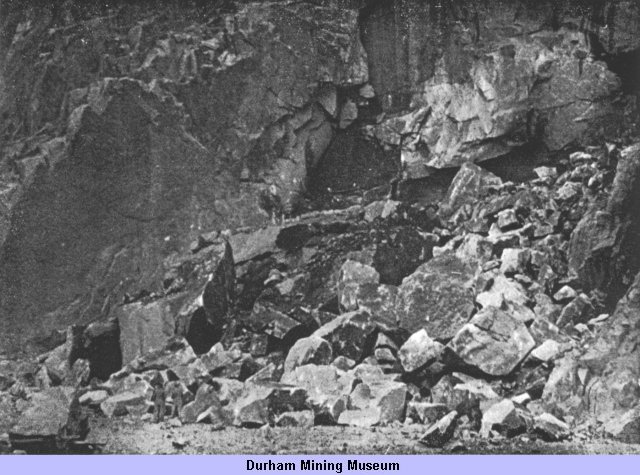
A view taken after the blast. The figures seen in the left foreground
give some idea of the amount and sizes of the rock brought down.
Recently a large tunnel blast was successfully carried out at the Shap Pink quarry belonging to the Shap Granite Co. Ltd. This blast was the biggest the company has yet undertaken, some seventy to eighty thousand tons being brought down.
Shap Pink quarry is at Wasdale Head, and six or seven hundred yards away from the main Penrith-Kendal road over Shap Fells. The deposit worked is the well-known Shap granite, and in this particular instance is required for the building of the new Wandsworth bridge over the Thames. This granite is similar to that supplied for the large graving dock at Southampton to accommodate the "Queen Mary," the docks at Goole, and the train ferry dock at Dover.
In order to control the quantity of granite and the charges, a survey was made, and the tunnel driven into the face for a distance of 45 ft. Cross-drives at right angles were then taken to distances of 45 and 25 ft. A height of approximately 5 ft. was maintained in the tunnel for quicker extraction of rock broken during the advance, and for easier transport of the explosives to the chambers in the cross-tunnel. The tunnel was driven in six weeks, and it took three and a half days to place the charges in position, pack and seal off the chambers, and convey and consolidate the broken rock used for stemming the tunnel. At the junction of the cross tunnels with the main level, steel rails were placed to strengthen the stemming.
The total charge in the blast was 6,600 lb. of black powder, the latter being chosen in order to avoid unnecessary shattering of the rock which is required in large pieces for the construction of the bridge.
Arrangements were made for the electrical initiation of the blast and, at the prearranged time, the switch was closed by Mr. H. B. Fleming, the managing director. The rock face was broken up into large boulders, some weighing up to fifteen hundred tons or more. One such piece, incidentally that in which the entrance to the tunnel had been bored, was 30 ft. square, and had been moved a distance of some 35 ft. A plentiful supply of granite which will be cut and dressed into blocks weighing up to four and five tons is thus assured. Work on the contract for the supply of these blocks for the bridge is estimated to occupy from twelve to eighteen months.
The heading for the explosion was designed and laid out by the technical engineers of Imperial Chemical Industries Limited, whose Explosives Group produced the black powder which was supplied by Fleming and Company of Glasgow.
We are indebted to the Shap Granite Co. Ltd., for permission to publish the above particulars of this blast.


Article reproduced from a copy of the magazine held at National Mining Museum Scotland, Newtongrange, Midlothian.




 Contains public sector information licensed under the

