


| Individual Details | Individual Details | |||
 |
 |
|||
William Powell
| Age: | 32 |
| Died: | 14th Jul 1888 |
| Accident: | 2nd Jul 1888 |
| Year Born: | abt. 1856 |
| Colliery: | Deckham Hall |
| Company: | Deckham Hall Coal Co. |
| Occupation: | Stoneman |
| Notes: | burnt by explosion of gas |
| Buried: | [not known] |
| Category: |
 |
 |
| Description | |
|
|
This occurred in the Bensham seam of this colliery, which lies at a depth at the shaft of 58 fathoms from surface, and which, together with the Yard seam above it, are the only seams at present in working. There are two seams below the Bensham, the first, the Six quarter about 15 fathoms below it, and the Five quarter, still lower. It is stated that gas has not been seen before in the Bensham and Yard seams, and they had been worked since the commencement, about two years previously, with naked lights, but that gas had frequently been seen in the two seams below, which are now abandoned in consequence of water.
The sketch below shows particulars of the place where the gas ignited.
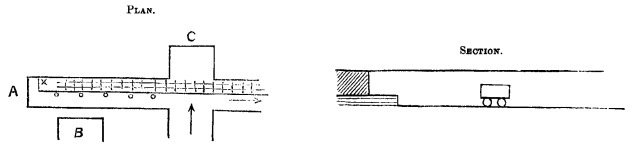
The ignition occurred in A, which at the time was 14 yards before the air, not bratticed, and rising about 1½ inches per yard. The coal is 2 feet 6 inches thick, and a canch of 1 foot thickness is shot up in the bottom. The places A, B, and C were occupied by hewers during the day, and the hewer in A left about 5 p.m. The back shift deputy was in A about 4 p.m. Candles were in use. The injured man came to work at 5 p.m., or two hours earlier than usual, the stonemen, shifters, and master shifter coming down at 7 p.m. as a rule. He worked some hours and fired several shots in other places, and then about 9 p.m., came into A with his tram and gear; he left the tram at the plate ends, and went to the canch which was 3 feet from the face when some gas ignited and burnt him. He was dressed in short trousers and bodyshirt, and was bare about the knees, arms, and neck. The place wasmoderately dry, and there was some dust. The dust does not appear to have been disturbed. There was no damage done, and no indication of burning. His candle was not found in the place, and he may have kept it in his hand; it would probably be put out, and it is said he lit another or perhaps the same candle with a watch to go out-bye with. The tram blocked his road out, and he stated that had it not been there he could have escaped easier. Mr. Atkinson examined the place on the 7th July, and reported: "When I was in, the bord B had been holed and A had advanced a yard or so. I saw no gas on the lamp, and the ventilation was good. The place A had not been examined between the hewer leaving it at 5 p.m. and the injured man entering it. Lamps are now used in the district, and an examination made before the night men go in. The bottom stone shot up is stowed at the side. The coal was not singing. Gas was seen in the place A after the explosion."
I think it is probable, as testified by one of the witnesses at the inquest, that gas had found its way up from the lower seam, as the place was not very far distant from a hitch or dislocation. The evidence, however, disclosed some degree of laxity as regards examination of places which have stood awhile, after being left by one shift, before the succeeding shift follows in, but not to such an extent as to be considered a direct violation of the Act. A claim of £312 was made in this case under the Employers Liability Act, and judgment was ultimately given for £150.
|
|
| Mines Inspectors Report Entry | |
|
|
|
|
| Sources | |
|
|
- 1888 Mines Inspectors Report (C 5779), Newcastle District (No. 3) by James Willis, H.M. Inspector of Mines, Page: 19 Where to find this report
- 1888 Mines Inspectors Report (C 5779), Newcastle District (No. 3) by James Willis, H.M. Inspector of Mines, Page: 31, Accident Number: 31 Where to find this report
|
|
| Researchers | |
|
|
If you are researching William Powell (e.g. for family tree purposes) and you would like to hear from others with the same interest then please complete the details in the following form. We will show the information you provide on this page so that you can be contacted.
 Return
 Return to Top



 Contains public sector information licensed under the

