


| Individual Details | Individual Details | |||
 |
 |
|||
Robert Johnson
| Age: | |
| Died: | 20th Dec 1856 |
| Accident: | 8th Dec 1856 |
| Born: | |
| Colliery: | Rainton, Nicholson Pit |
| Company: | |
| Occupation: | |
| Notes: | explosion of firedamp |
| Buried: | [not known] |
| Category: |
 |
 |
| Description | |
|
|
The explosion by which the third and last life was lost during the past year occurred at the Nicholson's Pit of the Rainton Colliery, on the 8th day of December, whereby there were four persons considerably burnt, one of whom, named Robert Johnson, died from the effects of the explosion on the 20th of the same month.
In the accompanying plan of part of the workings of the Nicholson's Pit, the point marked F is the place where the explosion took place, the direction of the air currents being indicated by the arrows.
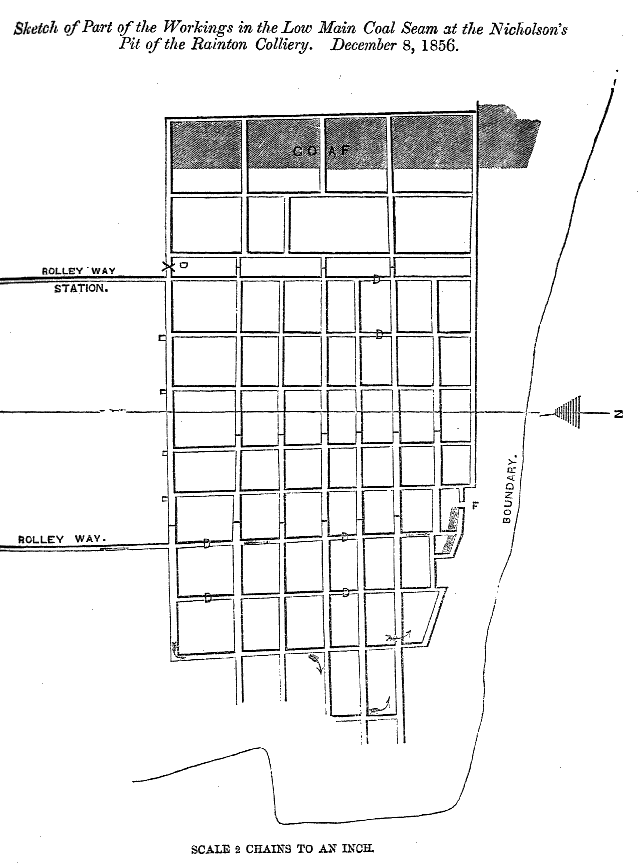
The working away of the pillars, or the broken working as it is termed, was just recently commenced at the point F at the time of the explosion, and was done entirely by means of safety lamps.
It may be observed that the board or fast jud at F had not been holed into the headways course to the west, nor into the board which was driven eastwards out of it, so that it was a likely place for gas to lodge, if any were generated; yet on my inspecting the place on the 18th of December, ten days after the explosion, I found it very well ventilated and quite free from gas. I may here state that I never received any notice under the Act, of this explosion till after I accidentally heard of it, several days after it occurred, when on my way to pay an ordinary visit to the colliery, although serious personal injury had been received by four persons. An examination of the 9th Section of the Coal Mines Inspection Act will show that the time specified for sending notices is confined (probably by some mistake in drawing the Act of Parliament) "to within 24 hours next after such loss of life," so that, although provision is made by the Act for notices to be sent to the Secretary of State, and to the Inspector for the district, in the event of serious personal injury being received from explosion of gas, yet, as there is no time specified as to when such notices are to be sent, unless a death should happen to ensue, there appears to be no chance of enforcing a compliance with this part of the Act within any useful time after the occurrence, in cases when it does not prove fatal ; although I have great pleasure in stating my conviction that there are perhaps few if any other collieries in this district, from which notices would not be sent within 24 hours after such an occurrence, as the Act appears to have been intended to mean.
That gas should have been found in the cavities of the edge of the goaf in this case, was only what might have been anticipated, for the reason already stated; and it would have proved harmless, had only perfect safety lamps been used in the place, excepting, as the evidence given on the inquest went to show, a lamp should become unsafe from injury received while amongst the gas.
The explosion appears to have occurred at the lamp of Lowery, the overman, while in the act of trying it for indications of gas above the level of the roof of the seam of coal, in the cavity of the edge of the goaf.
Lowery's lamp was of the description known as the Clanny lamp ; and after the explosion, when the lamp was exhibited at the inquest, it was proved to be in the same condition as it was found by the deputy overmen, William Thornton and Jacob Dowell, after the explosion ; and it was certainly in about the same condition as when I had seen it in the interval between the explosion and the holding of the inquest, exhibiting a close crack extending through the glass laterally, and from the top to the bottom vertically, with a small splinter at the top of the glass, extending only about half through the thickness of the glass, and slightly on each side of the vertical crack, forming an injury coincident with the crack itself, and extending a short way on each side of it; moreover, this splinter at the top of the crack, was situated almost entirely within the vertical brass ring enclosing the top of the glass, when the glass was properly screwed up, and was apparently protected from injury by any falling stone by the projecting horizontal brass ring of the lamp, rendering it very unlikely, in my judgment, to be the part of the glass which a falling stone would have fractured or splintered, which led me to suppose it probable that this splinter, at which the explosion had evidently originated, had been made at the same time that the vertical fracture in the glass had occurred, long before the explosion, and hence, to think it possible that the overman, Lowery, would, at the inquest, have been proved to be culpable for using a lamp in such an unsafe state.
I may here state that a short time before this occurrence I had had a long conversation with some of the underviewers and overman of the Marchioness of Londonderry's collieries respecting safety lamps, when I expressed a strong preference, as regards safety, for lamps not entirely dependent upon glass in any part for their safety, owing to the liability of glass lamps to be fractured by unequal expansion from heat, (most likely to occur when the lamp is being tried in an explosive mixture,) by a fall of stone or water upon the glass; the latter, when the glass is heated, being likely to cause a fracture by the too sudden cooling and contraction of the outside of the part of the glass on which it falls. The Nicholson's pit belongs to her ladyship.
At the inquest, the evidence of the deputy overman Thornton, and also that of the lampkeeper, both tended to show that the lamp, although cracked for a considerable time before the explosion, had not had the piece splintered out at the top of the crack before the occurrence; and it was evident that it was simply the combined effect of this splinter, and the fact of the glass not having been screwed close up against the brass ring at the top of the glass, which had given rise to the explosion; in the absence of either of which conditions, I can assert that the lamp would not have passed an explosion.
I should here observe that the glass fitted so tightly into the bottom brass ring, that it was not a very easy task to screw the glass tight up against the top brass ring, as the screw is of large diameter, and the leverage to work it with the fingers is very small, so that the threads are apt to get wrong into the recesses.
As I consider this to be rather an interesting instance of an explosion occurring at a safety lamp, which I believe to be a rare occurrence, I subjoin the substance of the evidence given at the inquest held on the body of the deceased, Robert Johnson, showing that if so-called safety lamps are not properly used and in good order, no dependence can be placed upon them when exposed to an explosive mixture.
At the adjourned inquest, held at Middle Rainton, on the body of Robert Johnson, on the 26th day of December 1856 :—
William Thornton, being sworn, said I am a deputy overman in Nicholson's Pit, at Rainton Colliery. I was in the place where the deceased, Robert Johnson, worked about two o'clock on the morning of the day when the explosion occurred, the 8th of December inst. It is situated in the north-west part of the Galloway way, and I examined the place before any one came to work in it. No person accompanied me in this examination. I examined the place where the men had to work, and also above the brow at the edge of the fallen goaf, for gas, by a safety lamp; but I found no indications of the presence of gas, nor had I done so in that part of the pit for a long time previously, although I have been in the habit of examining the pit for gas for a long time past. After I left that place I went to the station, where I found the workmen sitting, ready to proceed to their working places ; Johnson, the deceased, being one of them. They all went off to their working places after seeing me, and learning that all was right for them. I was again in Johnson's place before the explosion occurred; that would only be about half an hour after I left them. On this occasion I said to Johnson and his partner, that I thought everything was very "clever" for them, and they said "yes." I again examined the place with my lamp for indications of gas on this occasion. I then left them to go to other parts of the pit to see after the other workmen. I visited the station about half-past four o'clock, A.M., to get the boys started work, and when I was there "she fired," and blew my lamp out and left me in the dark. Soon after my lamp was blown out, a boy came running out with a lighted lamp, and said that he was burnt. I took the lamp from him and told him to hold his tongue and then Lowery (the overman), and Nailor (Johnson's partner), came out, both also burnt.
The explosion occurred direct north from the station. I then proceeded in that direction to get the burnt men's clothes, but could not get within ten yards on account of the after-damp, and had to come back to get my breath. I had then got about 100 yards northwards from the station. After I recovered my breath I ran in for the clothes. I am satisfied that the explosion took place about there, although I cannot tell the exact point.
Robert Johnson and James Naylor were working in the place, and Robert Bowes, the boy, was going into it with a tub. I do not recollect noticing Johnson come out, nor did I see him till after he got home.
William Lowerey was the overman and had charge of the pit, and it was his duty to see that the pit was safe. Jacob Dowell (another deputy overman) and myself went into the place about twenty minutes after the men had come out, and we found a safety lamp, of which Jacob Dowell took possession, and he kept it till Mr. Charlton, the under-viewer, came in, about eight o'clock; and I then saw Dowell give the lamp to Mr. Charlton, and I perceived that the glass of the lamp was cracked, but did not take very particular notice of it. I cannot say whether or not the lamp would explode the gas on the outside, but it is my opinion that the defect in the lamp was the cause of the explosion.
I have seen the lamp which Lowery generally used in the lamp cabin, and knew that it was cracked in the glass before the explosion. It might be about a fortnight before the explosion that I had seen and noticed it.
The piece of glass which is splintered off at the top of the crack, was not broken off at the time I saw the lamp about a fortnight before the explosion, although the glass of the lamp was then cracked.
Lowery told me that some stone had fallen and injured his lamp while he was trying it to see if there was any gas, at the time when the explosion occurred.
I had examined all the other lamps that were in use in the place where the explosion occurred, before they were taken in, on the morning of the explosion; but I did not see them again directly they were brought out, after the explosion.
I have not known the lamp which Lowery used tried in gas since I had first noticed the crack through the glass, before the explosion. I did not see Lowery go in, as he was going to the place where the explosion happened.
Jacob Dowell, being sworn, said: I am a deputy overman in Nicholson's pit. I was in that pit on the morning of the 8th inst., when the explosion took place.
I was at the hitch flat, about 400 yards from the place when the explosion happened. I felt that there had been an explosion from the wind, and I then proceeded in the direction of the place where I thought it had occurred; and, as I went, I met the deceased between the switch and the straight down flat, and observed that he was much burnt about the face and hands, and he said that the explosion had happened in "our place."
I next met Lowery, the overman, and neither Johnson nor Lowery had lamps with them. Lowery appeared to be, and he said he was much burnt.
I then proceeded, and went past Naylor, where the men were putting his clothes on. Grey was one of the men. Naylor was also severely burnt; and I went on to see if there had been any damage done. Thornton was about the place where Naylor was, and Lowery told me where his lamp would be found. Thornton and I then went in and found his lamp near the place he had told me. After finding the lamp I brought it out with me, and gave it to Mr. Charlton. I did not particularly examine the lamp at the time. I said that Lowery had told me that a stone had fallen on the lamp, at the same time he told me where I would find it. I had not observed the lamp previous to that day.
I identify the lamp now handed to me as the same lamp which I found (and gave to Mr. Charlton, the under-viewer, that morning) in the place to which Lowery had directed me.
James Middleton, being sworn, said : I am employed as lamp-keeper in the Nicholson's pit. I recollect the morning of the explosion. Johnson's and Naylors lamps were brought back to me after the explosion, and I found them perfect. Two or three days after the explosion I received both these lamp gauzes, and also the lamp bottoms, and found no defect in them ; and I think no explosion could have arisen from either of these lamps. I was in the habit of having this lamp of Lowery's, and I gave it to him that morning before the explosion happened ; the crack was then in the glass of the lamp, but it was not fractured then, as it is now, at the top of the crack.
This witness was now asked, whether he considered Lowery's lamp, which he held in his hand, to be in a safe state or not, and after a great deal of hesitation and delay on the part of the witness, he at length said he did not consider it to be safe in gas in its present state, and continued, "Lowery told me at the shaft after he had come out from where the explosion had happened, that a stone had fallen upon his lamp, and he thought it would be all broken to pieces."
Edward Charlton, being sworn, said I am the underviewer at the Nicholson's pit, and I went down that pit on the morning of the explosion, about two o'clock ; Lowery was in-bye, and I went into the south-east district whole workings, with Lowery, and found them all safe, and free from gas ; and we then came back by the waste into some pillar workings in the same district ; we then came out to the switch, and I measured the air, both in that district and in the north district.
I found 10,000 cubic feet of air per minute in the north side, and 6,000 cubic feet per minute in the south side. The air in the north district is nearly equally divided into two parts, one half going into that part where the explosion took place; and we then proceeded into the north district, in which the explosion afterwards took place ; but as Lowery told me that all was right in that district, and as I had to go to the plain pit, I did not travel round that district. I had examined that way on the 1st instant, and then found it all right, a week before.
I returned, and again went down the Nichlolson's pit, about seven or eight o'clock the same morning after the explosion had occurred, and I proceeded inbye, and joined the deputy overmen, who were sitting at the switch. Thornton and Dowell were there, and also Reed, the master wasteman ; Dowell gave me the lamp to look at, but he took it again and kept it till we came to bank. We examined it at the switch ; but we did not try to work the glass up and down. Dowell took the lamp to my house, where I found it afterwards. I identify this lamp as being the same lamp, and it is now in the same state as it was when I first saw it, after the explosion.
I do not consider the lamp safe to be used in its present state.
There had only been one ventilating sheet blown down by the explosion, and the deputies had put it up again when I got there.
The side of Johnson's place was fallen up about four feet above the roof, and I think Lowery had been up there trying his lamp for indications of gas, at the edge of the goaf when the explosion occurred.
The other men's lamps are all in a good state ; I have seen them since the explosion, and found them to be so. I am quite satisfied that the defective state of Lowery's lamp has caused the explosion.
James Naylor, one of the men who was burnt by the explosion, was also examined, and his evidence simply accorded with the foregoing in all material points, without throwing either doubt, or additional light on the subject.
As the crack in the glass of Lowery's lamp was too close for the explosion to occur through it, and as there was an opening of considerable size at the splinter at the top of the crack, which made a free communication between the interior and exterior of the lamp, unless the glass was firmly screwed up against the upper horizontal brass ring, (which appeared, by some oversight, and the tightness of the glass, not to have been done), there can be little doubt that the splinter and the glass not being screwed up had united to produce the explosion.
I deem it my duty to express the very grave doubt I have as to the splinter being caused by any falling stone ; as the position it was in, under the brass rim of the lamp, would, I think, have hindered any falling stone from touching that part of the glass. And I confess that I am of opinion that the splinter either had existed before the explosion, or that the heat of the gas exploding in the lamp, at the time, had caused the piece of glass to splinter and fly off at the top of the crack.
If this occurrence ought not to be taken as a beacon, giving warning against the general employment of lamps, in which the isolation of the flame from the circumambient atmosphere in any part is entirely dependent on glass, however strong the glass may be (in this case about one-fourth of an inch, I believe), at least I hope that it may tend to prove that overmen, deputy overmen, and other persons, whose lamps are mostly used to detect the presence gas, should avoid the use of such lamps, especially as gas is much more easily detected by common Davy lamp, although it must be admitted that the light afforded by the Davy lamp is much less than that given off by a Clanny lamp. I consider that, even where much light is a great object, the use of the Stephenson lamp, which, with a good light, combines a glass, and also a gauze protection, is much to be preferred for safety, to a lamp entirely dependent upon glass for the isolation of the flame.
The use of cracked glasses, in particular, I think, is to be depreciated; for who is there but has seen a slight crack in a drinking glass, most suddenly, on a very slight change of temperature, extend itself to a great extent, and sometimes end in the glass falling to pieces; evidently indicating that incipient cracks had existed, from the time of the original fracture, although quite invisible to ordinary observation. And it must be borne in mind, that the most dangerous moment (when an explosion of gas has occurred within a lamp) is also the moment when such an extension of a crack, as that alluded to, is most likely to occur with a safety lamp, owing to the sudden rise of temperature on the inside of the glass, while that of the circumambient atmosphere remains stationary.
That more accidents have not arisen from glass lamps than we have on record, is probably to be attributed rather to the limited employment of such lamps, and particularly of those in a cracked condition, than to any great amount. of safety which attaches to them.
|
|
| Related Articles | |
|
|
| Pub. Date | Article (Newspaper) |
|---|---|
| 13 Dec 1856 | Colliery Explosion (Newcastle Guardian and Tyne Mercury) |
|
|
| Sources | |
|
|
- 1856 Mines Inspectors Report
|
|
| Researchers | |
|
|
If you are researching Robert Johnson (e.g. for family tree purposes) and you would like to hear from others with the same interest then please complete the details in the following form. We will show the information you provide on this page so that you can be contacted.
 Return
 Return to Top



 Contains public sector information licensed under the

