


| Individual Details | Individual Details | |||
 |
 |
|||
Thomas Park
| Age: | |
| Died: | 11th Sep 1857 |
| Accident: | 11th Sep 1857 |
| Born: | |
| Colliery: | Hurlford |
| Company: | Allan, Gilmour, and Co. |
| Occupation: | Collier |
| Notes: | Winding shaft getting out of gear |
| Buried: | [not known] |
| Category: |
 |
 |
| Description | |
|
|
No. 27. Occasioned by the Engine getting out of Gear with the winding Connexions.
This description of accident has always appeared to me of the kind that might easily be prevented.
The engine at this work, like many others here, is arranged to pump water and wind coals.
In general such engines are not engaged at both at the same time, and the "plumber blocks," being moveable, admit of the wheels on the pumping or winding shafts being put out or in gear when required.
As some degree of mystery is generally attached to these accidents, I think it proper to draw attention here to a few of the more prominent points suggested at some of these investigations ; but premising, I would remark, that nearly all these accidents happen after a cessation of pumping, and immediately after the driving shaft is connected or put into gear with the one which winds.
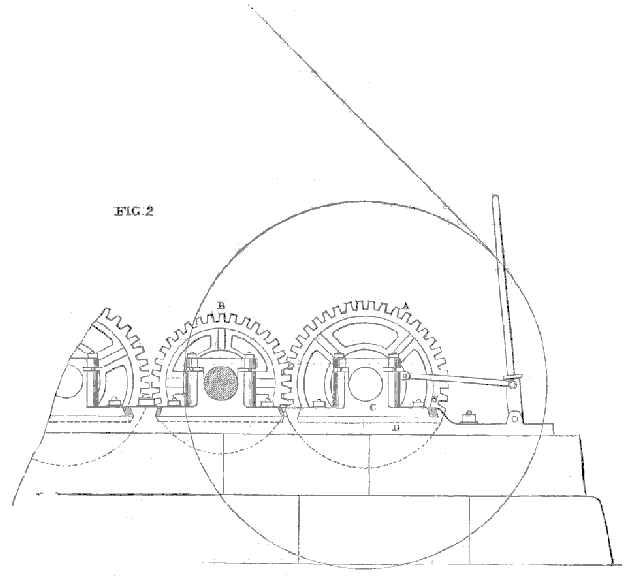
I have made several experiments with this description of machinery, and they generally prove that the wheel A, Fig. 2, if left free (to move with the plumber block C upon the sole plate D), will not keep in gear with the driving wheel B, unless the weight of the winding rope and load considerably exceed the friction of the plumber block C upon the sole plate D.
To prove it practically, in this particular case I experimented with the wheels A, B, in gear without the winding rope, and found that they kept in gear, with the engine at work, although the key S was out, and the plumber block C not screwed to the sole plate D. I next connected the rope and cage to the winding apparatus, when the resistance in turning the wheel being greater than the friction of the plumber block, &c., upon the sole plate, the wheel A was immediately thrown out of gear. The next trial was with the plumber block C screwed down to the sole plate D and without the key S ; in this state the engine worked correctly while raising or lowering the cage at a considerable velocity.
The last experiment was with the plumber block loose, not screwed down to the sole plate D, and the back key S in its place. I may remark, the key used in the experiment was soft wood, for the purpose of showing more clearly the tendency of the engine to throw it out, and the moment the engine was started, the plumber block C was driven full up to the key ; and in working in this state there was not the slightest possibility of its getting out of place.
These trials satisfied me that had the engineman in the present case screwed down the plumber block C to the sole plate D, without putting in the key S, the accident would not have happened ; and that had he only put in the key S, without screwing down the plumber block C to the sole plate D, the machinery would have remained equally secure. It is, perhaps, superfluous to remark that the key S should always be put in, and the plumber block C made secure to the sole plate D.
That these accidents should nearly always happen immediately after the changes I have stated, viz., when the engine is put off pumping, and into gear to wind, clearly bear out these experiments ; and it may be inferred, when such an accident occurs, that it is owing to the culpable neglect of the engineman, or person in charge of the gearing, as the case may be.
A popular notion exists that when the winding shaft is placed behind the driving shaft, the tendency of the rope and load to move forward will keep it in gear. This, to a certain extent, is correct, particularly when overwinding, but it is entirely a mistake to trust to it, and the present case is a fair illustration.
Various schemes have been devised to obviate mistakes independent of the engineman's care, while changing the gearing of this kind of machinery ; and a strong screw f, Fig. 3,
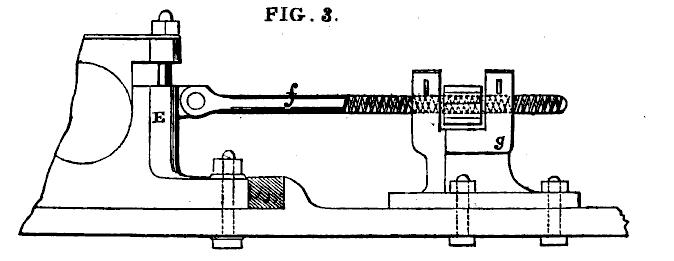
fixed in a stud g, connected to the plumber block E, has been successfully used. I do not know of an accident from this or a similar arrangement. Keys are also made, m, Fig. 4,
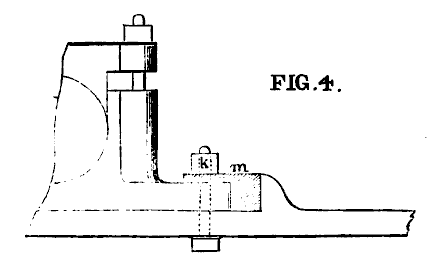
so that they can be screwed down with the same nut k that secures the plumber block to the sole plate. This, I believe, is also safe.
I have observed in use keys, Fig. 5, arranged so as to fall into their place by their own gravity, when the winding shaft was put into gear ; in working, the key n can be lifted up just so far as to allow the plumber block to pass ; it then rests on it, as sketched, and when the machinery again requires to be reversed, it falls back to its original position.
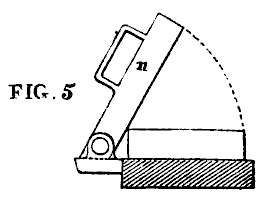
Each of these schemes appears to me efficient, and I am of opinion an accident like No. ^7 could not happen by them ; or if an accident did happen under such arrangements, it could at least be clearly shown who had been the culpable and negligent party ; but at present all such accidents are so involved in mystery that the guilty parties escape with impunity.
|
|
| Sources | |
|
|
- 1857 Mines Inspectors Report, by William Alexander, H.M. Inspector of Mines, Page: 126
- 1857 Mines Inspectors Report, by William Alexander, H.M. Inspector of Mines, Page: 132, Accident Number: 27
|
|
| Researchers | |
|
|
If you are researching Thomas Park (e.g. for family tree purposes) and you would like to hear from others with the same interest then please complete the details in the following form. We will show the information you provide on this page so that you can be contacted.
 Return
 Return to Top



 Contains public sector information licensed under the

