


| Mining History |

|

|

|
Mining History |
 |
 |
|||
Subsequent History of Stargate Pit
 For some weeks after the explosion the pit stood idle, with only the ventilating furnace being tended, to keep the gas from accumulating. During this period, in July, in spite of all the lessons which should have been learned, the day-to-day management was so bad that a repeat of the accident almost occurred. This time there were only three men in the pit and they were unhurt, but it was a near thing. Matthew William Dunn, of Hedgefield House who was to have inherited a quarter share in the colliery under the Will of his uncle, Matthias Dunn, and who subsequently had a distinguished career as one of the first H.M. Inspectors of Mines was annoyed at this indication of mismanagement. He was inclined to blame the other partners, George, William and Matthew the sons of George Thomas Dunn of Newcastle, for having meddled too much in the running of the pit. In a letter to his friend John Buddle, viewer at the time of Wallsend Colliery, M. W. Dunn described a visit he made to Greenside to enquire into this latest accident:
"I was at Greenside yesterday to examine into the latest explosion and found Geo. Jnr. there. Wm. also dropped in by chance. Geo. was appall'd a good deal at my appearance and when I ordered the persons who lit the furnace to be sent for, but still more when the following facts were elicited The Brockwell waste (10 acres) has been standing quite foul and unaired since the explosion (5 weeks). On the Thursday night they put out the furnace and replaced the doors at the incoming of the Brockwell seam but never even travelled through any part of the workings save 80 yards along the valley way. On Friday morning they found the air coming round in quite a firing state. On Saturday morning (at) 4 o'clock they found the return showing considerably on examining thought her quite clean, Between 5 and 6 o'clock without having ever looked at the return with a candle, and without still having at all travelled the low seam, they lit the furnace and, in the course of half an hour actually went away and left her without any attendance. An old man or two were subsequently sent down to keep on the fire and, on going through the doors they felt a succession of pushes or severe throbbings of the air, and on reaching the furnace found all was enveloped in a sulphur flame — even considerably back against the Five-quarter air, so that they had no chance of getting near the furnace.
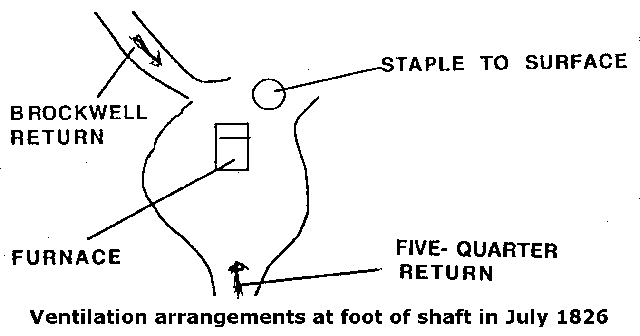
You will observe that the Brockwell return does not come upon the furnace but just in before it. The situation of these three men was awful. They deliberated whether to stay inbye or attempt to ride, they determined on the latter, when, before they had got to the meeting, she exploded and luckily took the upcast staples. They felt the hot air and concussion severely but nothing worse. You may judge of the column of fire when the wooden door at the tube is burnt. On going down the doors and stoppings about the shaft were carried away (this is what Geo. has been pleased to designate "just a hot push"). Sam. Cooper and Robson were the sole actors in this folly, but it does not appear that any distinct understanding existed of the waste being travelled."
The rest of the letter concerns Dunn's none too complimentary opinion of the other partners who, he thought, were inclined to blame the viewer, James Hall. In general Dunn takes Hall's part but does make one criticism of him, that he appointed an inexperienced deputy. There is a strong hint that this was a member of Hall's wife's family (Young) "Brought up in Walbottle Colliery and in all likelihood unacquainted with difficulties", and one is left with the distinct impression that Hall allowed himself to be strongly influenced by his wife's ambitions for her family.
Once the shock of the disaster had begun to fade, however, a decision would have to be taken about the future of the pit. To the owners it was a valuable source of income and could not be allowed to stand idle for long although of course, with most of the machinery and fittings destroyed. a further large investment of capital would be necessary before any more coal could be produced. From the miners' point of view any revulsion at working again in the place where so many relatives and friends had been killed would have to be overcome by the hard economic fact that work was necessary if their families were to be fed and clothed. For most of them the pit was the only place where that work could be found, especially as they were almost certainly "bound" to serve Dunns until the next "binding day" should come around, and so were unlikely to be taken on by any other local coal owner.
It seems that, although the pit was re-opened eventually, the Brockwell was abandoned and work concentrated on the Five-quarter and higher seams.
On the night of 1st December 1828, some two and a half years after the explosion, water broke into the Five-quarter seam and flooded it. It was a wild, stormy night and, it was said at the time, that this caused the Tyne to rise to such an extent that river water flowed into some old workings and so, through a maze of abandoned tunnels, into the Five-quarter. Fortunately the pit was not at work and only one person was in the seam at the time. This was William Roddam, the furnaceman. In all probability this was the same man who had been horse-keeper in 1826 and had given evidence at the Inquest after his narrow escape on that occasion. This time he was not so lucky. Roddam and fourteen horses were swept away by the running water. A tradition among Roddam's descendants is that he had had a premonition that he would not return from that particular shift; if this was so, then it was tragically correct. Eight or ten men in an upper seam, although cut off by the water, managed to make good their escape by means of a "travelling way" linking Stargate to the Grand Lease "C" Pit at the Folly. Although the flood water was soon pumped out of the seam, Roddam's body was not found. It was only when the flooded Brockwell seam was drained fifty-two years later, on 1st October 1880, that his remains were discovered.
During the years after the explosion the dispute in the Dunn family as to the ownership of the shares continued, and, no agreement being possible, Dunns surrendered their sub-lease of the Stella Grand Lease Royalty in 1833, causing the two pits then working; Greenside (also known as Whitefield) and Stargate (also known as Towneley Main), to close. The equipment of these two pits, as advertised for sale in the local papers on 10th June 1834, was as follows:
Following this closure Stargate Pit was disused for some forty years until re-opened by the Stella Coal Company. It passed into NCB ownership in 1947 and was finally closed in 1961.
References
Much use has been made of the account given by J. Maughan in his "HISTORY OF BLAYDON" serialised in the Blaydon Courier in the 1950s and available as collected cuttings in Newcastle Central Library. However, as Maughan is not always entirely reliable, other sources have been preferred whenever discrepancy has arisen. Contemporary Newspaper accounts in the Newcastle Courant and the Durham Advertiser give reports of the explosion, the public meeting and the relief fund. Details of the funerals were obtained from the Ryton Parish Burial Register. The letter from Dunn to Buddle re. the July 1826 accident is in the Buddle Atkinson papers of the North of England Institute of Mining and Mechanical Engineers. Use has also been made of documents in the collection of Durham University Department of Palacography and Diplomatic and of Durham County Record Office. Printed sources used here included amongst others Bourn's "History of Ryton Parish", Galloway's "Annals of Coal Mining and the Coal Trade" and the Transactions of the North of England Institute of Mining and Mechanical Engineering.





 Contains public sector information licensed under the

