


| Gallantry |

|
Gallantry | ||
 |

|
 |
||
Awards for Gallantry
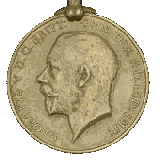 |
Vincent Elwick |
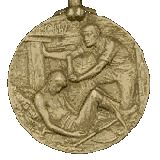 |
|
Edward Medal | |||
| Date: | 26 Oct 1924 | ||
| Colliery: | Murton Colliery | ||
| Occupation: | Deputy | ||
Award of Edward Medals
Whitehall, 19th December, 1924.
His Majesty The King has been graciously pleased to award the Edward Medal in Silver to Vincent Elwick and George Wilson, deputies employed by the South Hetton Coal Company Limited, in the following circumstances :—
On the night of Sunday, 26th October, 1924, two men named McNally and Place were engaged in filling debris into tubs at the Murton Colliery, Durham, when they were suddenly buried by a fall of sandstone and shale to the extent of nearly 200 tons. The roof was supported by iron bars and girders but the weight of the fall broke the bars and bent the girders so that some of these fell and rested on the tubs. Elwick and Wilson had just left off work and were partaking of a meal close by. They heard the fall and being informed that McNally and Place had been buried they at once collected some bandages and proceeded to the spot. They found that owing to the tubs taking the weight of the fall McNally and Place were alive, and in spite of the fact that stones were still falling they commenced tunnelling towards the imprisoned men. They succeeded in making a tunnel 12 feet long through which Elwick managed to make his way passing the stones back as he proceeded, and Wilson followed him. After twenty minutes hard work they managed to reach the buried men and succeeded in extricating Place but only after a struggle as he had become hysterical. They then returned to McNally but found that he was held fast by three of his fingers which were between a bar and the top of a tub. They therefore built up stones to support some of the falling bars and atempted to cut off the top of the tub with a hammer and chisel but their task was made impossible by the confined space. McNally agreed that his fingers must be cut off if he were to be saved, and further efforts to release him having failed, Elwick and Wilson proceeded to apply tourniquets to his arm and endeavoured to amputate the fingers with the only implements at hand — a knife, an axe and a hammer. The operation was found impossible until a fellow workman arrived on the scene with a sharp chisel; this was passed up the tunnel and with it Elwick and Wilson managed to sever the three fingers. McNally was eventually extricated and taken to Sunderland Infirmary.
Elwick and Wilson cannot be praised too highly. They knew only too well the risks they ran as they were well-acquainted with the nature of the ground and there were continual further falls of roof during their two hours work. During the whole of that time the spot where they were working gradually grew smaller and smaller but they never relaxed their efforts and never even suggested abandoning their task. There was a grave risk that their passage back would be closed, and indeed it did fall in shortly after the rescue was completed. Both Elwick and Wilson had been trained in ambulance work and they had the presence of mind to apply tourniquets not only with a view to preventing bleeding but also in order to stop the circulation so as to reduce the pain of the amputation as far as they possibly could. They undoubtedly saved McNally's life, and the story of their bravery and coolness is one of the most remarkable recorded in the history of rescue work.
 |
 |
| Additional Information | |
|
|
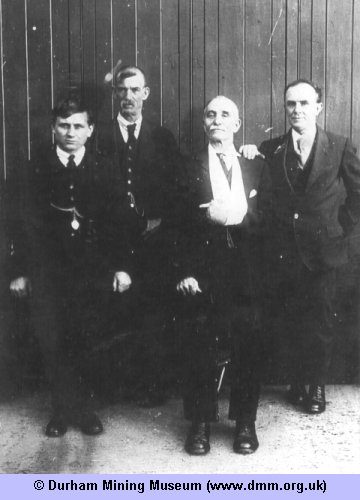
John Place is second from the left. McNally has his hand in a sling with only one finger displayed. We assume that the other two gentlemen are Elwick and Wilson but are not certain of which order they stand.
Photograph and additional information kindly supplied by Mr. Brian Anthony Place (grandson of John Place)
Source: London Gazette (02 Jan 1925)
|
|
| Researchers | |
|
|
| Researcher | Date | Interest | |
|---|---|---|---|
| brian a place | 24 Jun 2010 |
more information about the other miners in the above photograph |
|
| brian place | 18 Jul 2010 |
to find out further information on the above item |
|
| Elizabeth Elwick | 23 Apr 2017 |
Vincent was my grandfather and I want to compile his history for my own grandchildren. |
|
| Michael Elwick Targ | 15 Jan 2018 |
family history |
|
| vincent elwick | 04 Aug 2018 |
the picture above the man on the left must be vincent elwick as he looks the spitting image of my family. no doubt here. |
|
| Ernie Elwick | 28 Jan 2021 |
Just some Info. The man on the left is Vincent Elwick, my grandfather Regards |
|
If you are researching Vincent Elwick (e.g. for family tree purposes) and you would like to hear from others with the same interest then please complete the details in the following form. We will show the information you provide on this page so that you can be contacted.



 Contains public sector information licensed under the

