


|

|

|

|
|
 |
 |
|||
Safety Lamps
|
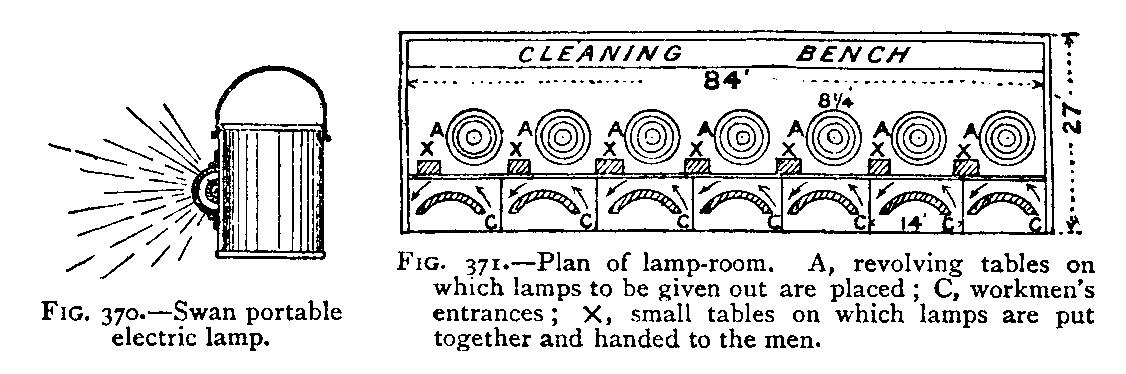
Lamp-room. – Whilst it is essential to have a lamp of a good pattern, it is no less important that it should be taken good care of. For this purpose, it is necessary to have a good lamp-room, and a sufficient staff, in the lamp-room, of experienced and responsible work-people, so that none of the parts may be improperly put together or omitted. With some of the shielded lamps now in use, it is quite easy for the lamp-cleaner to omit the gauze, which is essential to the safety of the lamps; and neither the workman who takes the lamp, nor the deputy who examines it, can very easily see the deficiency. This makes the examination by a deputy a mere farce, and it is obviously wrong that that should be the case. To avoid this, it is necessary, where such lamps are used, that the lamp should be given to the collier without the shield, which should be put on in his presence, and also in that of a deputy or an examiner especially appointed to see that the lamp is safe. This precaution involves more expense in giving out the lamps than has hitherto always been considered necessary, but it is a natural result of the use of shielded lamps. In order that too much time may not be consumed in giving out the lamps at a large colliery, it will be necessary to have a number of windows at which the workmen can take the lamps, and a number of lamp-men to distribute the lamps. Fig. 371 shows a design by the author for achieving this result.
|
|
|
Arc Electric Light. – This species of electric lamp gives far more light for a given expenditure of power than the incandescent lamp; it is, however, not a safety-lamp at all. It is largely used on the surface for lighting up railway sidings and other works; it is also sometimes used for lighting up large excavations in the pit. The author, in 1883, visited the Mechernich Lead-mine, where a large underground excavation, 200 feet long, 60 feet high, and 70 feet wide, was lighted by two electric arc-lamps, which gave a splendid illumination, and enabled the workmen to examine the sides and roof for loose pieces.
|
|
Electric Lamps. – Many portable electric lamps have been made; one by Swan (see Fig. 370). The electricity is supplied from a secondary battery, and the lamp will burn all day, giving a light of about half a candle; it weighs about 6 pounds. None of the numerous varieties of portable electric safety-lamps are yet in general use. There are, however, a great many fixed incandescent lamps used underground. These lamps are essentially safetylamps, as the air is entirely excluded unless the lamp should be broken. If the lamp were broken in an explosive mixture it would cause an explosion, but this is an improbable contingency. These lamps are now used to a considerable extent for lighting the pit porches, underground engine-houses, and, in some cases, engine-planes for long distances underground. The only practical danger in their use arises, not from the lamp, but from the conductors which convey the current; should these be too near each other, the current might pass between them and set fire to the timber; or should there be an explosive mixture, and the wire was severed, there would be a spark at the moment of severance, which would cause an explosion. These dangers may be reduced to a minimum by covering the conductors thickly with insulating material, and placing the positive and negative conductors at opposite sides of the road whenever practicable. Where the lamps are placed "in parallel," only a low voltage can be used, say 100 volts, and there is not much danger of the insulation being destroyed. If, however, the lamps are placed "in series," then a very high voltage may be employed, with a proportionate increase of risks.
|





 Contains public sector information licensed under the

