


|

|

|

|
|
 |
 |
|||
Safety Lamps
|
It would require a volume of considerable dimensions to describe all the lamps that have been made, and many of great excellence are perforce omitted from this list.
Uses of the Safety-lamp. – One use of the safety-lamp is to permit workmen to enter a place containing explosive gases without getting burnt. Another use is to permit workmen to remain in a mine liable to sudden outbursts or blowers of gas without danger of explosion. A third use is to enable the fireman to ascertain that the mine is free from gas without risk to himself. Before the safety-lamp was made, the presence of gas was frequently ascertained by means of a candle, the flame of which perceptibly enlarges in gas. A very small percentage of fire-damp can be detected with a candle; but, unfortunately, the use of the candle is attended with great risk. When an ordinary safety-lamp with full flame is placed in air containing firedamp, there is an elongation of the flame, and, if there is a considerable quantity, the lamp will be filled with the blue flame of burning gas. In testing for gas the lamp is generally raised, because the gas lodges in the higher parts of the mine, and in cavities which are not exposed to the air-current. For a minute examination, the flame of the lamp is drawn down until the yellow part of the flame is no bigger than a pin’s head. If there is 2 per cent, of fire-damp in the atmosphere, a small blue cap may be observed. In drawing down the flame of an oil-lamp for such an observation, it is very likely to be extinguished. The spirit-lamp is more convenient for this purpose. By means of a screw, the flame can be reduced till there is nothing but a small blue flame about 1/8 inch high; 1 per cent, of fire-damp will be rendered visible in the shape of a very faint blue cap. Mr. Win. Galloway, mining engineer, of Cardiff, made experiments as to the proportion of air that could be discovered with an ordinary safety-lamp (see Fig. 368). The height of blue cap is marked in inches. 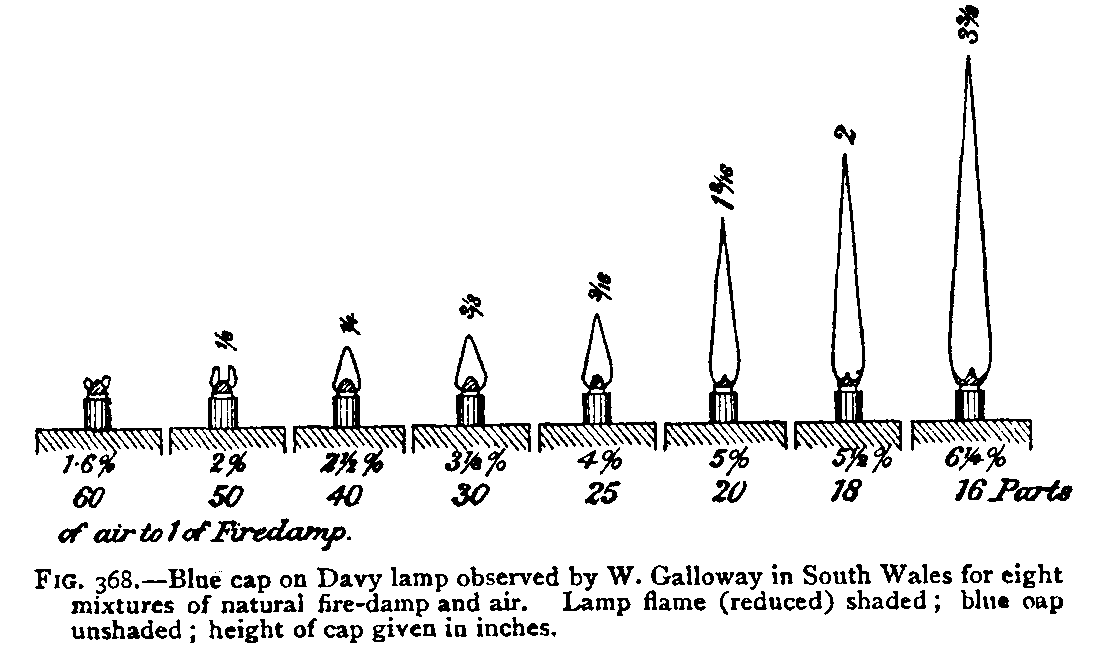
|





 Contains public sector information licensed under the

