


|

|

|

|
|
 |
 |
|||
Safety Lamps
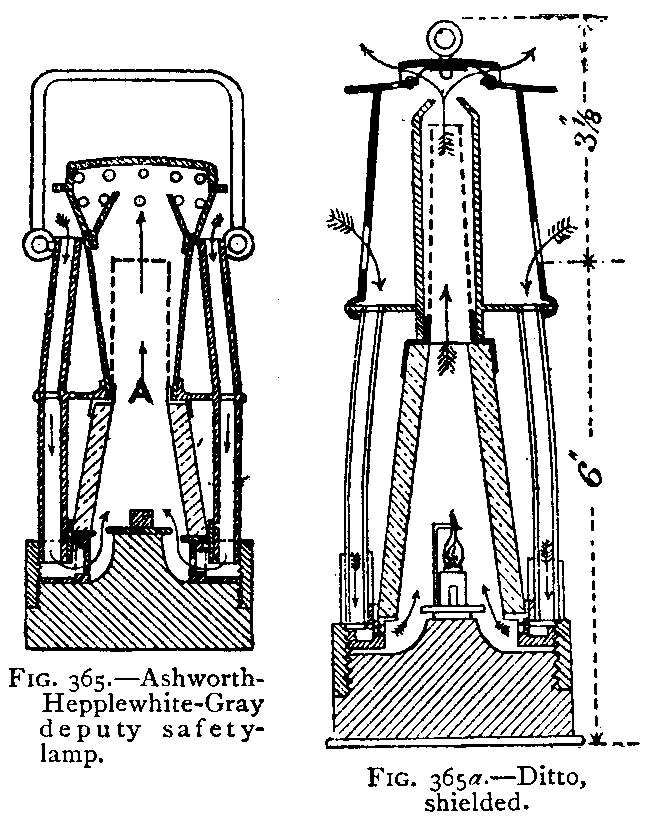 A. H. G. Lamp. – Another lamp that is used to a considerable extent by deputies, or fire-triers, is the Ashworth-HepplewhiteGray (Fig. 365). This lamp has a conical glass surrounding the flame, the air supplying which is introduced through a gauze below the glass, the products of combustion escaping through a gauze cap and metal chimney or shield above the glass. Four brass tubes extend from near the top of the lamp down to the brass ring below the glass, so that the air to feed the lamp is drawn from a stratum on a level with the lamp-top. So if this upper stratum contains gas, it will be detected by this lamp. There are, however, near the base of the tubes, openings closed by sliding shutters, so that the lamp can derive its supply of air from a lower stratum. The intention of the inventors is that the fire-triers shall first test the lower stratum of air, and, if that is clear, close the openings in the tubes, so as to suck air down from the top. They also recommend that the test be made without reducing the flame. The latest form of this lamp, as made by Mr. Ashworth, is shown in Fig. 365a. Here there is a shield, so that it can be carried in a rapid current of air.
|
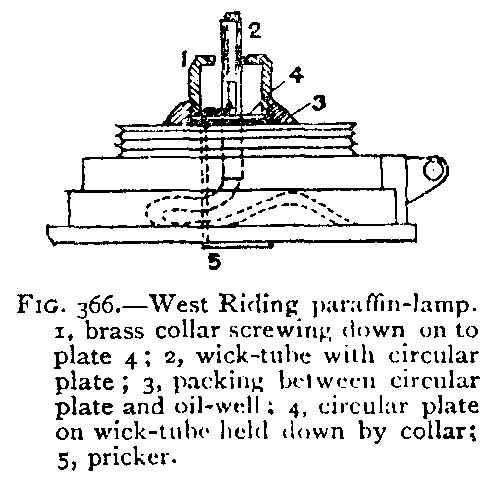 Many safety-lamps are now made to burn paraffin instead of rape oil; the burner has to be modified for this purpose, as shown in Fig. 366, which is a drawing of the lamp used at the West Riding Colliery.





 Contains public sector information licensed under the

