


|

|

|

|
|
 |
 |
|||
Safety Lamps
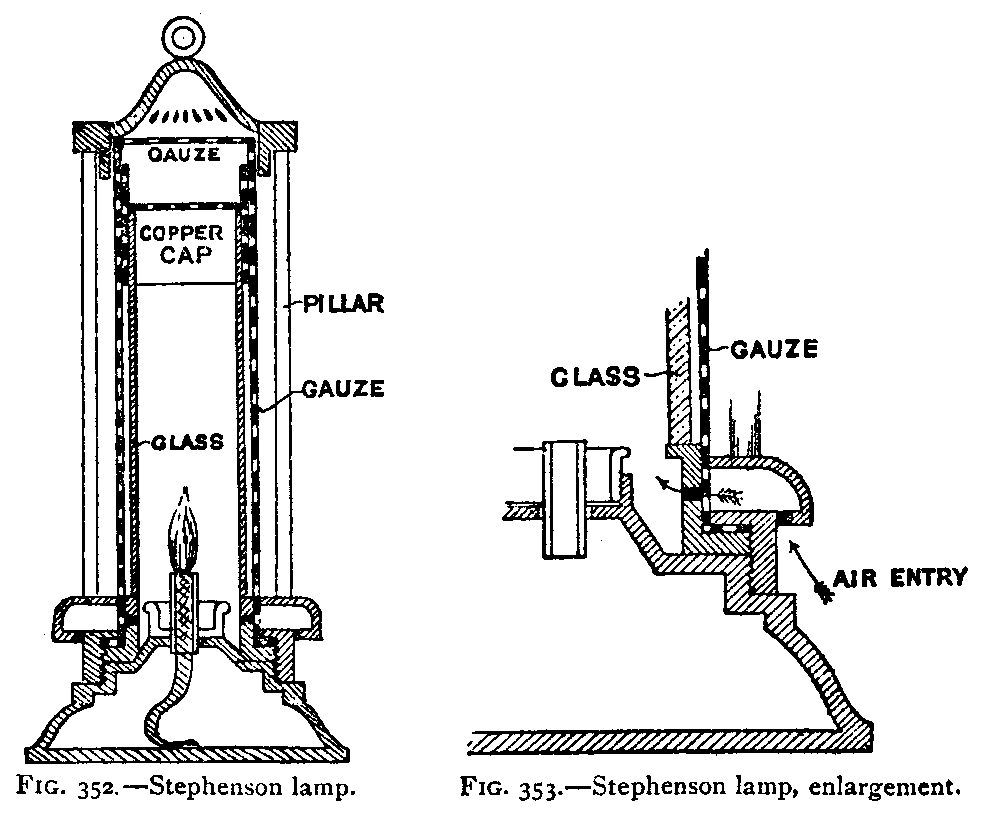 Stephenson Lamp. – The Stephenson lamp (see Fig. 352) differs from the Davy in the following respects: The gauze has a diameter of about 2 inches; inside is a glass which reaches nearly to the top of the gauze; the top of the glass cylinder is covered with a perforated copper cap, and it rests upon a brass ring. The air to feed the flame enters the lamp through a number of small holes about 1/20 inch in diameter (see Fig. 353) in a hollow collar; it then passes through the wire gauze, which is fastened to the lower flange of this collar. The amount of air that can enter the lamp is thus regulated by the size of the inlet orifices. The lamp above the flame is mostly filled with the products of combustion; if, therefore, instead of fresh air, fire-damp should enter the lamp by these holes and ignite at the flame, the oxygen inside is instantly burnt up. For lack of this necessary element the flame goes out, so that, should such a lamp be left burning in gas, it would quickly extinguish itself. If, however, the lamp is exposed to a current of inflammable gas and air, the pressure forces a sufficient supply of oxygen inside, and the flame continues till the lamp is red-hot. In a current of from 8 to 12 feet per second the Stephenson lamp is unsafe. |





 Contains public sector information licensed under the

