



|

|
|
||
 |

|
 |
||

Monthly Circular. | ||
| No. 227. | November. | 1914. |
To The Members. | ||
Gentlemen,
Miners' Conference.
On the 27th and 28th of October, a Conference of the Miners' Federation was held in the Westminster Palace Hotel, London. It would have been noted in the October circular, but it was in print and full up at the time the Conference met, and we are therefore compelled to insert it here. The circular convening the Conference stated that the annual meeting had been postponed on account of the war, and therefore the Secretary and President, had "considered it advisable to hold an Interim Annual Conference" for the purpose of the election of Officials, Executive Committee, and Auditors, and to receive reports on the questions of unemployment and distress caused by the war, the machinery set up in each district for the relief of distress and provision to be made for the support of widows and children, and the permanently disabled soldiers and sailors after the war."
There was a very full representation. All the districts being represented. The number of delegates being 137, and the Executive which brought the number up to 154. The chair was occupied by Mr. R. Smillie, the President of the Federation. In his opening remarks he dwelt at length upon the sufferings which the people of Belgium had been called upon to suffer. They played the least part of any nation in the intrigues and complication which led up to the war, and yet they had been compelled more than any other to see their cities destroyed, the country devastated and plundered, and their wives and children murdered. These people should have all the help that we could give them.
There was, however, a duty that lay near our own door, to secure the best possible conditions for the working people here during the present crisis. In his opinion the working people who are most in touch with the families of those who had gone to the front, were not sufficiently represented on the relief committees which had been formed (throughout the country.) This was not as it ought to be, and the leaders of the people should see to it, hat they should have a proper share of the work essential to the carrying out of that most important national duty.
At the conclusion of the President's Address, reports were taken from districts as to what had been done by the miners in respect to assisting in the raising of money and mode of distributing, and as to the amount per week. Mr. Ashton, the Secretary, had asked a series of questions as to the mode of distributing it and the amount per week paid in cases of distress caused by war. The reports were very varied in many respects. It was found that in some parts the workmen were submitting to deductions from their wages, to be devoted to the local funds, which had been formed, or paid into the national fund. There was, however, a lack of uniformity, and what was desired was as near as possible to have a uniform system. With that end in view, the following resolution was unanimously carried :—
"That we upon the War Office and on His Majesty's Government that an allowance of Ј1 a week should be paid to the wives of the soldiers and sailors now serving with His Majesty's forces, without any deductions from the pay of those serving at the front, and to the widows or other dependents whose husbands, brothers, or sons, etc., may be killed in the war or who may die from wounds received or disease contracted in the war, also Ј1 per week to those who may be disabled for life, or, if partially disabled, until they have fully recovered from their injuries.
"In addition to the above allowance, a payment of 3/6 a week should be made to each child under working age."
After the hearing the reports and the carrying of the resolution, the Conference turned its attention to two items of business, for which it in its pro tem character, was called, viz., the election of Officers for the incoming year, and the consideration of the balance sheet. The Officers elected were as follows :— President, R. Smillie; Secretary, T. Ashton; Treasurer, W. Abraham, M.P.; and Vice-Chairman, W. House. The Committee, on a principle of selection from the districts in proportion to numbers. Each district selecting and nominating its quota, the Conference accepting and confirming the choice. The number allocated to Durham is two, and the persons chosen for this year, are Mr. Galbraith and Mr. Wilson.
In respect to the Vice-President, there was competition, the final vote lay between Mr. H. Smith, Yorkshire, and our own President, Mr. House, the choice falling upon the latter. Keeping ourselves entirely clear of even the approach to an invidious distinction between the competing parties, and recognising fully the energy and ability of Mr. Smith, I feel confident you will all agree with me in expressing pleasure that Durham was honoured by having its own President selected for the position. There are various reasons (such as membership, contributions, etc.), which might have been urged in support of our claim as a county to the position, and on the ground of equity they would have been unassailable, but the election was not decided upon extraneous reasons. The choice was the pure result of belief in personal fitness That was the deciding factor. The delegates knew in part by observation and infrequent contact, what we in fuller measure, and by every day living proof know in fuller measure. We are confident of his personal fitness for the place he has been selected to fill, and we can therefore join in the hope that his health may be preserved, and that his life may be long to assist in the duties of his new and responsible office.
Balance Sheet.
This was the second item for which the Pro Tem Conference was called to consider. It is a very important matter, and certainly claims our attention. I am not inclined to mention any of the items, except those which relate solely to our own district, and those in the barest outline. Our contributions and levies for the year ending September, 1914, are as follows :—
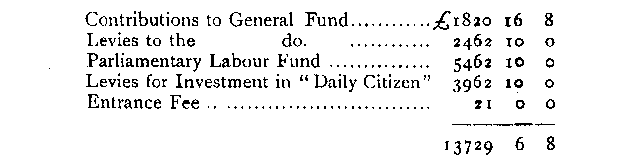
The items of expenditure set down solely for Durham are as follows :—

The Conciliation Board.
We are but at the beginning of the war, and yet our trade shows at this early stage how seriously it may be affected by it. Bearing in mind the firmness in the markets, at the end of June there is no other cause to which we can ascribe such a fall in prices, as the Board was met with at the meeting on November 6th, as the Federation Board in their report have made clear to you. The statement they give as to the extent of the fall and the change in wages, consequent upon that fall is clear and concise. There is nothing hid nor evasively stated. There would have been no necessity for any mention of that part of the Board's work in this circular, were it not for the fact that there are an instance or two where at Lodge meetings condemnatory resolutions have been passed, and the Federation Board blamed for agreeing to the reduction of 3¾ per cent. The names, of course, are withheld (as is our usual practice), because it does not matter. The fact dealt with is the thing demanding our attention in this case, as in all others, and those of us who whether it be on the Federation Board or any other position, are in duty bound to listen to any complaint, even if it implies censure for an imaginary neglect of duty or worse (as in this case), and give some reason for the action taken, or admit the complainer is right in his fault finding. There are only two parties. The men blamed, and the men blaming. Both cannot be right, for they are at the antipodes to each other. It is possible for one of them to have acted from impulse or from ignorance. We will not think of any other motive.
Let us look at this matter, but let us remember, that it is the easiest thing in the world to complain, and that if we are not careful we can make a serious complaint without any real reason for the same. Let us further remember that it is possible to do a gross injustice to a man or body of men if we are not sure of our reasons, and if the complaint implies a dereliction of duty as it does in this case. That may appear strong in statement, but it is logical. This is how it presents itself :— Either the Federation Board has done wrong. or it has not. That is the dilemma raised. Surely there needs some clear justification before even an insinuation such as that is applied, and certainly demonstration clear as day is required before a written charge is made.
The primary questions which meet us at this point are as follows :— Have the Federation Board during the 36 years of their operations not got all they could for their constituents? The proof of that is in every record. The irrevocable past is the witness which the accuser can turn to at any time, and which the Board will not hesitate to face whenever the court is open, and the indictment framed.
The second question is,— Why should they submit to a reduction if it could be avoided ? Discuss it on the lowest ground. Are they not lovers of high wages as much as any other man or men? and further, have we taken pains to ascertain how the disturbance in trade as a result of the war has affected the trade ? In normal times there are many things which affect a trade like ours, which call for more than a mere cursory or passing notice. That does not admit of controvension. How much more when we have been so suddenly plunged into a set of circumstances without parallel in the history of the world. Markets to which we ourselves exported quantities of coal, and our sister county in larger proportion, and other districts in varying quantities, have been closed or partially closed. New markets are not opening out, and as a consequence the coals excluded from foreign ports from the various causes consequent on the war, seek the markets nearer home, and no matter how we may desire a different state of things in human affairs, there are "chiels that winna ding." and the "Law of Supply and Demand" is one of them. Of that we get stern reminders.
We will not pursue the question much further, although there are other aspects which are of equal interest. One of these may be mentioned. As a county we may congratulate ourselves that we are so fortunately situated in conditions which are unique and serious, and which we (without being unwarrantably pessimistic) may expect will darken rather than brighten, and which we all are in duty bound by strengthening as far as possible the spirit of amicability and smooth working and meeting the requirements of the trade whenever the opportunity affords to assist. At the meeting on the 6th, although many of the pits are working slack time, yet we are told there were large numbers of' men (not sick or gone to the front, or into the camps), who lie idle when the pit is at work. What answer could we give or what legitimate excuse could we make for such action? Is there any lawful excuse to be found any where ? There cannot be in the peculiar times in which the trade is placed, and it is to be hoped that this friendly word (for so it is intended) may be sufficient to lead to the relationships of trade being fully considered, and proper use made of all the working time available, and thus the best possible be got from the sad circumstances into which we have been rushed, and judging from appearances we shall be in for some considerable time yet.
I should not like to close the subject without asking for the fairplay which is the just due of every Briton. If such an indictment was framed against any of those who are so ready with their accusation (without proof) where would they stand ? There is not a man anywhere against whom some glib tongue could not make a charge, but that would not satisfy the requirements of the case. He would still feel it was incumbent upon the charge maker to prove the guilt or dereliction of duty. In the eye of the English law, and before the are of truth and manhood, every man is innocent until guilt is proven. I speak here for myself, and I am sure my colleagues on the Board will concur that we are ready to meet any and every aspect of the proceedings arising out of the meeting on November 6th.
Dependents upon Unmarried Soldiers.
I have had repeated questions put to me as to the position of parents who are dependent upon a son or sons who have gone into the service. Although in full sympathy with the old people in such circumstances, and never able to see the difference between the need of a parent or parents, who were dependent upon their son, and a wife and family where the father had gone, yet I was not in a position to give definite information. I have advised old people who have come to me, as well as I could, and in what I felt confident the public sentiment would confirm. I am glad, however, that the Government have solved the question, and have issued a form bearing on the subject. My object in drawing attention to the matter here is to suggest to our members that the necessary forms of application can be got at any post-office and if there be any such dependent persons, all that is necessary is to apply for one.
A Generous Suggestion.
From one of our Lodges I received the following letter. It speaks for itself; and its spirit is highly commendable, and certainly worthy of imitation :—
Dear Sir,
"I am instructed by my Lodge to write and let you know that we have decided to have our accident fund put in force for the benefit of any of the dependents of our men who are killed in action, or die of wounds within 12 months of receiving such wound. Hoping you will mention this in your circular."
The idea is not new, for certain letters have appeared in the press on the same subject, but so far as I know this Lodge is the first to operate it. The funds mentioned are peculiarly the property of the Lodges. There can be no interference by us, but I have no hesitation in saying that the resolve of the corresponding Lodge is very generous.
The usual meeting of this Committee was held on November 2nd. The agenda contained 21 cases, 10 of these being fatal, and 11 non-fatal.
Fatal Cases.
Fatal Cases
| Lodge | Name | Age | Occupation |
|---|---|---|---|
| Dunston | Emmanuel, Blackburn | 22 | Bottom Cutter |
| South Moor (Louisa) | William, Blair | 16 | Driver |
| Twizell | John, Bowen | 62 | Shifter |
| South Hetton | Edward, Davies | 14 | Driver |
| Dawdon | Robert Henry, Kennedy | 18 | Putter |
| Tudhoe | John, Lloyd | 29 | Hewer |
| Follonsby | Thomas, Maddison | 16 | Rope Lad |
| Hetton | Edward, Pearson | 17 | Pony Putter |
| Murton | William, Potts | 19 | Stone Putter |
| Felling | George, Simpson | 46 | Stoneman |
Non-fatal Cases.
Non-fatal Cases
| Lodge | Name | Age | Occupation |
|---|---|---|---|
| Shildon Lodge | Isaac, Ball | 22 | Putter |
| Lambton | A., Donachie | 16 | Driver |
| Shotton | Elijah, Fletcher | Hand Putter | |
| Shildon Lodge | T., Hartley | 20 | Putter |
| Tanfield Lea | S., Hindson | 38 | Hewer |
| Newfield | Robert, Kidd | 58 | Hewer |
| Houghton | Patrick, McCormick | 65 | Waggonwayman |
| North Biddick | Daniel, Parks | 44 | Hewer |
| Woodifield | John George, Peart | 23 | Hand Putter |
| Stanley Drift | Matthew, Robson | 65 | Stoneman |
| Roddymoor | J., Wilkinson | 59 | Shifter |
Durham, 1914. John Wilson.
| Source: | NEEMARC - Ref: NUMDA/1/6/39, D.M.A. Minutes, Circulars etc. for 1914 (two volumes: covers Jan-Jun, Jul-Dec) |




 Contains public sector information licensed under the

