



|

|
|
||
 |

|
 |
||

Monthly Circular. | ||
| No. 218. | February. | 1914. |
To The Members. | ||
Gentlemen,
The Aged Miners' Homes.
In our last circular we reviewed in outline the work of last year, showing the financial position of the Association, with the work of our respective Committees. That review would be incomplete, and we should not feel satisfied if some mention were not made of the work done during the year, showing the extent of the movement at the present, and the immediate prospects of buildings. Naturally this should have found a place in the last circular, but space would not permit, but we can easily add this to the outline of last month. Our work in this direction is too noble and generous to be left out of our summary. It is unique, regardless of the point of view we take, and we are justified in feeling proud of the grand movement we initiated, and which we have been enabled to carry on with such wonderful success, and to reach a point which when shown to strangers fills them with the greatest admiration.
What is the present position ? From the inception of our movement, when it was but an idea, it bore the stamp of greatness. It is one of the greatest romances of any age, and it carries in itself a guarantee of a largely enhanced greatness. It is its own surety and witness. To apply a few words from Tom Hood, it has a power in it stronger than steam. During the year it has received the stamp of Royalty. Not in a mere formal or conventional sense, but in reality. The visit of the Queen was cheering to herself, as she has stated to her friends, as we have been informed from reliable sources, and we were cheered ourselves, and the influence of her presence has been, and is now felt by the prominence given to our movement, and the increased attention the general public are giving to it. The total number of our houses at present is 483 for married people, and 34 for single men. In addition there are the following groups :— The Simpson Memorial, consisting of eleven cottages built by Dr. J. B. Simpson at Ryton, in memory of his father; the two groups at Tanfield Lea and Shiney Row of twelve each, erected by Lord Joicey, and reserved for his own workmen. The group at Tanfield Lea has during the year been increased in number by an addition of six cottages, which Mrs. W. J. Joicey erected in memory of her husband (with a promise to give other six). In respect to these individual groups the workmen at Cockfield have six, the entire cost of which as to the purchase of land and cost of erection was borne by themselves, and the houses are kept under their own supervision, and for their own special use.
During the year we have opened 12 cottages at Sherburn and two at East Hetton, and the six to which reference has been made at Tanfield Lea. Those at Sherburn are built on a site which Lord Joicey gave to us. The gift includes not merely the site for the homes, but sufficient ground to provide a flower garden in front next the road, and a beautiful self-contained yard to each house, with kitchen garden behind. The two houses at East Hetton were given to us by Mr. G. Henderson. The donor was at one time checkweighman at that colliery, and was a member of our Executive Committee. He is at present the head of a Cinema Co. and Picture Show Proprietor, and resides in London. The only condition attached to his gift was that the house should be named after his mother, whose name is inscribed on a tablet, and in whose memory they were erected. Noble idea, and a generous method of showing the depth of filial feeling.
Such then is our present position. If we were to rest satisfied with it, our work would be deserving of the highest praise, but we never entered upon a year yet with such an outlook for expansion as this. On every hand there is a desire for home-providing. It is not merely a desire a wish for — but it is embodied in action. The following table sets forth the localities and number of houses it is proposed to build :—
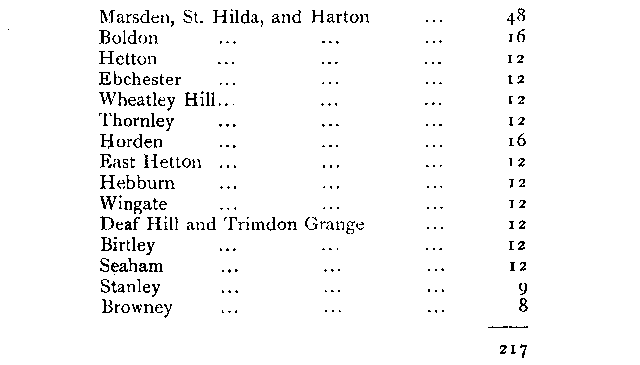
In addition to the houses for married people, the people at Thornley and Browney intend building a home for single men at each of their collieries. At every colliery there is the greatest enthusiasm. The levies are being paid most ungrudgingly, and in some instances large sums are in hand as a result. One very pleasing feature is the harmonious co-operation between the managers and the workmen in aid of the movement, and the generous help which is being given in the sites, materials, and gifts of money.
I believe that (although the donors have no such thing in view), it is a duty devolving upon us not to allow such generous help to be done in a corner, but to let all see how we can appreciate it, and how grateful we are for it. Ours is a movement which was based at first on willing help, voluntary ready assistance from those who love their fellow-men. From the first whether within our own ranks or amongst those we designate the general public, we have never asked nor desired a single item of assistance, but we have welcomed all cheerful givers (for such the Book says, the Lord loves and we love), and take them into our partnership as co-workers with us in a movement which is as near the spirit of the Master, and as far within His commendation as any matter ever instituted, and we have been ready to acknowledge all help from whatever source. A grudging giver finds no response with us, but the cheerful generous spontaneous helper never has found. nor never will, find us in the least hesitant in our gratitude and acknowledgments.
This year, as I have shown, finds us with a large full catalogue of work, but it likewise contains many grand promises of help; and, therefore, gives assurance that the work will find early completion. Let us enumerate some, if not all. The first on the list is the generous gift from the Harton Coal Co. The Ecclesiastical Commission (who from the inception of our movement have assisted us most generously) gave us in aid of the intended Homes at the collieries belonging to that Company, five acres of land as a site for 16 houses at Boldon, and 48 at the other three collieries. The Company then, without any solicitation on our part promised us four thousand pounds, being one thousand for each colliery, to be paid in four instalments of £250 a year. Sir Lindsay Wood is the managing director of the Company, and a member of the Ecclesiastical Commission, and I cannot refrain from expressing my opinion that a great deal of the credit for this large donation is due to his sympathy with us in our work. To some of us he is well-known, and as highly appreciated. An appreciation which has increased with the years of our acquaintance.
We have again another instance of the generous help which Lord Joicey has given us. In him the movement has found a very ready helper. We have had from him the three groups of twelve each at Tanfield, West Pelton, and Shiney Row (with the promise of other twelve near Lambton), with the site at Sherburn, and large gifts of money. For the work of this year we have his promise of a site for twelve houses at Hetton. Rowland Burdon, Esq., of Castle Eden, on the bare mention of the intention of the workmen at Wingate to build twelve houses readily promised to do all he could He is a large landlord and royalty owner at that colliery. In the Ebchester group the Governors of Sherburn Hospital have done all in their power to meet us. A large portion of the land in the neighbourhood is part of the charity under their control. The conditions of their trust will not permit them to give it, but they have met us in the following manner :— They have fixed the ground rent at three pounds per year (which is small for a site for twelve houses), and they give us a contribution of £100. That sum invested will meet the yearly rent charge, and, therefore, the rose smells as sweet to us by one name as another. Lord Londonderry has promised a site for 12 houses, and to let them bricks at half-price. We have another instance analogous to the action of the Sherburn Authorities. This is in relation to the Birtley group. In our search for a site we appealed to Lord Ravensworth, and a meeting was arranged with his Land Steward (Mr. Johnson), who met us in a kindly and gentlemanly manner, and explained to us the position. The land is entailed. His lordship cannot sell, but he can lease. He offered us a site in a beautiful position — on the following terms :— The amount will be one-half the usual charge to other people, and Lord Ravensworth will give a yearly subscription equal to the rent to our funds. Here again we can apply Shakespeare's aphorism, and are satisfied and grateful to the donor. This list of generous gifts would not be complete if we did not mention the generosity of J. Wood, of Coxhoe Hall. He has given us six sites at Trimdon, and we understand the Trimdon Grange Owners are intending to do as much either in site giving, or in some other material way. The giving of the six sites is not the full measure of Mr. Wood's kindness. In relation to the yearly processions at Coxhoe, and in other ways he has shown himself a very sympathetic friend of the movement.
The natural query arising here is what is being done in the other places. The answer, I am sorry to say, is nothing by land owners, but I have no hesitation in saying, something ought to be done. It is true we may not have a legal right to sites at the other collieries, but we have a moral right. What is it makes land valuable on the surface, and in the shape of royalty rents? Are the two main elements not the aggregation of the people and the labour of the miner? Without these the land values would be small. I do not say we can demand a site for our movement for the benefit of men who have dared the dangers of the mine. The law would forbid, but we are justified in requesting free sites, and the moral law sanctions the request, and it is the higher law in this matter.
These references to our prospective work, and the help we have received outside, do not exhaust the subject, nor show the whole of the encouraging indications. In our own ranks there never has been a period of greater enthusiasm than is shown everywhere at present. From the first meeting ever held in connection with the movement, when self-help was propounded as the prime motive, and when a single objection was not raised there has never been seen such a volume of ardent desire than we see everywhere. Without demur our members are consenting to levies, and in some cases before ever a start in the building is made, the sum in hand has reached ten or twelve hundred pounds. The sum paid individually is small, but in the aggregate enables us to carry on our grand and beneficial work. Reckoning up all the forces which are for us, the generosity of the public and the great desire in our tanks, we have no fear but we shall bring to a successful issue the long list of prospective buildings, and find our individual pleasure enhanced by seeing these Homes not merely domiciles or shelters, but Homes (in the best acceptance of that sacred term) all over the county in which our aged and toil-worn brothers may find comfort as the shades of life's day gather around them.
Deputations to Ministers.
The opening of Parliament is very interesting for many reasons. At present we are only concerned with one of them. It is an occasion which is used by various trades and interests to deputise the heads of our government departments, with the view to induce them to introduce legislation, dealing in a specific manner with matters in which the deputation is interested. The Committee of the Miners' Federation have been active and prominent amongst the groups so engaged, and had interviews with the Home Secretary and the Prime Minister a few days prior to the opening of Parliament.
Our notice of these shall be in the order stated. For information we shall use the press reports which are sufficient for our purpose, as all we can deal with is an outline showing the questions upon which it is deemed necessary to have legislative action. These are "an eight hour day for all surface workers, and in respect of checkweighing, pit bank weighing machines, workmen's compensation, fines, &c.," and an additional number of mines inspectors. The last mentioned was placed (and rightly) at the front of the questions. The spokesman to whose hands was committed the statement of the reasons why the increase was needed, was Mr. W. Brace, M.P. The choice was a wise one. He is in the front rank of leaders in the mining districts, and no question with which he deals hoses for want of either force or clearness.
He referred to the sad fact that the last year's record showed that theme was a death roll of 1742 in and about the mines of the United Kingdom. The thought of this was horrible, and in his opinion if the Home Office was going to sufficiently protect the lives of the Miners, then there was great need for re-organising the whole system of inspection. In making that statement there was no intention of making a charge against the present inspectors. The complaint was against the system. He had faith in the skill, ability, and desire of the staff at present employed, "but it was a physical impossibility for the inspectors to do their work. The system of inspection by sample simply left the Miners in a fool's paradise. A mine might be in a perfect condition, save in one small portion, but that was enough to devastate the whole mine and destroy all the lives in the pit." It was, therefore necessary, that there should be an increase of another class of inspectors "who would be appointed by the workmen, and paid by the State, at a salary of £150 to £200 a year, and who would live in an area of 5000 miners. Every colliery to be thoroughly inspected once-a-month." The dangers of mining have developed to such an extent that they were entitled to ask the State to whom the Miners render so great a service to enable them to have a fighting chance for their lives when they go into the mine.
The Home Secretary in his reply said, the Royal Commission condemned the increase of inspectors if the appointment should be made by the men and paid by the State. The total number of persons employed underground was about a million. Mr. Brace had urged the appointment of 200 to insure a complete inspection of the mines. Four years ago there was one-fifth of that number, to-day there were about half the requisite number, and there was slow but sure increase going on. "He desired the Federation to decide, and let him know whether they would prefer the system of inspectors appointed by ballot among the workmen, and holding a first-class certificate to the highly-qualified men whom the Home Office appointed."
In respect to the fines which Mr. Brace said the mine employers were deducting from the men's wages for breaches of contract. Mr. McKenna pointed out such actions were illegal and outrageous, and if the Federation would bring any case to his notice, he would deal with it at once. This could be done with ease, if, as was alleged, "the Truck Act was being violated right and left."
As regards the disabilities under which the checkweighmen laboured, he thought that outside the mine they ought not to have their liberty of action curtailed more than any other citizen, but in and about the mine they must be bound by the conditions of the Act under which they were appointed. The questions of amending the Workmen's Compensation and the Eight Hours' Day for the surface workers should be dealt with by the Trades Union Congress. "If they were to extend the eight hours' day to surfacemen, they must consider the extension to all workmen. It did seem difficult to argue that the surfacemen are in a different position from anyone else."
The deputation desired the Home Secretary to arrange for the mines inspector to issue a report on the condition of any mine he may be called upon to visit immediately after the inspection was made. In response to the request, he "pointed out that by Statute the reports of the workmen's inspectors were published, but the reasons for not publishing the Home Office inspector's report immediately outweighed the reasons in favour of its publication. The Miners, however, wanted safety, and he was prepared to issue instructions that in every case where an inspector found on inspection that there was immediate danger to life, and the management failed to comply with his request to withdraw the men, the inspector should communicate to the men's representatives the facts he had discovered."
The Home Office, added Mr. McKenna, were fully alive to the dangers of the mine, not only those arising from accidents, but those which were the result of foul conditions and an injury to health, and were as anxious to preserve the health, as they were to prevent the injury to life and limb from whatever cause, and they would not risk one at the expense of the other. It was their intention to bring in an amendment to the Coal Mines Bill of 1911.
As we would like to give as full an outline of the interview with the Prime Minister as possible, and as we have reached our customary length, we will leave it over until next month.
These cases should have been inserted in the January circular, but were kept out for want of space. By placing them here we shall keep the record intact.
Non-Fatal cases.
| Lodge | Name | Age | Occupation |
|---|---|---|---|
| North Biddick | James, Alexander | 31 | Hewer |
| Clara Vale | George, Barron | 43 | Hewer |
| Newton Cap | George, Bradley | 62 | Waggonwayman |
| Lambton | James, Brown | 73 | Hewer |
| Dunston | David, Cheek | 41 | Hewer |
| Littletown | James, Clarkson | 27 | Hewer |
| Pelton Fell | Albert, Creswell | 15 | Driver |
| Spen | William S., Easton | Hewer | |
| Houghton | John W., Elliott | 15 | Driver |
| Sunnybrow | Lister, Goldsborough | 51 | Hewer |
| Dean and Chapter | Frederick, Henderson | 14 | Beltboy |
| Victoria Garesfield | Thomas, Laing | 52 | Hewer |
| Shildon Lodge | William, McGrievey | 16 | Braker |
| Thornley | Patrick, Miles | Putter | |
| Silksworth | Leonard, Mould | 70 | Shifter |
| Chester Moor | William, Ridley | 17 | Driver |
| Houghton | Robert, Rose | 24 | Hewer |
| Houghton | Paul, Stokoe | 19 | Putter |
| Houghton | William, Vasey | 18 | Landing Lad |
| Chester Moor | John, White | 37 | Filler |
| Seaham | John, Wilson | 53 | Hewer |
John Wilson.
Durham, 1914.
| Source: | NEEMARC - Ref: NUMDA/1/6/39, D.M.A. Minutes, Circulars etc. for 1914 (two volumes: covers Jan-Jun, Jul-Dec) |
 |
 |
 |
||||||

Mail: Webmaster |

Back |

Home |
 Contains public sector information licensed under the
Open Government Licence v3.0. Copyright © 1999-2024 by The Durham Mining Museum and its contributors Registered Charity No: 1110608 Page last updated: 24 Nov 2008
|

Search |

|
|||