


| Companies | Index | Companies |
 |

|
 |
James Joicey and Co., Ltd.
Warning: This is not intended to be an exhaustive history of the company, but an indication of the changes of ownership and the links between companies and directors in those companies. The company may own other properties etc. and there may have been other changes of ownership etc. for which we currently do not have details.
Quick Links
| Next Company: | Lambton, Hetton and Joicey Collieries Ltd. |
 |
 |
| 1858 | |
|
|
Links to other areas of this site
| 1858-04-16 | Official Notice from The London Gazette |
Collieries/Mines Owned
| Employees | |||||
| Name of Mine | Locality | Manager | Under | Above | |
| ground | ground | ||||
| Pelton, West | Chester-le-Street | — | — | ||
| South Tanfield | Chester-le-Street | — | — | ||
| Tanfield Moor | Gateshead | — | — | ||
| Twizel | Chester-le-Street | — | — | ||
|
|
| 1875 | |
|
|
Collieries/Mines Owned
| Employees | |||||
| Name of Mine | Locality | Manager | Under | Above | |
| ground | ground | ||||
| Beamish | Gateshead | — | — | ||
| East Stanley | Gateshead | — | — | ||
| Tanfield, East | Gateshead | — | — | ||
| Tanfield, Lea | Gateshead | — | — | ||
| Tanfield, Moor | Gateshead | — | — | ||
| Tanfield, South | Gateshead | — | — | ||
| Twizel | Gateshead | — | — | ||
| West Pelton | Gateshead | — | — | ||
|
|
| 1880 | |
|
|
Links to other areas of this site
| 1880-09-07 | Official Notice from The London Gazette |
|
|
| 1881 | |
|
|
Links to other areas of this site
| 1881-09-02 | Official Notice from The London Gazette |
|
|
| 1882 | |
|
|
Collieries/Mines Owned
| Employees | |||||
| Name of Mine | Locality | Manager | Under | Above | |
| ground | ground | ||||
| Beamish, Air | Chester-le-Street | Edward Nicholson, Junr. | — | — | |
| Beamish, Second | Chester-le-Street | John P. Kirkup | — | — | |
| Beamish, Stanley Pit | Chester-le-Street | Edward Nicholson, Junr. | — | — | |
| East Tanfield | Lintz Green | Thomas Pringle | — | — | |
| Hand in Hold | Chester-le-Street | Edward McKinlay | — | — | |
| South Tanfield | Chester-le-Street | George Humble | — | — | |
| Tanfield Lea | Lintz Green | Thomas Pringle | — | — | |
| Tanfield Moor | Lintz Green | Thomas Pringle | — | — | |
| Twizell | Chester-le-Street | John Humble | — | — | |
| West Pelton | Chester-le-Street | Edward McKinlay | — | — | |
|
|
| 1883 | |
|
|
Collieries/Mines Owned
| Employees | |||||
| Name of Mine | Locality | Manager | Under | Above | |
| ground | ground | ||||
| Beamish, Air | Chester-le-Street | Edward Nicholson | — | — | |
| Beamish, Second | Chester-le-Street | John P. Kirkup | — | — | |
| East Tanfield | Annfield Plain | Thomas Pringle | — | — | |
| East Whiteheaps | Blanchland | — | — | Standing | |
| Hand in Hold | Chester-le-Street | John Humble | — | — | |
| Jeffries, Derwent (Lead ore) | Blanchland | 25 | — | Standing | |
| Nookton | Blanchland | — | — | Standing | |
| Shildon (Lead) | Riding Mill | — | — | Standing | |
| South Tanfield | Chester-le-Street | George Humble | — | — | |
| Stanley | Chester-le-Street | Edward Nicholson | — | — | |
| Tanfield Lea | Annfield Plain | Thomas Pringle | — | — | |
| Tanfield Moor | Annfield Plain | Thomas Pringle | — | — | |
| Twizell | Chester-le-Street | John Humble | — | — | |
| West Pelton | Chester-le-Street | John Humble | — | — | |
| 25 | 0 | ||||
| 25 | |||||
|
|
| 1885 | |
|
|
Collieries/Mines Owned
| Employees | |||||
| Name of Mine | Locality | Manager | Under | Above | |
| ground | ground | ||||
| Beamish, Air | Chester-le-Street | Edward Nicholson | — | — | |
| Beamish, Busty | Chester-le-Street | Edward Nicholson | — | — | |
| Beamish, Second | Chester-le-Street | John P. Kirkup | — | — | |
| East Tanfield | Annfield Plain | Thomas Pringle | — | — | |
| Hand in Hold | Chester-le-Street | John Humble | — | — | |
| Shildon (Lead) | Riding Mill | — | — | Standing | |
| South Tanfield | Chester-le-Street | George Humble | — | — | |
| Stanley | Chester-le-Street | Edward Nicholson | — | — | |
| Tanfield Lea | Annfield Plain | Thomas Pringle | — | — | |
| Tanfield Moor | Annfield Plain | Thomas Pringle | — | — | |
| Twizell | Chester-le-Street | John Humble | — | — | |
| West Pelton | Chester-le-Street | John Humble | — | — | |
|
|
| 1887 | |
|
|
Collieries/Mines Owned
| Employees | |||||
| Name of Mine | Locality | Manager | Under | Above | |
| ground | ground | ||||
| Beamish, Air | Chester-le-Street | Edward Nicholson | — | — | |
| Beamish, Busty | Chester-le-Street | Edward Nicholson | — | — | |
| Beamish, Second | Chester-le-Street | John P. Kirkup | — | — | |
| East Tanfield | Annfield Plain | Thomas Pringle | — | — | |
| Hand in Hold | Chester-le-Street | John Humble | — | — | |
| South Tanfield | Chester-le-Street | Peter Kay | — | — | |
| Stanley | Chester-le-Street | Edward Nicholson | — | — | |
| Tanfield Lea | Annfield Plain | Thomas Pringle | — | — | |
| Tanfield Moor | Annfield Plain | Thomas Pringle | — | — | |
| Twizell | Chester-le-Street | John Humble | — | — | |
| West Pelton | Chester-le-Street | John Humble | — | — | |
|
|
| 1888 | |
|
|
Collieries/Mines Owned
| Employees | |||||
| Name of Mine | Locality | Manager | Under | Above | |
| ground | ground | ||||
| Beamish, Air | Chester-le-Street | Edward Nicholson | — | — | |
| Beamish, Busty | Chester-le-Street | Edward Nicholson | — | — | |
| Beamish, Second | Chester-le-Street | John P. Kirkup | — | — | |
| East Tanfield | Lintz Green | Thomas Pringle | — | — | |
| Hand in Hold | Chester-le-Street | John Humble | — | — | |
| South Tanfield | Stanley, R.S.O. | Peter Kay | — | — | |
| Stanley | Chester-le-Street | Edward Nicholson | — | — | |
| Tanfield Lea | Lintz Green | Thomas Pringle | — | — | |
| Tanfield Moor | Lintz Green | Thomas Pringle | — | — | |
| Twizell | Chester-le-Street | John Humble | — | — | |
| West Pelton | Chester-le-Street | John Humble | — | — | |
|
|
| 1894 | |
|
|
Collieries/Mines Owned
| Employees | |||||
| Name of Mine | Locality | Manager | Under | Above | |
| ground | ground | ||||
| Beamish, Air | Chester-le-Street | John Humble | 227 | 56 | |
| Beamish, Mary | Chester-le-Street | John Humble | 354 | 107 | |
| Beamish, Second | Chester-le-Street | Edward Nicholson | 280 | 86 | |
| East Tanfield | Stanley | Thomas Pringle | 353 | 142 | |
| Handen Hold | Chester-le-Street | John Humble | 214 | 49 | |
| South Tanfield | Stanley | Robert Kay | 503 | 93 | |
| Stanley | Stanley | Edward Nicholson | 232 | 67 | |
| Tanfield Lea, Ann | Stanley | Thomas Pringle | 278 | 62 | |
| Tanfield Lea, Bute | Stanley | Thomas Pringle | 285 | 67 | |
| Tanfield Moor | Stanley | Thomas Pringle | 233 | 79 | |
| Twizell | Chester-le-Street | John Humble | 144 | 29 | |
| West Pelton | Chester-le-Street | John Humble | 273 | 54 | |
| Whitehall | West Pelton | John Humble | — | — | Included in Pelton |
| 3,376 | 891 | ||||
| 4,267 | |||||
|
|
| 1896 | |
|
|
Collieries/Mines Owned
| Employees | |||||
| Name of Mine | Locality | Manager | Under | Above | |
| ground | ground | ||||
| Beamish, Air | Chester-le-Street | John Humble | 220 | 51 | |
| Beamish, Mary | Chester-le-Street | John Humble | 398 | 110 | |
| Beamish, Second & Burn | Chester-le-Street | M. J. Starford | 316 | 83 | |
| East Tanfield | Stanley | Thomas Pringle | 466 | 180 | |
| Handen Hold | Chester-le-Street | John Humble | 228 | 48 | |
| South Tanfield | Stanley | Robert Kay | 505 | 102 | |
| Stanley | Stanley | M. J. Starford | 212 | 65 | |
| Tanfield Lea, Ann | Stanley | Thomas Pringle | 289 | 71 | |
| Tanfield Lea, Bute | Stanley | Thomas Pringle | 290 | 74 | |
| Tanfield Moor | Stanley | Thomas Pringle | 277 | 71 | |
| Twizell | Chester-le-Street | John Humble | 103 | 25 | |
| West Pelton | Chester-le-Street | John Humble | 274 | 54 | |
| Whitehall | West Pelton | John Humble | — | — | Inc. in West Pelton |
| 3,578 | 934 | ||||
| 4,512 | |||||
|
|
| 1899 | |
|
|
Collieries/Mines Owned
| Employees | |||||
| Name of Mine | Locality | Manager | Under | Above | |
| ground | ground | ||||
| Beamish, Air | Chester-le-Street | John Humble | 197 | 52 | |
| Beamish, Mary | Chester-le-Street | John Humble | 381 | 98 | |
| Beamish, Second and Burn | Chester-le-Street | James B. Sample | 360 | 96 | |
| East Tanfield | Stanley | W. A. Swallow | 493 | 172 | |
| Handen Hold | Chester-le-Street | John Humble | 188 | 59 | |
| South Tanfield | Stanley | Robert Kay | 378 | 90 | |
| Stanley | Stanley | James B. Sample | 193 | 62 | |
| Tanfield Lea, Ann | Stanley | W. A. Swallow | 311 | 67 | |
| Tanfield Lea, Bute | Stanley | W. A. Swallow | 283 | 64 | |
| Tanfield Moor | Stanley | W. A. Swallow | 287 | 67 | |
| Twizell | Chester-le-Street | John Humble | 257 | 49 | |
| West Pelton | Chester-le-Street | John Humble | 260 | 45 | |
| 3,588 | 921 | ||||
| 4,509 | |||||
|
|
| 1900 | |
|
|
Collieries/Mines Owned
| Employees | |||||
| Name of Mine | Locality | Manager | Under | Above | |
| ground | ground | ||||
| Beamish, Air | Chester-le-Street | William Severs | 206 | 51 | |
| Beamish, Mary | Chester-le-Street | William Severs | 346 | 112 | |
| Beamish, Second and Burn | Chester-le-Street | William Severs | 396 | 96 | |
| East Tanfield | Stanley | W. A. Swallow | 440 | 144 | |
| Handen Hold | Chester-le-Street | John Humble | 173 | 51 | |
| South Tanfield | Stanley | Robert Kay | 398 | 81 | |
| Stanley | Stanley | William Severs | 183 | 49 | |
| Tanfield Lea, Ann | Stanley | W. A. Swallow | 301 | 80 | |
| Tanfield Lea, Bute | Stanley | W. A. Swallow | 285 | 77 | |
| Tanfield Moor | Stanley | W. A. Swallow | 275 | 66 | |
| Twizell | Chester-le-Street | William Severs | 286 | 70 | |
| West Pelton | Chester-le-Street | John Humble | 256 | 47 | |
| 3,545 | 924 | ||||
| 4,469 | |||||
|
|
| 1902 | |
|
|
Collieries/Mines Owned
| Employees | |||||
| Name of Mine | Locality | Manager | Under | Above | |
| ground | ground | ||||
| Beamish Air | Chester-le-Street | William Severs | 204 | 57 | |
| Beamish Apple | Chester-le-Street | William Severs | 64 | 5 | |
| Beamish Burn | Chester-le-Street | William Severs | — | — | Standing |
| Beamish Mary | Chester-le-Street | William Severs | 432 | 106 | |
| Beamish Second | Chester-le-Street | William Severs | 286 | 103 | |
| East Tanfield | Stanley | W. A. Swallow | 499 | 100 | |
| Handen Hold | Chester-le-Street | John Humble | 347 | 85 | |
| South Tanfield | Stanley | Robert Kay | 407 | 92 | |
| Stanley | Stanley | William Severs | 209 | 48 | |
| Tanfield Lea | Stanley | W. A. Swallow | 693 | 149 | |
| Tanfield Moor | Stanley | W. A. Swallow | 300 | 65 | |
| Twizell | Chester-le-Street | William Severs | 313 | 58 | |
| West Pelton | Chester-le-Street | John Humble | 251 | 53 | |
| 4,005 | 921 | ||||
| 4,926 | |||||
|
|
| 1905 | |
|
|
Collieries/Mines Owned
| Employees | |||||
| Name of Mine | Locality | Manager | Under | Above | |
| ground | ground | ||||
| Beamish, Air | Chester-le-Street | William Severs | 234 | 45 | |
| Beamish, Apple | Chester-le-Street | William Severs | — | — | Standing |
| Beamish, Mary | Chester-le-Street | William Severs | 488 | 116 | |
| Beamish, Second | Chester-le-Street | William Severs | 369 | 88 | |
| East Tanfield | Stanley | W. A. Swallow | 583 | 146 | |
| Handen Hold | Chester-le-Street | John Humble | 491 | 123 | |
| South Tanfield | Stanley | Robert Kay | 377 | 66 | |
| Stanley | Stanley | William Severs | 236 | 44 | |
| Tanfield Lea | Stanley | W. A. Swallow | 842 | 198 | |
| Tanfield Moor | Stanley | W. A. Swallow | 280 | 60 | |
| Twizell | Chester-le-Street | William Severs | 284 | 36 | |
| West Pelton | Chester-le-Street | John Humble | 258 | 60 | |
| 4,442 | 982 | ||||
| 5,424 | |||||
|
|
| 1909 | |
|
|
Collieries/Mines Owned
| Employees | |||||
| Name of Mine | Locality | Manager | Under | Above | |
| ground | ground | ||||
| Beamish Air | Chester-le-Street (Beamish) | William Severs | — | — | |
| Beamish Mary | Chester-le-Street (Beamish) | William Severs | — | — | |
| Beamish Second | Chester-le-Street (Beamish) | William Severs | — | — | |
| Beamish, Stanley Pit | Stanley (Beamish) | William Severs | — | — | |
| East Tanfield | Stanley (Shield Row) | W. A. Swallow | — | — | |
| Handen Hold | Chester-le-Street (Beamish) | J. Humble | — | — | |
| South Tanfield | Stanley (Annfield Plain) | W. H. Ramsay | — | — | |
| Tanfield Lea | Stanley (Shield Row) | W. A. Swallow | — | — | |
| Tanfield Moor | Stanley (Shield Row) | W. A. Swallow | — | — | |
| Twizell | Chester-le-Street (Beamish) | William Severs | — | — | |
| West Pelton | Chester-le-Street (Beamish) | J. Humble | — | — | |
|
|
| 1910 | |
|
|
Collieries/Mines Owned
| Employees | |||||
| Name of Mine | Locality | Manager | Under | Above | |
| ground | ground | ||||
| Beamish, Air | Chester-le-Street | William Severs | 167 | 31 | |
| Beamish, James | Chester-le-Street | William Severs | 152 | 7 | |
| Beamish, Mary | Chester-le-Street | William Severs | 716 | 94 | |
| Beamish, Second | Chester-le-Street | William Severs | 236 | 70 | |
| East Tanfield | Stanley | W. A. Swallow | 501 | 101 | |
| Handen Hold | Chester-le-Street | J. Norman Humble | 556 | 151 | Re-opening old Handen Hold Pit |
| South Tanfield | Stanley | W. H. Ramsay | 467 | 67 | |
| Stanley | Stanley | William Severs | 158 | 33 | |
| Tanfield Lea, Ann and Bute | Stanley | W. A. Swallow | 472 | 95 | |
| Tanfield Lea, Wind and Margaret | Stanley | W. A. Swallow | 956 | 162 | |
| Tanfield Moor | Stanley | W. A. Swallow | 279 | 55 | |
| Twizell | Chester-le-Street | William Severs | 319 | 54 | |
| West Pelton | Chester-le-Street | J. Norman Humble | 281 | 64 | |
| 5,260 | 984 | ||||
| 6,244 | |||||
|
|
| 1913 | |
|
|
Company Notes
The production of coal in the County of Durham is for the most part in the hands of a few large and important companies or private individuals, amongst whom the firm of James Joicey & Co., Ltd., stands prominently forward. The beginnings of the present firm go back to 1838, in the last century, when Mr. James Joicey, a young schoolmaster, left his profession and began with a partner to work the coal deposits in the western section of the Durham coalfield, in the neighbourhood of Beamish and Tanfield. The venture prospered and the concern grew steadily in importance, until it comprises one of the leading groups of collieries in this part of the Kingdom, working the coal under an area of some 6,000 acres, giving employment to over 6,000 men, and responsible for an output amounting to approximately 1¾ million tons per annum.
In the course of years Mr. James Joicey became one of the greatest industrial leaders in the North of England. After his death, in 1863, the active management of the collieries ultimately devolved upon the nephew and namesake of the founder, Mr. James Joicey, now Lord Joicey, the late Major Joicey, and the late Mr. Thompson.
Although in 1886 the company was registered under the Limited Liability Acts, it remains entirely a private concern, Lord Joicey and other relatives of the founder and their immediate connexions holding practically the whole of the capital. The directors of the company are five in number, viz., Lord Joicey and his Sons, the Honbles. James Arthur and Sydney Joicey, together with Mr. James J. Joicey and Mr. J. George Joicey. Under the chairmanship of Lord Joicey the management and control of the business rests in the hands of his two sons above named, who have been appointed jointly as managing directors.
THE COLLIERIES.
The company are proprietors of a number of collieries in West Durham ; at Beamish, the Mary, the Second, and the Stanley; at West Pelton, the Handen Hold No. 1, the Handen Hold Old Pit, the Alma, and the Twizell ; and round about Tanfield, five other collieries — in all a dozen. The pits vary in productive capacity, as is only to be expected, seeing that some of them date their origin back to the time when an output of two or three hundred tons per diem was considered enormous. Although modern machinery has increased both the ability to win a larger bulk of the mineral and to raise it with greater celerity to the surface, any further increase in capacity is limited by the dimensions of the shaft. Nevertheless, at West Pelton, where the company has four pits, the Handen Hold Old Pit — which in spite of its name has a very modern equipment — is drawing some 4,300 tons daily.
The aggregate output of the Joicey collieries in this western part of the Durham coalfield amounts, as already stated, to approximately 1¾ million of tons annually. The coal raised from this part of the Durham coalfield is bituminous in character and excellent, therefore, for gas-making and coking purposes, as well as for manufacturing and smithy work.
The question of working the thin seams, as stated by the Royal Commission appointed to inquire into the coal supplies of this country, will arise ere long. This is true not only in the West Durham coalfield, but practically all over the country, the thick seams being naturally those that have been most vigorously worked, and, in some cases, almost exhausted. The coal consumer must therefore, taking the industry as a whole, be prepared for a gradual rise in the price of this fuel, since, quite apart from the question of wages (which have shown for some years an upward tendency) and the additional expenditure involved by the numerous Government Acts of Parliament, the increased cost of working the thinner seams must perforce be taken into account. Even to the non-expert reader it will be apparent that to extract a layer of coal, say, 2ft. in thickness, involves much expense in removing a quantity of stone in order to give room for the miner to carry on his work — considerations which scarcely arise when a 6ft. seam has to be dealt with.
There is plenty of coal still in West Durham. The thick seams are not yet quite exhausted, but, as above stated, the thin seams are now being called into action as and when the demand arises for their exploitation. The trend, however, of prices of coal throughout the kingdom, if on no other grounds than those above stated, must be on the whole in an upward direction.
A FORWARD POLICY.
Costs of production can be, and in such progressive concerns as the Joicey Colliery Company, Ltd., are, reduced wherever possible by the introduction of the most modern labour-saving machinery, both below and above ground. There is nothing laisser faire in the management of the company. A forward policy is adopted all along the line of work. The equipment at each Colliery is from time to time overhauled and brought up to date as and when required.
COKE.
A quantity of the coal raised from the Joicey pits is converted at the pithead into a very fine quality coke, which finds a ready market among the blast furnaces of Middlesbrough and West Cumberland.
TRANSPORT.
The company's transport facilities are of the best. The pits are connected by sidings with the North-Eastern Railway Co.'s system, the coal being carried direct to the staithes on the river at Dunston, above Newcastle, or to Tyne Dock near the mouth, where the appliances for loading the coal into the steamers are of the most rapid and modern description, ensuring a minimum of handling and of consequent breakage.
About 60 per cent of the output of the Joicey collieries goes to the Continent ; the balance is disposed of at home, the London gas companies taking a considerable proportion.
A small fleet of steamers is employed by the company for their export and coastwise trade. Their names are given in another column. In this fleet, whose aggregate tonnage is about 42,000 tons, Lord Joicey and his colleagues hold a controlling interest. Its management is in the hands of Messrs. John Fenwick and Son, of 57, Gracechurch Street London, E.C.
Source: The Times Newspaper
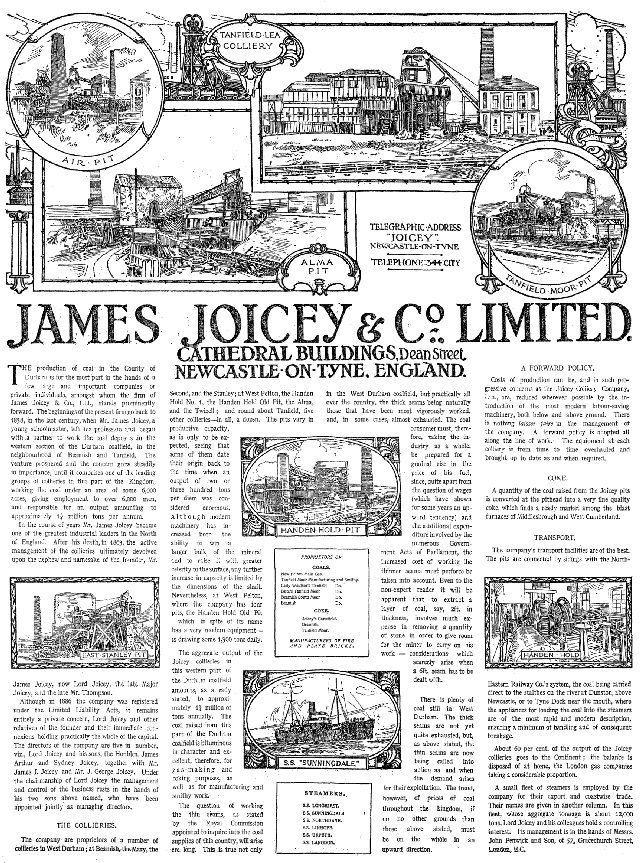
1913 - Advert from The Times (1913)
Source: The Times Newspaper
|
|
| 1915 | |
|
|
Collieries/Mines Owned
| Employees | |||||
| Name of Mine | Locality | Manager | Under | Above | |
| ground | ground | ||||
| Beamish, James and Mary | Chester-le-Street | William Severs | 749 | 120 | |
| Beamish, Second | Chester-le-Street | William Severs | 145 | 36 | |
| East Stanley | Stanley | William Severs | 170 | 34 | |
| Handen Hold | Chester-le-Street | J. Norman Humble | 76 | 11 | |
| Handen Hold, Busty | Chester-le-Street | J. Norman Humble | 363 | 145 | |
| South Tanfield | Stanley | — | — | Hutton (Section), Main Coal and Beaumont Abandoned | |
| Tanfield Lea, Ann and Bute | Stanley | John Rogers | 284 | 83 | |
| Tanfield Lea, Wind and Margaret | Stanley | John Rogers | 534 | 117 | |
| Tanfield Moor | Stanley | John Rogers | 181 | 48 | |
| Twizell | Chester-le-Street | G. Holden | 303 | 55 | |
| West Pelton | Chester-le-Street | J. Norman Humble | 266 | 60 | |
| 3,071 | 709 | ||||
| 3,780 | |||||
|
|
| 1921 | |
|
|
Collieries/Mines Owned
| Employees | |||||
| Name of Mine | Locality | Manager | Under | Above | |
| ground | ground | ||||
| Beamish, James and Mary | Beamish | William Severs | 729 | 143 | |
| Beamish, Second | Beamish | William Severs | 169 | 63 | |
| East Stanley | Stanley | William Severs | 289 | 55 | |
| Handen Hold | West Pelton | G. Holden | 146 | 12 | |
| Handen Hold, Busty | West Pelton | G. Holden | 466 | 144 | |
| Tanfield Lea | Tanfield | P. S. Blunden | 852 | 183 | |
| Tanfield Moor, Willey | Tanfield | P. S. Blunden | 258 | 54 | |
| Twizell | Beamish | T. Adamson | 363 | 80 | |
| West Pelton | West Pelton | G. Holden | 313 | 77 | Abandoned |
| 3,585 | 811 | ||||
| 4,396 | |||||
|
|
| 1923 | |
|
|
Company Details
| Registered Office: | Dean Street, Newcastle-on-Tyne |
| Annual Output: | 4,000,000 tons |
| Class of Coal: | Coking, Gas |
| Source: 1923 Colliery Year Book and Coal Trades Directory. Published by The Louis Cassier Co. Ltd., from a copy held in the Scottish Mining Museum, Newtongrange, Midlothian | |
Company Directors
| Directors: | Joicey, J. A., Hon. |
| Joicey, J. G. | |
| Joicey, Lord | |
| Secretary: | Joicey, J. G. |
Company Mergers, Acquisitions etc.
| Consolidated subsidiaries as: | Lambton, Hetton & Joicey Collieries Ltd. |
Collieries/Mines Owned
| Employees | |||||
| Name of Mine | Locality | Manager | Under | Above | |
| ground | ground | ||||
| Beamish James & Mary | Beamish | William Severs | 717 | 176 | |
| Beamish Second | Beamish | William Severs | 165 | 60 | |
| East Stanley | Stanley | William Severs | 266 | 52 | |
| Handen Hold Busty | West Pelton | J. F. Gibson | 459 | 154 | |
| Handen Hold | West Pelton | J. F. Gibson | 137 | 11 | |
| Tanfield Lea | Tanfield | P. S. Blunden | 986 | 209 | |
| Tanfield Moor "Willey" | Tanfield | P. S. Blunden | 274 | 51 | |
| Twizell Burn Drift | Beamish | J. F. Gibson | 28 | 16 | |
| Twizell | Beamish | T. Adamson | 376 | 78 | |
| 3,408 | 807 | ||||
| 4,215 | |||||
|
|
| 1924 | |
|
|
Links to other areas of this site
| 1924-12-05 | Official Notice from The London Gazette |
|
|
| 1925 | |
|
|
Links to other areas of this site
| 1925-07-14 | Official Notice from The London Gazette |
|
|
| Sources | |
|
|
- Mineral Statistics for 1858 (Memoirs of the Geological Survey of Great Britain, and of the Museum of Practical Geology), compiled by Robert Hunt, F.R.S.
- 1875 Mines Inspectors Report (C. 1499), Newcastle-on-Tyne District by James Willis, H.M. Inspector of Mines Where to find this report
- Banners of the Durham Coalfield, Norman Emery, 1998, Sutton Publishing Ltd., ISBN 0-7509-1708-3
- 1923 Colliery Year Book and Coal Trades Directory. Published by The Louis Cassier Co. Ltd., from a copy held in the Scottish Mining Museum, Newtongrange, Midlothian
- 1881 Mines Inspectors Report (C 3241) Where to find this report
- Mineral Statistics for 1883 - Government report from the Mines Department (C 4058), published in 1884 — includes List of Mines and Mineral Works
- Mineral Statistics for 1885 - Government report from the Mines Department (C 4771), published in 1886 — includes List of Mines and Mineral Works
- Mineral Statistics for 1887 - Government report from the Mines Department (C 5464), published in 1888 — includes List of Mines and Mineral Works
- 1888 List of Mines - Government report from the Mines Department Where to find this report
- 1894 List of Mines - Government report from the Mines Department Where to find this report
- 1896 List of Mines - Government report from the Mines Department, also available online at Peak District Mines Historical Society Ltd Where to find this report
- 1899 List of Mines - Government report from the Mines Department Where to find this report
- 1900 List of Mines - Government report from the Mines Department Where to find this report
- 1902 List of Mines - Government report from the Mines Department Where to find this report
- 1905 List of Mines - Government report from the Mines Department Where to find this report
- 1909 List of Mines - from Reid's Handy Colliery Guide Where to find this report
- 1910 List of Mines - Government report from the Mines Department Where to find this report
- 1915 List of Mines - Government report from the Mines Department Where to find this report
- 1921 List of Mines - Government report from the Mines Department Where to find this report
- 1923 List of Mines - Government report from the Mines Department Where to find this report
- The Times Newspaper
|
|
| Further Research | |
|
|
 Research Notes for James Joicey and Co., Ltd.



 Contains public sector information licensed under the

