


 |

|

|

|
|
 |
 |
|||

July, 1957
The oiling of coal
By D. A. Hall, B.Sc, Ph D, F R I C., M.I.Min.E,, M.Inst.F.*and H. MacPherson, M.Sc., A.M.C.T., M.Inst.F.**
The authors describe experiments that are being carried out in the N.C.B., Durham Division to improve the handling characteristics of coal as well as increasing the bulk density by adding oil to washed small coal
Since nationalisation, the policy of the N.C.B. Durham Division has been directed towards producing the maximum tonnage of cleaned carbonisation coal from the Durham coalfield. The county of Durham has always been noted for the high quality of the carbonisation coals which it produces, but as the cleaner seams become exhausted and mechanisation increases, the quantity of impurities in the run-of-mine coal has increased. To meet this problem in the past, the coal-owners installed dry cleaning plants for treating the small coal minus about 2 in. and depended upon a plentiful supply of labour for hand cleaning the larger sizes.
The present trend towards intensive mechanised mining, the increase in dirt content beyond the capacity of the dry cleaners to remove the heavier material, the necessity to use water underground for dust control, and a growing shortage of labour in the industry, have combined to make the old methods of preparation impracticable. In consequence, Durham Division's policy has been towards washing the run-of-mine coal. This, of course, is a fundamental change because, compared with dry carbonisation coals, the washed coals require more heat per unit weight for carbonisation, have a lower bulk density so that the throughput of ovens and retorts is reduced, and are more difficult to handle through conventional equipment such as bunkers, conveyors, screens, feeders, crushers, etc.
The Durham Division are aware of this position and are endeavouring to find ways of minimising the troubles while still retaining all the economies and advantages which arise from the use of the most efficient methods of cleaning. In addition to fundamental research work on these and other problems by the Board's research organisation, the Durham Division have a small team of workers who are concentrating upon field investigations into methods for reducing the moisture in washed coals and improving their handlability. The addition of oil to coal in order to improve the bulk density and hence to obtain increased throughputs and gas yields at carbonisation plants is, of course, a common practice and there is considerable evidence, both from this country and the U.S.A., that this practice also improves the handlability of the coal. One of the methods which is under examination is, therefore, that of adding oil to washed small coal. These experiments were undertaken to test the practicability of applying the oil at the washeries and so gaining the benefit of the improved handling characteristics of the coal throughout the discharging of wagons and ships, and during its passage through the initial handling equipment at the consumers' works, as well as the increase in bulk density.
The washed small coal which causes the major handling difficulties usually consists, in the Durham Division, of a mixture of centrifuged small coal, below about in. in size, and froth-floated filter-cake. Laboratory tests have indicated that such a mixture can be improved by either
| (a) |
adding oil to the filter cake after froth flotation.
| |
| (b) |
adding oil to the small coal, e.g., before centrifuging, and then mixing filter cake with the dewatered smalls, or
| |
| (c) |
by mixing oil into the general flow of centrifuged coal and filter cake.
|
These methods have been tried on a large scale but, for technical reasons connected with the operation of the washing plant, most of the tests have been carried out with coal which has been treated by spraying oil on to the flow of centrifuged coal and filter cake as it enters the paddle mixer. A number of oils have been used, but for the main experiments the oil used was a gas oil of sp. gr. 0.84 with a Redwood viscosity at 100°F. of 34 sec., a pour point below 20°F. a minimum flash point of 150°F. and a calorific value of 19,600 B.Th.U. per lb. The quantity added was equivalent to half to one gallon per ton of the finished washed small coal. It is of interest to note that this is the same order of oil addition as that required to obtain maximum increase in bulk density of wet coal as practised at coke ovens of the Durham Division.
In the first tests, the "oiled" washed smalls were sent by rail to local coke works, i.e., a relatively short railway journey. The laboratory experiments had indicated that the addition of ¼ to ½ per cent. of oil to in.-0 in. washed coal improves the flow characteristics by a factor of about 2. Table I, which lists the time of emptying various coals from trucks at the cokeworks, shows that a similar improvement is obtained on a large scale, and also indicates the differences in teeming between graded coals, and various smalls.
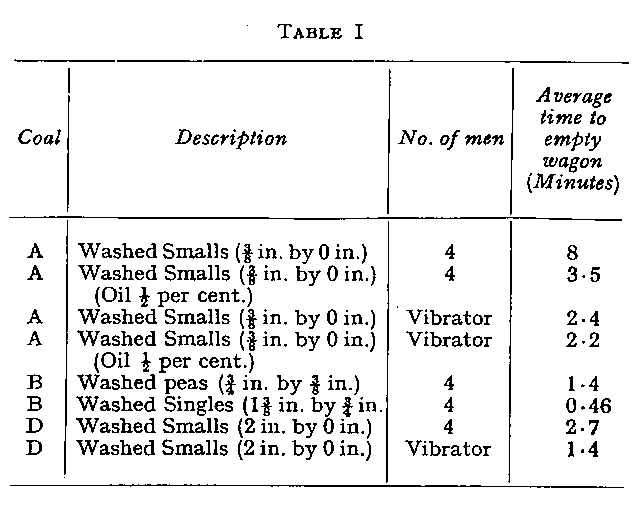
It will be noted that the use of a vibrator enables unoiled washed small coal to be emptied as easily as oiled coal, but subsequent handling through the plant and bunkers was much easier with the oiled coal.
Later the smalls were sent longer distances so that the effects of longer time and increased shunting, etc., could be determined. More recently, one test has been made in which oiled washed small coal was mixed with washed graded coals in the normal manner to make "Gas mixture." This was loaded into one hold of a ship and sent to a Thames-side gasworks. In all cases, representatives of the N.C.B. visited the consumers' works and observed the behaviour of the coal during handling from wagons or ship, and through the consumers' equipment.
The general results of the tests can be summarised as follows
(1) Oiled coal does not arch over and cease to flow through the bottom doors of railway wagons. When bottom doors are dropped, the oiled coal runs much more freely than normal washed smalls and the wagons require a minimum of attention to ensure complete emptying-this is usually confined to a little clearing at each end of the wagons.
The time required for emptying a consignment of oiled small coal is approximately half that required for the same coal in the unoiled condition.
(2) The free-flowing characteristics observed from wagons is maintained through each other item of equipment. Difficulties previously experienced with washed small coal, e.g., build-up in bunkers, blocking of screens and feeders, adherence to chutes, scrapers and conveyors, are all minimised until the coal approximates to dry coal in ease of handling.
(3) The appearance of washed coal is improved by oiling. The larger pieces remain bright and free from adhering fine particles so that it bears a close resemblance to dry coal in appearance.
Apart from the improvement in handlability, other benefits would result from oiling coal, e.g., the coal would be frost-proofed, the degree of protection depending on the proportion of oil used, and the coal would be partially water-proofed so that during bad weather there would be a minimum absorption of rain water.
This paper is published by permission of the National Coal Board. The conclusions arrived at and the views expressed are the authors' and do not necessarily represent those of the Board.
* Divisional Chief Scientist, N.C.B. Durham Division.
** Divisional Coal Preparation Engineer, N.C.B. Durham Division.


Article reproduced from a copy of the magazine held at National Mining Museum Scotland, Newtongrange, Midlothian.




 Contains public sector information licensed under the

