


 |

|

|

|
|
 |
 |
|||

July, 1956
A North-Country Drift Mine
At Havannah Colliery, in the No. 1 Area of the Northern (N. & C.) Division, National Coal Board, the total output is brought to the surface by means of a cable-belt conveyor installed in an inclined drift
In addition to the major reconstruction of existing large collieries and the sinking of new high-output shafts, the National Coal Board are devoting attention to the provision of a number of drift mines.
Under the right circumstances these drift mines have shown many advantages. Not only are they able to produce coal quickly and with the minimum of capital cost but, in most cases, the productivity obtained is of a very high order. Drift mines are therefore expected to do much to meet the country's demand for coal, particularly in the interregnum before the large-scale reconstructions reach fruition.
One of the most successful drift-mining operations is that at Havannah, five miles north of Newcastle. Here in the space of just over four years, the green sod (or, to be more precise, a boggy marsh) has been converted into a colliery producing over 1,200 tons per day at an output per manshift well above the national average. How well the newly-erected surface buildings blend with the surrounding countryside may be judged by reference to the accompanying illustrations which indicate that it is possible for such constructions to be both functional and aesthetically pleasing. This new colliery has now settled into routine production, and recently, through the kindness of Mr. R. S. Pratt, M.C., Area General Manager, we were allowed to visit the mine to see what has been accomplished there.
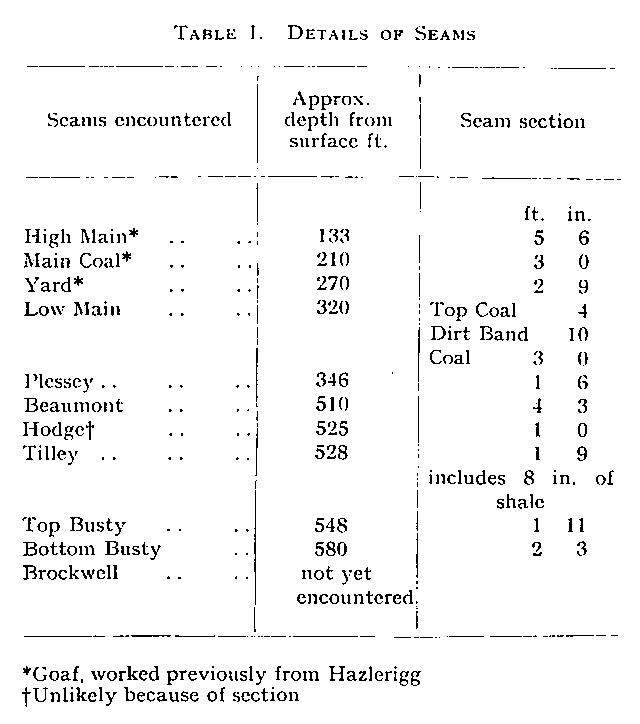
The Havannah Drift project was commenced in order to work an area of coal 900 acres in extent, bounded by faults to the east and north, outcrop to the west, and other colliery workings to the south. It was not deemed practicable to work this area from existing collieries owing to the presence of several large faults, and to the long hauls that would have been necessary. Accordingly, plans were drawn up to drive two drifts 50 yards apart to intersect, centrally with regard to the area of the take, the seven proved workable seams shown in Table I. It was estimated that the working of these seams would give the colliery a life of 30 years with a possible extension of a further 15 years from unproved resources. From proved resources alone, 11,250,000 tons of coal were expected.
Surface excavations
Contracts were given to George Wimpey & Co. Ltd., London, W.6, for the levelling of the site, the commencement of the drifts and the erection of surface buildings.
On February 6, 1950, a Ruston Bucyrus 33 RB excavator and a Caterpillar D/8 wheeled scraper commenced the excavations for the entrances to the main intake and return drifts. The entrance to the main drift was to be 630 ft. long and to the return drift 325 ft. long, both dipping at a gradient of 1 in 12. Removal of overburden presented no difficult problems and each drift was constructed in the form of an arch, cast in situ using transportable shutters and concrete, reinforced with approximately 100 tons of ½ in., 7/8 in. and 1 in. diameter steel bars and reinforcing fabrics. Both floors were concreted and the finished internal dimensions of the drift entrances were 14 ft. wide and 9 ft. 6 in. high. In all a total of 1,500 cubic yards of concrete were poured into position, a 4-in. Blaw-Knox concrete pump being used for the purpose. In the floor of each drift, a surface-water drainage channel was formed, rails were embedded for a minecar track and a channel was left between the rails for haulage-rope rollers. A view of the main drift entrance during the time driving operations were in progress is given in Fig. 6.
In November 1950, at an approximate depth of 50 ft., the last 12 ft. of the entrances were tunnelled into the rock face to provide a suitable "key." The drifts were then taken over by M. & H. Mining Contractors Ltd. who continued the work until coal was reached in April, 1952.
When all concrete work on the drift entrances had been completed, back-filling and relevelling of the soil over the drifts were commenced. D.8 Caterpillar bulldozers were used on this work and our titleblock, which photograph was taken on October 6, 1950, shows the operation in progress.
On completion of the concrete drift entrances, those buildings required urgently for drifting, an electrical substation and an explosive store, were soon erected. Meanwhile work proceeded with concrete access roads, main outfall and water drainage, temporary haulage houses, refuse hoppers, minecar ramps for both main and return drifts, compressor and screening plant foundations, new railway sidings and a new single line railway to link with an existing railway system at Hazlerigg Colliery.
In December 1951, work was commenced on two larger buildings, the workshops and the stores. These were constructed on a framework of approximately 160 tons of structural steelwork and had 11 in. cavity walls faced with grey N.C.B. bricks. A view of the completed workshops and stores can be seen in Fig. 4. In connection with this construction it is worth noting that inclement weather, which included severe frost, snow and excessive flooding, curtailed progress for almost three months, but as these buildings were required urgently, every effort was made to make up the leeway and the work was completed on schedule. Other buildings, including administrative offices, baths, canteen and lamp room, were completed in due course and as our illustrations show, they are as decorative as they are utilitarian.
Drift-driving operations
At the point of entry of the drifts, the strata consisted of hard fireclay and as the drift entrances had been stemmed full of concrete during construction, it was found unnecessary to use any special methods to support the portals during drivage. Normal mining practice was commenced at a distance of 150 yards from the entrance of the main drift and 108 yards from the entrance of the return drift. The driving of the drifts was accomplished by conventional blasting methods, the resultant debris being loaded by means of slushers into minecars which were hauled to the surface by direct-rope haulage.
On each shift, which lasted 7½ hours, six men and a chargeman were employed at the face of each drift. Because no man, apart from the foreman, was experienced in this class of work, specific tasks were not allotted to any person and the men worked together as teams performing all the required duties except for the operation of the slushers which was usually reserved for men specially trained for the purpose. For shotfiring, a wedge cut was employed and the holes were drilled with a Holman Silver Dart or SL 3 compressed-air drill used in conjunction with Hadfields hollow, hexagon drill steels. Two drilling machines were normally employed at the face but on occasions, when particularly hard strata were encountered, three were used. A check on their working order was carried out daily and repairs were carried out as and when required.
Compressed air for the drills was supplied from the surface where there were two Ingersoll Rand air-cooled, 100 h.p. compressors delivering 388 cu. ft. of air per min. at 100 lb. per sq. in. pressure; air was first carried in a 6 in. diameter pipeline to a 500 cu. ft.-capacity receiver sited near the entrances from where it was taken by 4 in. diameter mild-steel pipelines down the drifts. For wet drilling, town water was kept in small tanks fitted with ball cocks. These tanks were placed in the drifts and were moved up to the face from time to time to control the head of water.
During each round, 80 to 90 lb. of explosive were used and this was initiated by sec. delay multi-shot detonators. The explosive employed was Gelamex until the first workable seam was encountered, after which permitted explosives such as Driftex were introduced. In order to keep the face of the drift dry during drivage, Mono pumps were employed, and in the early stages they delivered direct to the surface. As the face advanced, a system of stage pumping wells made in the drift floor was adopted. Armoured flexible suction hose brought water from the face to the pump after which it was carried in 4 in. steel delivery pipes. Mono D 10 D, 10 h.p. 960 r.p.m. pumps delivering 120 g.p.m. with a 350 ft. head were employed in this operation.
Loading of the debris made by drift driving was performed by a Joy model SNE.211 scraper loader using a 36 in. scraper bucket delivering into six-ton Sheepbridge "Manvers" drop-bottom minecars. These cars are normally rated to carry six tons of coal but for this duty they were cut down to carry six tons of stone. The Joy scraper loader is powered by a 35 h.p. G. C. motor, has a rope pull of 2,320 lb., a rope speed of 244 ft. per min. and holds up to 420 ft. of ½ in. diameter rope. The discharge end of the slusher was sufficiently high and wide to accommodate one of the cut-down minecars, and, as only one car was used in each drift, crossovers, shunts, or similar contrivances were unnecessary at the face, the car being hauled away by the direct-rope haulage as soon as filled; while waiting for the car to return roof dressing proceeded and the remaining debris was brought into position near the receiving apron of the slusher. All the dirt at the face was handled by slusher bucket except for a very small quantity that was used to stow behind the slabs between the arch girders.
Ventilation of the drifts was carried out by two 20 in. Sirocco axial-flow fans, one for each drift, situated on the surface. These fans, which deliver 8,000 cu. ft. of air per min. at 3,000 r.p.m., with a water gauge of 1.1 in., are powered by a 20 h.p. direct-coupled motor fitted with a solenoid brake and reversing gear. Air was forced down 2 ft. diameter steel tubes to within five yards of the face obviating the need for flexible air ducting at the head end.
An average rate of advance of 124 yards per week was maintained during drift driving and the maximum drivage for any one week was 26 yards. Each member of the drifting team was paid a day wage, plus a bonus for any advance over 12 yards per week.
The seams encountered during drift-driving, their approximate depths from the surface and their sections can he seen in Table I.
The drifts were driven at a gradient of 1 in 674 as far as the Low Main seam which was encountered at a distance of 900 yards from the entrance of the intake drift. From the Low Main seam both drifts dip at 1 in 45 to the Bottom Busty seam. The total length of the intake drift, which is most southerly, is 1,300 yards and the return drift 1,200 yards. Both are supported by 14 ft. arch girders set 4 ft. apart on soft wooden foot blocks, steel strutted and completely filled with reinforced-concrete slabs. During driving, the return drift was always in advance of the intake drift and coal drawing commenced from the return drift in April 1952.
Drawings and Photographs accompanying the article


Article reproduced from a copy of the magazine held at National Mining Museum Scotland, Newtongrange, Midlothian.




 Contains public sector information licensed under the

