


 |

|

|

|
|
 |
 |
|||

February, 1950
Steam production at collieries
Where the life of a steam-driven pit does not justify electrification, it is often possible to effect considerable economies by improved boiler plant, steam storage and similar modifications
About the year 1705 Newcomen succeeded in making his atmospheric engine pump water from a Cornish tin-mine; in 1714 one of Newcomen's engines was installed for pumping duties at Byker colliery. The discharge from some of these pumps was used to drive water-wheels which raised the corves and men up the shallow shafts then existing. Newcomen and Savery's engines were atmospheric, but Watt added the condenser about 1770 and the demand for steam at mines was established. The rocking beam and connecting rod were invented in 1780, and in 1784 Boulton and Watt installed a rotative double-action engine at Walker colliery for winding coal and men in a shaft. It is a notable fact that as the necessity for pumping water in the mines of Cornwall led to the development of the steam pumping engine, so the need for improved transport at ironworks and collieries led to the development of the steam locomotive. Following Trevithick in 1803, two colliery engineers, William Hedley and George Stevenson, produced the link motion and made winding engines to raise and lower cages. Pressures in the early days were low, and boilers little more than tanks with external furnaces. Pressures increased steadily and cylindrical egg-ended boilers were developed. The single internal furnace displayed early notions of heat conservation in the Cornish boiler, followed by the two-furnace Lancashire boiler with bottom and side flues.
By 1865 winding engines were of appreciable size; at Forster pit, Seaton Delaval, a pair of horizontal cylinders, 35-in. diameter by 6-ft. stroke, fitted with double-beat valves, drove a drum 25 ft. in diameter, which raised 1,100 tons of coal in 12 hours. Boilers were egg-ended with large external furnaces for burning slack. At Abercarn a pair of 42-in. vertical cylinders, 8-ft. stroke, drove drums 25 ft. in diameter, raising 1,380 tons in 12 hours. The boilers were 34 ft. long with a single tube, internally fired. The engine exhausted into a condenser. The estimated consumption of steam per wind was 600 to 700 lb. at 45.50 lb. per sq. in., or for the output stated, 25 to 30,000 lb. of steam per hour.
About 1880, compound engines were introduced in Germany and in this country soon afterwards. Up to 1850, engines were mostly of the single vertical-cylinder type, with an integral spray condenser. About this time boilers became available for 25 to 30 lb. per sq. in. pressure, and the power of the engines was increased. Condensers worked satisfactorily with continuously running pumping engines (using the pump discharge for condensing) but were troublesome with intermittently operating winding engines. By 1885, pressures of 100 lb. per sq. in. were common, and condensers were less frequently used on winding engines.
The period 1867 to 1902 saw the change from single-cylinder beam engines with balance chains in staple pits to four-cylinder compound engines with cylindro-conical drums. Steam pressures increased from 30 to 40 lb. to 180 lb. per sq. in. with superheat of 150° F. The compound engine was exceptional, but there were hundreds of low-, medium- and high-pressure double-cylinder winders working. The introduction of the exhaust steam turbine in 1904, and later the mixed-pressure turbine, prolonged the useful life of these engines.
The winding engine was for many years the chief steam user at collieries, and the very irregular steam demand necessitated boilers with large reserves of heat ; in fact, the boiler was a combination of a steam generator and a heat accumulator, meeting the high short-period demands by a drop of pressure, which varied from slight to excessive, according to the heat storage and steaming capacity of the boilers. The Lancashire boiler met these demands reasonably successfully; it was also capable of dealing with the available feed-water without serious trouble at the pressures and temperatures prevailing. Labour required for the hand-fired furnaces was high and the overall efficiency of the whole steam plant low; the low-pressure and, later, the mixed-pressure turbo-generator, improved steam utilisation efficiencies considerably, using the 50 per cent. of heat energy previously exhausted to atmosphere, but even this economy was not fully exploited, as the early low-pressure accumulators were crude in the extreme and a large proportion of the exhaust steam energy was lost.
Rateau improved their efficiency somewhat, but it was not until the advent of the Ruths and Morrison accumulators, which were scientifically designed, that the full economies possible were achieved. With these heat-storage devices the high peak discharge from the largest winding engines could be absorbed and stored, bridging gaps between winds of one to two minutes.
The gasholder or Swartz-type steam accumulator gives the most uniform pressure within the limits of its capacity, and is little more costly than a Ruths type. Radiation losses are high, however, as it is difficult to insulate. The writer operated several with most satisfactory results; they have several advantages — the back pressure on the engines is low and uniform and this full pressure is available at the turbine. Safety devices and control of discharge are simple and effective.
Early low-pressure non-expansive engines probably had steam consumptions of over 100 lb. per shaft horsepower. Improvements in piston and cylinder packings, valve-gears and automatic cut-off gears, with increased pressures and superheats now enable makers to give guarantees of 30 to 35 lb. of steam per shaft horsepower, or 20 to 25 lb. per indicated horsepower.
To enable a winding engine to start at any crank position, a late cut-off is necessary; the automatic gear cuts off steam earlier in the stroke, reducing the volume taken per stroke, taking advantage of the expansion properties of the steam. Many of the larger steam winding engines are compounded, permitting further expansion of the steam, but condensers are seldom used except when the steam has passed through a low-pressure turbine, as the expansion to low pressures is limited by the permissible cylinder dimensions. Without expansive working, the available power from a pound of steam varies little over a wide range of pressure, and it is only when the steam is used expansively that the benefits of high pressure are secured.
The steam taken by these modern efficient engines, even for winds of over 800 yards, seldom exceeds 600 lb. per wind, over a period of 30 to 35 seconds, or at the rate of 20 to 30 lb. per second, the maximum rate occurring just before the cut-out gear operates. The high ratio between average and peak loads is liable to cause priming in boilers which have limited water surface for the release of the steam, and for this reason the Lancashire boiler remained the standard at collieries long after it had been replaced by the water-tube type at power stations.
The winding engine, often combined with the pumping engine, was the only load on the early colliery boilers. Later steam fan engines were added, giving a base load of almost constant demand ; later still steam-driven compressors and electrical generators became fairly general. Peak loads of winding engines alone are frequently five times the average, but the other loads bring up the average in comparison with the peak.
At the end of the nineteenth century the normal colliery boiler plant consisted of hand-fired Lancashire boilers, the fuel more often than not being anything that happened to be available, dumped into open bunkers or on the firing floor, without any attempt to weigh or record the quantity used. As long as the boilers could maintain steam, efficiency was not considered. Chimney-induced draught was normal, although steam-jet forced draught was occasionally used for difficult fuels. As the demand for steam increased by the addition of fans, haulages, compressors, pumps and other loads, the consumption of fuel became a matter of concern and attempts were made to improve the boiler plant by economisers, patent grates and other ancillaries, as it was found that during the winding shift good saleable coal was demanded by the stokers to maintain steam pressure. Stoking, particularly when cleaning fires burning high-ash coals, was an unpleasant job, and labour for the boiler plant was difficult to find and to train, and was therefore expensive. Mechanical stokers were at length introduced to ease this burden. These required better class coals and would not deal with the rubbish previously considered good enough. Screening plants and washeries were developing at this time, and washery slurry had to be disposed of. Patent grates with forced draught could deal with this material but had to be hand-fired. A typical example of the progressive development of the boiler plant is afforded by that of a well-known Midland colliery company.
Four 8-ft. diameter by 30 ft. Lancashire boilers were sufficient for these early steam requirements, burning rough slack having a calorific value of 9,500 to 10,500 B.Th.U. per lb. To meet increasing demands, two more Lancashires were added, these being fitted with mechanical stokers, which were later fitted to the other four boilers. Thirty per cent. of the fuel now used was better-quality sized coals. With a weekly output of 7,000 tons, 600 tons were consumed in the boiler plant. Electric generating plant was now demanded to supply the colliery and the district. Three water-tube boilers were installed, each of 18,000 lb. per hour steaming capacity; pulverised-fuel firing was decided upon after an experiment on one of the Lancashires had proved successful. Dust 0-1/8 in. in size was used and the increased load was carried on two of the water-tube boilers for a consumption of 350 tons of dust per week.
Charges for the various coals varied from 4s. for dust to 8s. per ton for sized coal, these being the normal prices prevailing over the period of development. The cost of steam during the three stages was :–
| 1st. | Hand-fired Lancashires | 18 | pence | per | 1,000 | lb. |
| 2nd | Mechanically stoked Lancashires | 10 | ,, | ,, | ,, | ,, |
| 3rd | P.F. fired water-tube boilers | 6 | ,, | ,, | ,, | ,, |
| Including capital charges on new plant | 8 | ,, | ,, | ,, | ,, |
These costs include fuel, labour and management, repairs and maintenance, and electric power for the powdered-fuel plant. No capital charges are included in the cases 1, 2 and 3. Line 4 gives costs including capital charges at 10 per cent. on the powdered-fuel water-tube boiler plant. Evaporation per pound of fuel varied from 4.5 lb. in case 1 to 6.16 lb. in case 3, over the weekly load. This was increased to over 7 lb. by improvements in control and operation of the pulverised-fuel plant. No economisers were fitted.
In spite of the obvious advantages of modern water-tube boiler plant, many Lancashire-boiler installations, still operate, and some of these have been installed within the last 20 years. Brownlie's crusade in the 1920's disturbed the complacency of the mining industry regarding their boiler plant, but in the last few years the Fuel Efficiency Committee have found glaring examples of poor operation. Air leaks in brickwork, short circuiting of flue gases, badly fitting dampers and cleaning doors have been exposed by CO2 tests. In other instances, low output has been proved to be due to scale, irregular blowdowns, no water preparation plant, bad firing methods, excessive grate area, unsuitable fuels for the plants installed, indifferent lagging, leaking valves and joints, economisers and superheater not installed or out of action due to neglect, working pressures dictated by the oldest boiler; bad housing, bunker and fuel-unloading arrangements; and indifferent methods of ash disposal. All these defects increase labour and reduce the efficiency. The Fuel Efficiency Committees have done valuable work in investigating these defects and recommending remedies, but many plants are beyond reclaim, due to initial bad layout and ill-advised additions.
Complete electrification is the recommendation of the Reid Report, but the probable life of the undertaking may not justify the heavy expenditure required for this.
Despite the prejudice against them, several collieries with outputs per day of over 2,000 tons, with deep shafts and, therefore, large winding engines, have been equipped from the start with water-tube boilers, with satisfactory results, both from the operational and efficiency standpoints. Two typical boiler-load charts are given. Fig. 1 gives steam consumptions with and without a 2,000 kW. mixed-pressure turbo-alternator, and for comparison, a non-working day. The turbine runs only during the coalwinding shift and is supplied with low-pressure steam from two large winding engines, through a Bell-type accumulator.
Fig. 2 gives load charts for a very large colliery. A 3,000 kW. mixed-pressure turbo-alternator runs continuously, taking low-pressure steam from two tandem compound winding engines, through a Rateau accumulator. In each case the boilers are all of the water-tube type with chain-grate stokers burning washed duff derived from a medium-volatile coal. Economisers, superheaters and induced-draught fans are fitted, and the boiler efficiencies average over 70 per cent., the pressure being 150 lb. per sq. in. and the temperature 500° F.
Modifying existing steam plant
The possibility of improving the efficiency of existing steam installations without the heavy capital expenditure involved in complete electrification is worthy of investigation, as many steam collieries have a life which would not justify this change. High-class steam winders have an almost indefinite life of constant efficiency if maintained as they deserve, but there is little scope for the introduction of the devices which have revolutionised the efficiency of electric power generation in the last 20 years. Improved heat cycles with higher pressures, superheats and vacua, reheat between high-pressure and low-pressure expansions, multi-stage feed heating, with bled steam using latent heat previously lost in the condenser are all unavailable to the steam-winder reciprocating engine. The late cut-off necessary to give the required starting effort at any crank position limits the benefits from higher pressures. Superheat is also limited by the necessity to lubricate the sliding surfaces exposed to the steam. Pressures were limited by the use of Lancashire boilers to a maximum of 200 lb. per sq. in. and superheats to 550° F. by lubrication difficulties. The possible avenue for improvement is the boiler plant. Hand-fired fire-tube boilers at collieries seldom maintain more than 65 per cent. efficiency. The low heating-surface to grate-area ratio entails the use of economisers. The Economic type of boiler, with its higher ratio of heating surface to grate area and general higher efficiency was not popular due to the available feed waters forming scales which were difficult to remove from the fire tubes.
The high-peaked, short-period loads of the winders necessitate large reserves of boiler plant to prevent priming troubles, and the resulting low load factor is all against efficiency; mechanical stokers improve the average efficiency but the varying character of the fuels dumped into the colliery boiler bunkers makes it difficult to obtain the best results from the stoker plant. Further, the marked difference in the average loading between the winding shift and the afternoon and night shifts all oppose efficient operation of colliery-boiler plants.
An improvement from the 65 per cent. average boiler efficiency to 80 per cent. would justify appreciable capital expenditure, subject to the use of available fuels and maintenance of uniform boiler pressures for the winders, compressors and other steam-driven plant. Steam winders installed during the last 40 years are almost invariably large for their normal loading, for various reasons; boiler pressures frequently fall to low levels during the maximum winding periods and the cylinder diameters have been made large to allow for this and to afford other safety margins. If uniform steam pressure could be assured then the operating pressure could be lowered to the anticipated minimum and the weight of steam per wind proportionally reduced. Uniform superheat also helps efficiency in reducing cylinder condensation.
Results from an actual scheme
The writer therefore proposes to describe a colliery steam plant with which he was concerned, in which, by incurring a moderate capital expenditure, modifications were introduced whereby the overall efficiency was greatly improved, using the fuel available at the colliery.
The original boiler plant consisted of six Lancashire boilers, hand fired with washed and sized fuel; neither economisers nor superheaters were provided, the draught being induced by chimney and forced by steam jet. By the addition of two 30,000 lb. per hour pulverised-fuel boilers using collected and aspirated dust, and the conversion of two of the Lancashires into high-pressure Ruths' accumulators, steam to the winding engines was made available at a constant pressure throughout the day.
Table I gives details of the steam-using plant and the schematic diagram reproduced in Fig. 3 gives the steam consumptions when dealing with an output of 1,500 tons of coal per day.
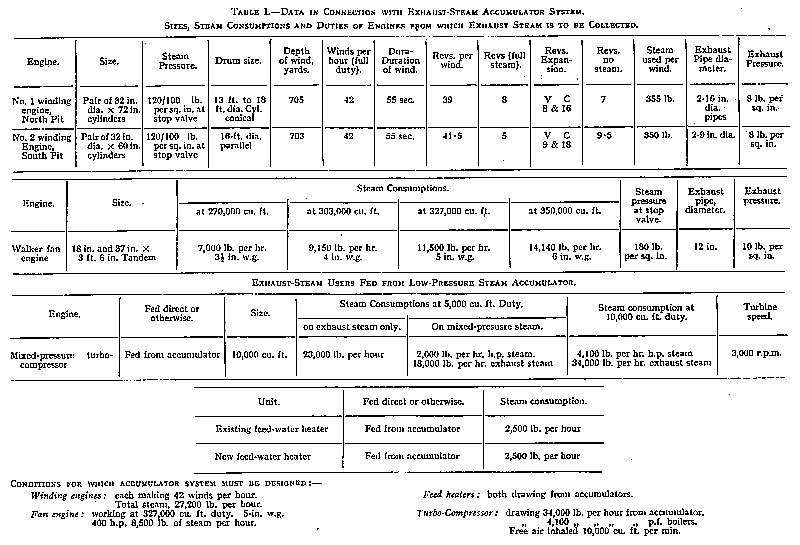
Indicator cards of both winding engines, Fig. 4, gave the consumption per wind of 350 lb. and 355 lb. The fanengine indicator cards, Fig. 5, give the consumption at full load; the Willans line for other loads is given. Similar Willans lines for low-pressure, high-pressure and combined steam consumed are given in Fig. 7, for the 10,000 cu.ft. turbo-compressor. A slow-speed reciprocating compressor of 3,000 cu. ft. capacity and an electrically driven vertical high-speed compressor of 2,500 cu. ft. per min., were available for compressed-air supplies when loads did not justify running the turbo-compressor. An electrically driven fan was also available, sufficient for week-ends or holiday periods.
The Lancashire boilers were retained to permit complete shut-down of the pulverising-fuel boilers and the accumulators for service and maintenance.
Fig. 6 gives a daily record of such a plant, showing the uniform boiler pressure and medium-pressure steam supply to the winders. The variable pressure in the accumulator gives some idea of the balancing effect, the ripples on the curve corresponding to the operations of the two winding engines. To give clear records of the three pressures on the chart scale, the boilers, accumulator and low-pressure steam were adjusted and should be read at 25 lb. above the printed records. The steam supply to the winders was 100 lb. per sq. in. Load on the pulverised-fuel boiler remained practically constant at 30,000 lb. per hour from 5 a.m. to 2 p.m., when it was reduced to 20,000 lb. Safety valves on the accumulator were set at 180 lb. per sq. in., working pressure being from 100 to 175 lb. per sq. in. The chart indicates that blow-off only occurred once (for a few minutes) in the 24 hours. The boilers blew-off twice. Winder control was greatly improved by the uniform pressure available.
The points marked "check" at 2 p.m. and midnight indicate to the pulverised-fuel-fired boiler attendant where he should check the output of the boilers by reducing the coal feed. The dotted line indicates the desirable steam pressure in the accumulator. These checks would prevent the blow-offs recorded. At 4-30 a.m. the coal feed to the boilers should be increased and the accumulator pressure built up to maximum to meet the heavy winding load from 5-15 a.m. to 8 a.m.; again the dotted line shows the desired pressure curve.
Having arranged the high-pressure steam supply satisfactorily, and incidentally reduced the fuel consumption appreciably, attention may be turned to the utilsation of the exhaust steam from the winders and fan engines. The quantities of low pressure steam available are given in Fig. 3, together with the high-pressure demands and small quantities taken by the feed pumps and feed heater. Steam to the fan engines and turbo-compressor is supplied directly from the pulverised fuel boiler at 200 lb. per sq. in. and 550° F. Fig. 3 also indicates the demands to and from the various steam-using machines, and the flows in the high-pressure and low-pressure systems.
Fig. 8 gives the layout of the low pressure piping, and the position of the receivers and the low-pressure accumulator. Discharge to atmosphere is provided for all engines for use when the turbo-compressor is shut down and there is no use for the low-pressure steam.
The coal consumption of one pulverised fuel boiler for the 30,350 lb. per hour required is 1.6 tons per hour for the 8 to 10 hours of the coal-winding shift, and a reduced quantity for the afternoon and night shifts. Normally the turbo-compressor runs continuously for the working days, as coalcutters, conveyors, pumps, haulages and other air-using machines are running. At week-ends it is shut down, and either the steam or electrical compressor carries the colliery load.
The estimated coal consumption is 31.5 tons per day or 210 tons per week, about 2.8 per cent. of the colliery output.
Collected dust amounts to ¾ of 1 per cent. of the daily output, the remainder being aspirated dust extracted at the duff screens.
This should be compared with the Lancashire boiler consumption (for a lower daily output) of twice the tonnage of sized washed coal, valued at more than twice the price per ton.
The above illustrates a possible method of increasing the overall efficiency of a colliery steam plant, and of collecting and correlating the data required. The cost would be considerably less than for complete electrification.
Drawings and Photographs accompanying the article


Article reproduced from a copy of the magazine held at National Mining Museum Scotland, Newtongrange, Midlothian.




 Contains public sector information licensed under the

