


 |

|

|

|
|
 |
 |
|||

July, 1939
Black A.R.P. Lighting
One of the fundamental problems connected with an air-raid black-out is to ensure that at any rate essential services can be maintained without interruption due to darkness. Blinds enable conventional lighting to be retained, but if they are in any way defective they become a positive source of danger, and there are many circumstances where blinds are undesirable or impracticable. In such cases a special lighting system offers very substantial advantages.
An ingenious lighting system which enables switchboards and other control points to be manipulated in total darkness has been devised by The General Electric Co. Ltd. The system depends on the fact that a wide range of powders fluoresce under the action of ultra-violet radiation, emitting visible light of various colours. Osira mercury-vapour lamps in "black" glass are used as the radiant source, giving an abundant supply of ultra-violet rays but negligible visible light, and the points to he illuminated are treated with fluorescent material in one of several ways.
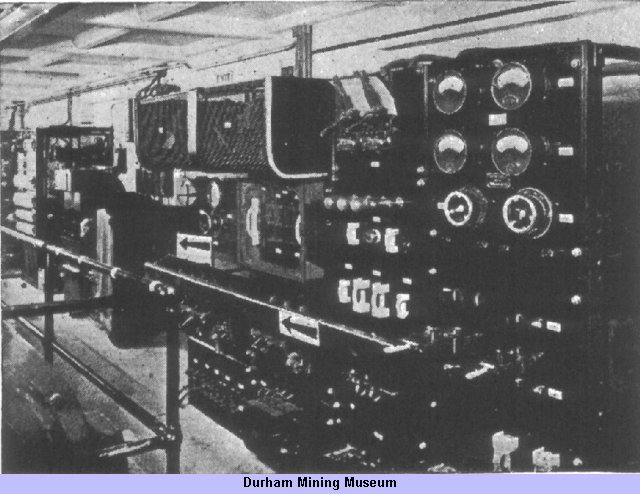
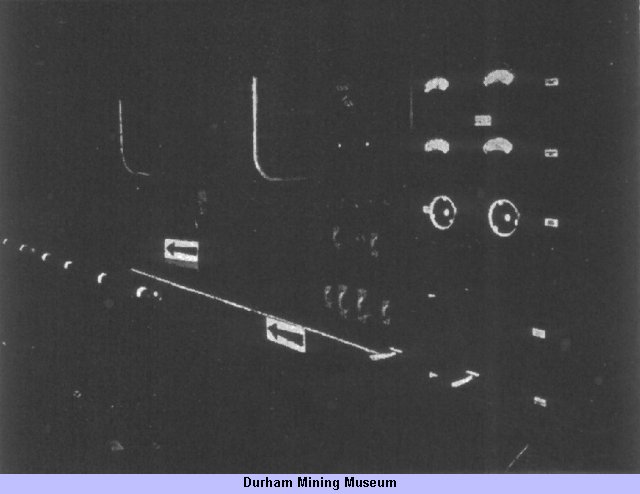
The accompanying illustrations show an industrial switchboard under normal lighting and under "Black" A.R.P. lighting. Instruments can be read and switches and controls located. This system can also be used to illuminate turbine or engine controls, winder controls, shaft signalling instruments and depth indicators, to render visible A.R.P. notices and route signs, and to mark handrails, stairs and obstructions.
The fluorescent materials can be applied in various ways according to circumstances. Instrument dials, switch handles and engine controls are treated with fluorescent paint, and labels, switch covers, &c., can be made of bakelite in which fluorescent powder is incorporated during manufacture. Fluorescent signs are also available in vitreous enamel to withstand outdoor conditions.
These materials will glow for several hours after the lamps have been switched off-an obvious advantage in the event of a cessation of electricity supply.


Article reproduced from a copy of the magazine held at National Mining Museum Scotland, Newtongrange, Midlothian.




 Contains public sector information licensed under the

