


 |

|

|

|
|
 |
 |
|||

May, 1939
Barvoys Washery at Wingate
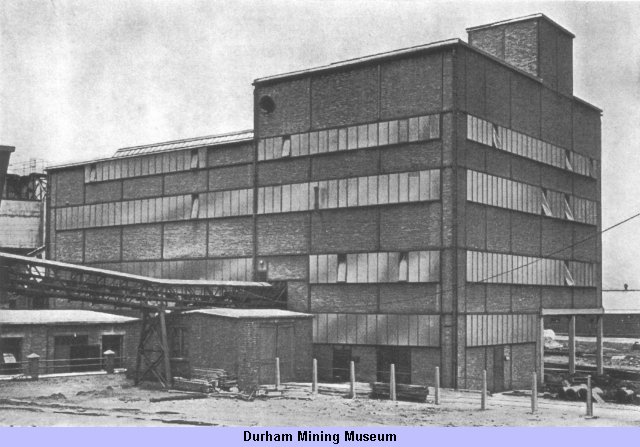
The washery at Wingate Colliery was the first Barvoys plant to be built in this county, and is washing to within 0.1 per cent. of fixed ash in sizes down to ¼ in.
One of the most interesting developments in coal cleaning within the past few years has been the introduction of heavy-medium washers. The Barvoys system was invented by G. Jan de Vooys, a Dutch engineer who is technical director of Sophia Jacoba Colliery, Aachen. It will be recalled that the system was discussed by Dr. R. A. Mott in our February, 1935, issue. In January, 1937, the first Barvoys plant to be built in this country was ordered by The Wingate Coal Co. Ltd., and Colliery Engineering Limited, Sheffield, were then engaged upon its erection. This plant has now been in operation sufficiently long for a reliable estimate to be formed of its capabilities, and although a number of other Barvoys plants have since been installed, some of them naturally embodying detail improvements made as the result of the experience at Wingate, a peculiar interest always attaches to the first British plant of its kind.
In the Barvoys process the medium employed is a suspension of barytes (barium sulphate) and clay. If a suspension of pure barytes in water is allowed to settle, it does so until a consolidated suspension containing 45 parts by volume and of 237 sp. gr. is formed below a clear-water layer.
The specific gravity of this suspension is higher than that required for coal cleaning, but if clay is added to it in suitable proportions, a stable medium of convenient specific gravity is readily obtained. The medium is readily pumped, and the specific gravity is regulated by adjusting the proportion of barytes. When the plant is first put into commission a suitable mixture is prepared, but thereafter the clay content is supplied by the clay from the coal itself. Not only does this reduce the cost of medium but it is of material benefit in alleviating the sliming problem.
The settling curve for the clay-barytes mixture discloses a further valuable characteristic from the standpoint of coal washing. Initial settling to the region of the specific gravity required is rapid, but further settling is slow. Dr. Mott, in the article we have referred to, gives a settling curve in which 35 per cent, of clear water was produced in 3 hours, but 24 hours was required to produce the original 50 parts of suspension at 1.47 sp. gr., and during the last 16 hours of this period the increase in density was only 0.005 sp. gr. per hour. The diluted medium, on standing, will therefore rapidly give clear water for spraying, but thereafter will act as a stable medium giving true gravity separation. Separation does not depend on the presence of upward currents, and although for practical reasons there is a flow of medium through the washer, this is very slow, and it is claimed that the plant would continue to separate even if the circulation ceased. Indeed, part of the flow is actually downwards, and the movement on the surface is so slight that a scraper conveyor is used to draw the clean coal to the discharge end of the washbox. It is claimed that owing to the stability of the medium great accuracy is obtained in the separation, so that an appreciably higher yield of cleaned coal at any given ash content is obtained. This is a point of commercial importance, as the increase in yield represents a substantial revenue. It is, in fact, the regular practice to control the specific gravity to the second place of decimals. The virtual absence of circulating currents is also held to reduce the risk of mechanical entanglement of coal and shale. Again, except for fines, there is no limit to the size of coal that can be washed. It is quite feasible to wash all sizes in a single box, although it may be desirable to wash large and small sizes in different boxes so that they can be treated at different specific gravities.
A further property of the medium is that it does not penetrate the coal. Only the surface is wetted, and spraying immediately produces bright coal which dries rapidly.
The Wingate plant
The Wingate plant, which was built by Colliery Engineering Limited, Sheffield, has been designed for a capacity of 130 tons per hour, the coal flowsheet being given in Fig. 1. Coal is won from five seams — Main Coal, Hutton, Harvey, Low Main and Busty — and the washery treats the mixed output from these five seams in all sizes down to ¼ in. Coal from the Main Coal, Hutton, Harvey and Low Main seams is handled by a common tippler, and according to market requirements can either be sent direct to the washer or can be passed over a 10 in. screen, the oversize being reduced to 10 in. in a B.J.-D. crusher. As the Busty coal is a lower-grade fuel it is important to keep it separate from the house coal in the final product, but from the washing point of view, there is no need to treat it separately. It is therefore handled by a separate tippler, screen and crusher to reduce it to 2½ in., after which it mixes with the coal from the other seams. The clean-coal classifying screens are set to make the first cut at 2½ in., so that although the Busty coal is washed with the other coals, none of it finds its way into the large coal.
The mixed raw coal is fed to a Niagara screen which separates at 1¼ and ¼ in. The 10-1¼ in. and 1¼-¼ in. sizes are delivered to separate compartments of the Barvoys box. Both compartments operate at the same specific gravity of separation, because it happens that the Wingate coal can be treated economically in this manner. In other plants arrangements are made for treating different size fractions of the raw coal at different specific gravities. At the time of our visit the bath was working at a specific gravity of 1.41.
Cleaned coal is now sprayed to remove the coating of medium, and passes forward to the classifying screens, which make above 3 in., 3-1¾ in., 1¾-0.875 in., and under 0.875 in. Middlings and intergrown coal are sprayed and crushed to ½ in., after which they are mixed back with the raw coal, and shale is also sprayed before rejection.
Raw coal under ¼ in. from the Niagara screen is passed through a Lessing deduster and is then treated in a simple Hoyois washer comprising a washing trough for coal, two barrel and decanter units, and a shale washing trough. After passing over a dewatering screen it mixes with the under 0.875 in. size from the Barvoys screens. Here it is joined by the dust from the cyclone of the Lessing plant, the resulting mixture being used for coking.
Water from the Hoyois dewatering screen is passed to a clarification thickener, the concentrated suspension being treated in a vacuum filter to remove the solids in the form of a cake.
A diagram of the Barvoys box and medium circuit is given in Fig. 4. The box is shown at a. Raw coal enters on the right, and as the bath is virtually static a scraper b is used to withdraw the clean coal. Upward and downward currents of very low velocity are maintained in the bath by means of suitably arranged weir overflows. These currents do not alter the separation taking place, but are very useful in promoting the flow of coal through the apparatus and help to realise a remarkably high capacity. The velocity of the currents does not exceed 1.0 mm. per second. The relative values of these flows are adjusted by weirs c and d, weir c influencing the upward flow and weir d the downward. Rejects from the washbox fall to a middlings tube e where they meet an upward current circulating through the middlings tube, over the middlings scraper f, down a return tube g, and back through the shale elevator box h. At Wingate this current is maintained by a centrifugal pump, but in later plants a propeller pump is employed. This current separates middlings from shale, the middlings being carried upwards to the scraper f and the shale falling to the boot of the elevator h.
Clean coal, middlings and shale are all sprayed with clear water to recover the medium, and the spray water is pumped to a Dorr thickener i. Here the water is clarified, and is recirculated for further spraying by pump j the thickened medium recovered by the sprays descending to a mixer k where fresh barytes is added as required. From the mixer k the suspension can be run as required into a heavy-medium feed tank l, which also receives the overflows from weirs c and d. Hourly samples are taken from this tank to determine the specific gravity, and any variation is counteracted by adjusting the supply of barytes. A pump m circulates the medium to the washbox.
We have already explained how the clay from the raw coal enters into the composition of the heavy medium. There remains the question of contamination of the medium by fine coal, and this is catered for by a small froth flotation plant. From the fact that this plant, when we saw it, was obviously working well under capacity, trouble from this source does not appear to be serious.
Results
In making tests on the Wingate plant it was considered that owing to the accuracy of the process reference to a washability curve of a sample of the raw coal would be unsatisfactory, and a washability curve was derived by compounding the float-and-sink analyses of the products in their weight proportions, this curve being an accurate representation of the coal as actually washed during a test. Special care was also taken in sampling the shale, as the proportion of wrongly classified material was so small that breakage of shale during delivery would have given rise to significant errors.
Various tests have shown that the difference between the actual ash content and the fixed ash corresponding to the yield obtained is about 0.05 per cent, for coal above 2½ in., about 0.08 per cent, for 2½-0.875 in. coal, and about 0.1 per cent, for 0.875-¼ in. coal. These figures will be seen to show a comparatively small variation with coal size, and the variation with the proportion of middlings has been found to be correspondingly small. The shale contains 0.2 per cent, floating at the specific gravity of the separating medium and only a small proportion of middlings.
It is estimated that the yield is at least 3 per cent. greater for the same ash content than would be obtained from a normal type of washer, corresponding to an increase in yield, at full capacity, of about 4 tons per hour.
In presenting this account we are happy to acknowledge the courtesy of The Wingate Coal Co. Ltd. in allowing us to inspect the plant, and would particularly express our indebtedness to Mr. G. H. Braithwaite, the manager, for his kind co-operation.
Drawings and Photographs accompanying the article


Article reproduced from a copy of the magazine held at National Mining Museum Scotland, Newtongrange, Midlothian.




 Contains public sector information licensed under the

