


 |

|

|

|
|
 |
 |
|||
September, 1936
Thornton Firedamp Detector
In 1933 Prof. W. M. Thornton read a paper before the Institution of Mining Engineers in which he described an electrical gas-measuring miner's lamp. The Thornton firedamp detector has now received the official approval of the Mines Department, and its present form as applied to a Gray safety lamp is depicted herewith. The detector consists of a metal filament within a chamber protected by gauzes, which, on pressing a button, is caused to glow. Any firedamp burns flamelessly on the surface of the filament and causes it to glow more brightly. The brightness of this filament is compared with that of a comparison bulb by directing the light from the two filaments upon two half-moon sectors placed side by side to form a circular field of vision but separated by a partition. The brightness of the comparison bulb is adjusted by means of a resistance so that at either 1¼ or 2½% of gas, as may be desired, the brightness of the two segments are equal. The sequence of indications with the instrument adjusted to 1¼% of gas is given in the second illustration. If no gas is present the left hand segment is darker than the right. but at 1¼% the brightnesses are equal. At 2½% the left-hand segment is the brighter, and becomes progressively brighter as the percentage of gas increases.
The detector is calibrated to the percentage required by means of a metal tube containing a celluloid disc, one-half of which is shaded to reduce the brightness of the segment lit by the comparison bulb. This tube is inserted in the observation window and the comparison-bulb resistance adjusted until visual equality is reached, the resistance then being locked.
The success of the detector depends, of course, upon the correct choice of detector filament, and the present design is the outcome of many years of research. The filament must run sufficiently hot to burn the smallest percentage of gases but not hot enough to burn out. Platinum wire is unsuitable as it is too soft, and becomes contaminated with the products of combustion. Tungsten burns out at once. A hard platinum alloy has been chosen, wound into a spiral of such diameter and pitch that the radiation from one turn can activate the gas at the surface of the adjoining turn. The degree of enclosure has also been found to be important. By keeping the gauze-covered orifices leading to the combustion chamber sufficiently small the filament is able to detect a much greater percentage of gas with no risk of burning out.
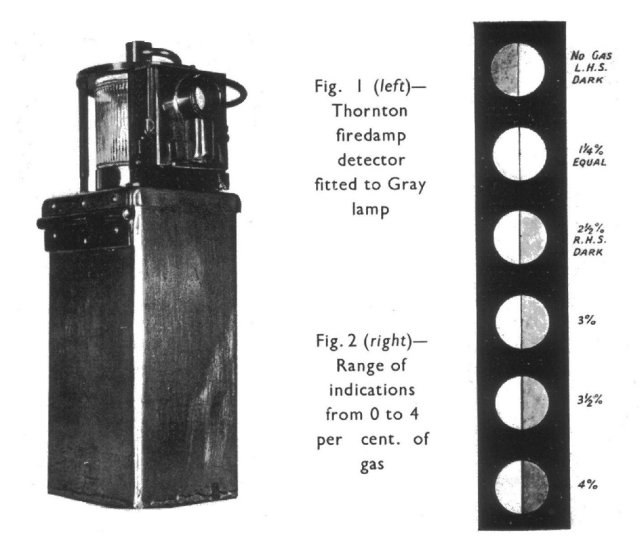
In the form illustrated, which is supplied by W. Gray, 17-19, Archer Street, London, N.W.1, the detector is contained in a metal case which is bolted to the top of the battery box between two lamp pillars.


Article reproduced from a copy of the magazine held at National Mining Museum Scotland, Newtongrange, Midlothian.




 Contains public sector information licensed under the

