


 |

|

|

|
|
 |
 |
|||

June, 1936
A New Washing Plant at Fishburn Colliery
H. Stobart & Co. Ltd., a subsidiary of Pease & Partners Ltd., have erected a new Coppee washery which affords great elasticity of operation
The coals mined at Fishburn Colliery are largely disposed of to special classes of customers whose separate requirements are not only quite different but whose demands, following upon the improvements in the technique of their business, are now more exacting than they were in the past. The "trebles," for example, are used for steam-raising purposes, while the "doubles" and singles are particularly suitable for gas-making on account of their high volatile and low sulphur contents. The washed smalls make a coke of proved suitability for the production of special haematite pig iron on account of the low phosphorus content. These coals have always given very satisfactory results, but it was felt that in order to keep pace with the trend of progress it was necessary to instal a modern washery to turn out cleaner and more accurately sized products, and which, at the same time, would be capable of meeting the demand of any customer needing the immediate delivery of any particular class of coal. Flexibility of operation was thus an important desideratum of this plant. In order to simplify our account as much as possible we propose to discuss this elasticity in the course of our description as otherwise it would make a rather involved story.
The plant has a capacity of 125 tons per hour and was designed for working 16 hours per day. The contract was secured by the Coppee Company (Great Britain) Limited, and in addition to the erection of the washery proper included for certain alterations to the screens, the addition of two dirt-collecting belts through the screen building, and a rotary tippler and skip hoist for dealing with the pit dirt. This latter, as will be explained later, is delivered into a ropeway bunker which also accommodates the dirt pickings from the screen and the refuse from the washery.
The programme which had to be considered in connection with this washery was, in the first place, that it should deal with 1,125 tons of Busty coal and 670 tons of Harvey coal from Fishburn colliery and in the second place that provision should be made for an additional 85 tons per hour washery to be erected to treat separately 675 tons per day of Busty and 675 tons of Harvey coal from Thrislington colliery. All this coal is from 3½ in. to zero; the capacities are based upon a working day of 16 hours. Arrangements also had to be made for certain quantities of dry trebles, rough smalls and dry smalls to be taken out of the existing screens before washing. The plant was arranged therefore to turn out the products listed in Table I.
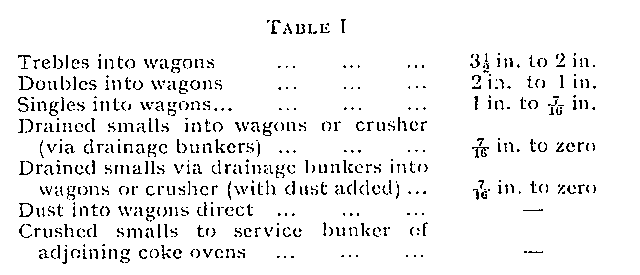
As yet the plant for treating the Thrislington coal has not been erected, but arrangements have been made so that this second unit can be so added to ensure easy supervision, working and maintenance.
To take care of fluctuations in the pit output a raw coal bunker of 200 tons capacity is provided, and ultimately, when the need arises, this can be extended to have a total capacity of 600 tons. Each bunker is of 100 tons capacity, and as the coal is fairly friable the bottoms are inclined at 45° to prevent breakage. This bunker is fed by a troughed belt conveyor from the screens, distribution to the bunkers being effected by a scraper conveyor which traverses the bunker tops. Alternatively, the coal on this belt can be by-passed to a secondary screen capable of receiving any size down to 7/16 in., the small coal being returned to the troughed belt again. Or yet again, the raw coal instead of going to the bunkers can be delivered to the main washery elevator.
Each bunker is provided with a shaking feeder which discharges the coal to a troughed belt conveyor; this, in turn, feeds the main raw coal elevator. This elevator, it should be mentioned, dips into a ground bunker and is available to handle any foreign coal brought to the colliery.
The main elevator delivers the coal to the dedusting plant. This operates on a practically closed circuit, the coal being first delivered to a slotted screen, through which some of the small passes, and then over two sets of louvres, during which it is traversed by the air current. The air enters the extractor at the lower end, and after passing through the coal stream is discharged into a cyclone, the dedusted air being then returned to the fan.
The dedusted coal is then passed direct into the washbox. This is the usual type of Baum box, but is of welded steel construction and is fitted with Coppee type air valves, also automatic shale-extraction valves are fitted. By means of these valves the height of the shale bed is kept constant, any variation in the depth of the bed being communicated by a float to a controlling dial. This apparatus is supplied with air, from the washery blower, at a pressure of 2½ lb. per sq. in. and normally operates by means of a leak-off. If the height of the shale bed rises the float shuts off the air leak, and the pressure, which then builds up against a diaphragm, operates a clutch, thus causing the valve to rotate and the shale to be evacuated. Should the level of the shale bed tend to fall this procedure is reversed; that is, the float subsides, the rate of air leakage is intensified, and the shale valve is stopped until the height of the bed is at its predetermined level again. By maintaining a constant depth of bed in this way the washer is always operating at optimum efficiency, and the products are much more uniform than under the old system, in which heavy fluctuations inevitably occurred in the depth of bed.
The washed coal is now passed to the first sizing screens, the trebles, doubles and singles being separated out and loaded by boom conveyers into wagons on separate roads. All the small (below 7/16 in.) is taken to the vibrating dewatering screens. All of these above-mentioned sizes can be intermixed in any proportion on a recomposition conveyor, which takes the mixed coal and loads it on to a separate siding.
From the dewatering screens the small coal is taken by a belt elevator to six concrete drainage bunkers having a total capacity of 800 tons, distribution to the various compartments being effected by a scraper conveyor traversing the top. The drained coal is fed by revolving tables to a reversing trough belt which delivers it to a British Jeffrey-Diamond hammer mill of 70 tons per hour capacity. After crushing, the coal is conveyed to the overhead bunker serving a battery of 50 Simplex coke ovens.
Instead of passing through this crusher, however, the coal can be loaded by a vibrating chute and belt conveyor on to a separate small coal road.
All the dirty water falls to the pump basin where it is pumped to the slurry tower, the clarified water being, of course, drawn off for re-circulation. The slurry is taken to two dewatering sieves and then mixed with the dry dust from the dedusting plant. This material is delivered to the reversing belt to be crushed with the small coal.
Before dealing with the dirt it is perhaps opportune to give a word or two of explanation as to the method of dealing with the foreign coal. As already mentioned, this is delivered to a ground bunker, from which it can be removed by the main raw-coal elevator and delivered either direct to the washery or to the 200-ton raw coal bunker. Should the foreign coal already be washed when it arrives it is taken to the reversing belt, delivered to the boot of the small elevator and passed to the drainage bunkers. Alternatively, the foreign washed coal can be passed direct to the crusher and subsequently loaded in the same manner as the other crushed coal.
All the dirt from both the screens and the washery, together with the stone brought up from the pit, is conveyed on an elevated dirt bunker of 150 tons capacity. The hand pickings from the screens are delivered by two belts to the same belt conveyor which handles the washery refuse. This belt delivers direct to the overhead refuse bunker, which is constructed of reinforced concrete and stands 55 ft. above ground level. To raise the pit dirt to this level a skip hoist has been installed, the 35-cwt. capacity skip being loaded direct from the pit tubs by means of a rotary tippler. The skip is raised by means of a drum winch driven through suitable reduction gearing by a 15-h.p. motor. From the bunker the dirt is removed to the refuse tip by a ropeway erected by R. White & Sons.
All the motors employed on the plant are of Crompton Parkinson manufacture and operate on a 440 volt, 50 cycle supply. Ellison switchgear is provided, and Marsh Bros., of Sheffield, were responsible for the electrical installation.
In order to keep the various seams separate when the second washing unit is erected, it is proposed to adopt the following programme: With the present washery, of course, the 1,125 tons of Fishburn Busty and the 675 tons of Fishburn Harvey are mixed and washed together continuously throughout the 16 hours. With the Thrislington coal, however, the Busty and Harvey seams will he kept separate and treated exclusively in the second unit. In order to do this, 337 tons of the Harvey coal will be delivered to the raw coal bunkers (now of 600 tons capacity) in the afternoon, and will be dealt with at the rate of 42 tons per hour in the morning of the next day. As this coal is being discharged from the bunkers, further Thrislington Harvey coal, at the rate of 42 tons per hour, will be delivered to the bunkers from the screens. Consequently this coal can be drawn off at the rate of 82 tons per hour; so that in eight hours 672 tons will be treated. The Busty coal will be treated in the same way and at the same rate of feed during the afternoon shift, 672 tons being similarly treated in eight hours.
Drawings and Photographs accompanying the article


Article reproduced from a copy of the magazine held at National Mining Museum Scotland, Newtongrange, Midlothian.




 Contains public sector information licensed under the

