


 |

|

|

|
|
 |
 |
|||

April, 1935
Ringrose Firedamp Alarm
Firedamp detection by means of flame safety lamps has the defect that the tests are necessarily intermittent, and no guarantee is afforded that gas in sufficient quantity to form an explosive mixture will not appear soon after an inspection has been made. Such considerations have led the Secretary for Mines to make a fresh attempt to deal with this danger, and draft regulations have now been issued making it compulsory for a sufficient number of approved gas detecting appliances to be provided in each ventilating district where safety lamps are normally required to be used.
The Ringrose automatic firedamp alarm has already received the approval of the Mines Department for this purpose and has the further distinction of having been officially approved by the Belgian, French and German authorities. This device has recently been greatly improved and in its latest form is at once a reliable, accurate and mistake-proof detector; moreover, it is entirely automatic in action and functions without any reference to the human element. Some eighteen months ago a series of tests with the Ringrose detector was made in certain collieries in the Yorkshire, South Wales and Lancashire coalfields and it was to meet the criticisms of the bodies conducting these tests that the recent improvements have been made. An analysis of reports on the tests, which extended over 14,000 shifts, revealed that in no instance had an alarm failed to detect the presence of gas at the prescribed percentage (2½ to 3½ per cent.), nor did any of the alarms act when no gas was present. It was suggested, however, that it would be an advantage if the apparatus could be made to give a permanent signal if any defect should arise when it was in use underground. As will be seen later, this point has been fully met in the latest pattern of the apparatus.
The principle of the Ringrose apparatus depends upon the burning of the inflammable gas, by contact with a heated filament, within a porous container. Combustion takes place in accordance with the equation -

Condensation of the water vapour causes a contraction in volume, which causes a partial vacuum to be formed within the porous container. This vacuum tends to be destroyed, of course, by infiltration due to the higher pressure outside the pot, but as the burning is continuous, the partial vacuum is maintained to an exact degree corresponding with the percentage of gas surrounding the apparatus. Referring to Fig. 2, this decrease in pressure is communicated, by means of a capillary tube, to the interior of the diaphragm d to which is attached an adjustable contact k. A similar action takes place if the filament should fuse, due to the cooling of the gases. The filament inside the porous pot p is heated by a 2 volt battery, absorbing current at the rate of 1 amp. In parallel with this circuit is one in which a white-light lamp w, rated at 0.3 amp., 4 volts, is mounted in series with a 2-volt red lamp r rated at 0.7 amp. When current passes the white lamp thus becomes incandescent while the red lamp is not illuminated. Any fault in the bulbs or connections is thus at once apparent by the extinction of the white light. When the contacts k are closed by the burning of the gas or the fusing of the filament, the white light is short circuited and the red bulb r is illuminated by the 2-volt circuit.
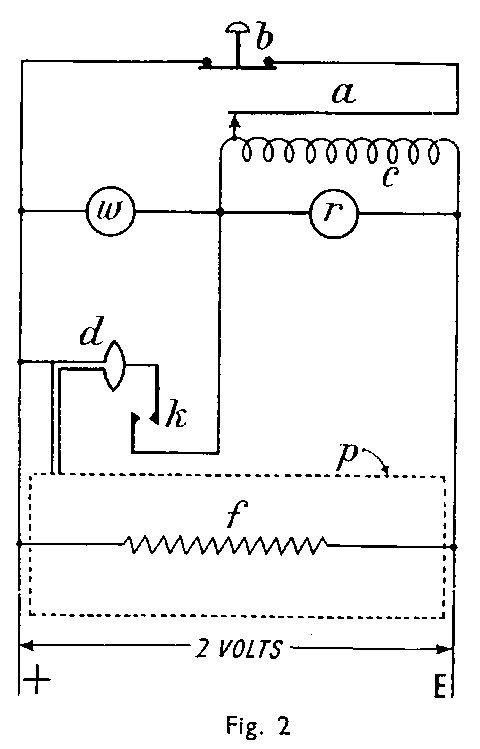
These are the essentials of the gas detecting part of the apparatus. It has, however, been found desirable to maintain the red lamp permanently lit, once it has operated, in order to obtain safer working. This is accomplished by shunting the red lamp with a relay coil c. When the red lamp is lit by the closing of the contacts k the relay coil is energised and the armature a is attracted, the 2 volt current to the coil being supplied quite independently of the contact at k. A press button at b is provided to break the circuit to the relay coil, and if the contacts k are not closed by gas the operation of this button de-energises the armature coil, thus putting out the red light and causing the white lamp to glow. Should the contacts k be closed by gas, however, pressure on the button b will have no effect. Not only, therefore, does the apparatus indicate the presence of gas but it also shows whether gas has been present and has subsequently dispersed.
The chief characteristics claimed for the Ringrose apparatus in its latest form may, therefore, be summarised as follows — It operates automatically and continuously and no work need be stopped to make tests for gas. If any defect develops in the apparatus a permanent and arresting signal is given. No manipulative skill is necessary and it operates quite independently of the human element. It can be set to give certain indications of gas when present to the tune of only 1¼ per cent. There is a deliberate time lag of 40 seconds before the red light glows when gas is present at the predetermined setting. but the interval shortens automatically as the percentage of gas is higher, and with 15 to 20 per cent, of gas the filament fuses. Once the predetermined percentage of gas has been reached, of course, the red light remains "on," whether the filament subsequently fuses or not.
All the necessary adjustments can be made by an intelligent lampman, and a testing stand is supplied which enables him to set the apparatus to operate at any pre-determined percentage of gas. The price of the alarm is Ј5 5s., inclusive of the battery, and it is stated that with reasonable care the life should be at least ten years. The weight is 7 lb. 6 oz.
We understand that the Staveley Coal & Iron Co. Ltd. and the Doncaster Collieries Association, who, between them, are operating some 400 of the detectors, have professed themselves very satisfied with the results obtained and consider that the Ringrose apparatus is capable of making a definite contribution towards safer working conditions. The apparatus has been used for many years by sewage boards and municipal councils throughout the country to safeguard workmen against dangerous accumulations of gas, and the Admiralty has adopted the Ringrose system for the detection of gas on submarines. The object of the recent improvements has been to make it pre-eminently suitable for use in collieries.
Drawings and Photographs accompanying the article


Article reproduced from a copy of the magazine held at National Mining Museum Scotland, Newtongrange, Midlothian.




 Contains public sector information licensed under the

