


 |

|

|

|
|
 |
 |
|||
July, 1935
Miners' Protective Hats
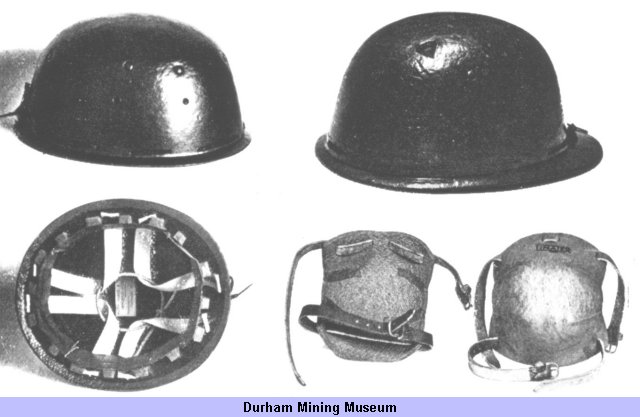
Although there is no doubt of the value of protective headgear in reducing the incidence of head injuries, there is a certain reluctance to their use owing to their alleged discomfort. The "Thetford" protective hat, made in Thetford and supplied by Hugh Wood & Co. Ltd., has been specially devised to combine adequate protection with comfort to the wearer. The body of the hat is made of compressed, moulded and impregnated wood pulp; it is water and damp-proof and is much lighter than either metal or leather. Sponge-rubber pads between the head band and the hat body afford a firm but comfortable grip, and leave ample ventilation space between the band and hat body. Ventilation is further assisted by holes in the sides of the hat. A strong cradle of webbing, adjustable by a cord, fits snugly over the head, and distributes the force of any blow.
The hat is tested by placing it on a wood block, similar to a miner’s head, and dropping an 8-lb. iron ball from a height of 5 ft. on to the crown, which must not dent or break sufficiently to touch the wood block. The hat illustrated (top right) was being worn by a miner when a stone fell on it; the photograph shows clearly what would have happened to the miner’s head if he bad not been wearing the hat.
The "Thetford" hat is available with or without a peak, and with a bracket for a cap lamp.
Another useful item of protective equipment is a set of knee pads (lower right illustration). These are sold under the name of "Linatex" knee pads, and consist of a resilient form of rubber claimed to be highly resistant to abrasion, corrosion, hardening and embrittlement. They are fixed by chrome leather straps, and are stated to be both serviceable and exceedingly comfortable to wear.


Article reproduced from a copy of the magazine held at National Mining Museum Scotland, Newtongrange, Midlothian.




 Contains public sector information licensed under the

