


 |

|

|

|
|
 |
 |
|||
| Colliery Engineering | December, 1934 |
The Wolf Safety Lamp Co. (Wm. Maurice) Ltd.
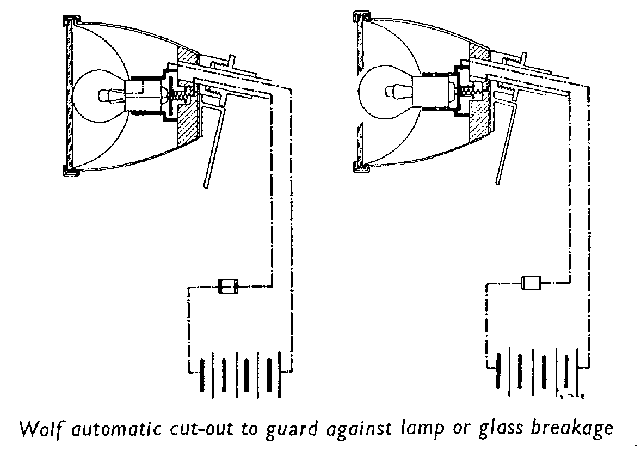
ALKALINE HAND LAMPS Nos. 950/E AND 950/00. — By virtue of their pioneering work with the alkaline lamp — their first model was introduced as early as 1913 — this firm have not found it necessary to develop new types to meet the more stringent conditions. Two hand lamps are on the Schedule A list, and it is significant perhaps that the first of these, the 4 c.p. 950/00 lamp, has been in regular use since 1926. The No. 950/E lamp is constructed to the same design but is slighter larger, yielding 6 candle-power; it was introduced in 1931, and is claimed to have a higher illuminating value than any other miners' handlamp known. Both lamps are of the two-part construction originated by the Wolf concern. The positives of these lamps are unique in that the active material is pasted on finely perforated pure nickel foil, which is afterwards folded, pressed into cakes and mounted in pure nickel frames, it being claimed that this construction affords the accumulator a lower rate of depreciation than any other. The plates are supported by nuts and bolts to an ebonite coverplate and are separately detachable. To avoid leakage the contacts, which are of nickel steel, are moulded into the coverplate. The terminals, which are fitted with double springs, afford mechanical and electrical continuity from end to end. The bulbs used are of the gas-filled vertical type, and were another innovation of this firm. As made for the Wolf lamps they have both the conducting wires completely insulated so that in the event of the bulb becoming loose in the cap socket no short circuit can occur. Although it is not yet a requirement of the Regulations to have any safety devices in the lamp top, Wolf lamps have been fitted with a cartridge fuse for some time. Since ten years ago they have also been made with automatic cut outs which short circuit the battery even if the cover glass is hit and not necessarily broken. A prismatic, frosted, spherical wellglass is fitted, and this again, it is claimed, was first developed by the Wolf Company and has been used with their lamps since 1928.
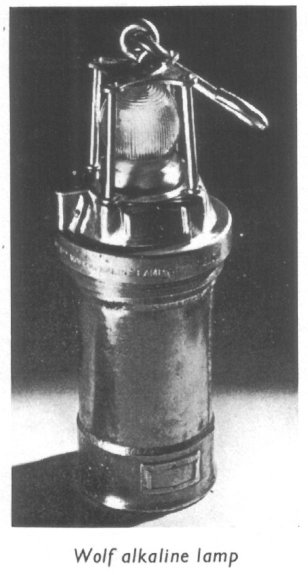
The case is of cold rolled steel, and is homogeneously cadmium plated as a protection against rust. This is provided with a pressed steel false bottom and a steel partition, both of which are welded in position. The cut-away lamp top in substitution for the older round stamping and later square stamping is a Wolf improvement for better distribution of light which dates from about 1926, and the use of inclined instead of parallel pillars, to give greater rigidity, also dates from this time.
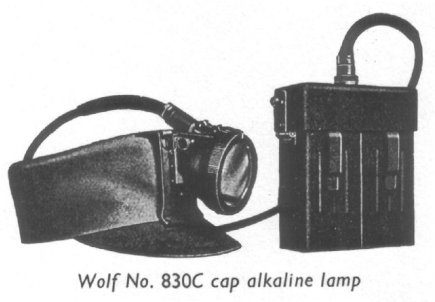
CAP LAMP No. 830C. — This lamp is stated to have been the first of its kind to be made on the two-part principle. The rather weighty practical problem of sealing the top, which is necessarily rectangular in shape, has been successfully met by an ingenious application of the compound lever. The cover plate, which carries knife contacts instead of the usual point contacts, can be put on or taken off by turning a single screw. A cartridge fuse is incorporated in the battery case to take care of cable-shorting risks, and in the headpiece is fitted an automatic short circuiting device, which blows the fuse if the cover glass should be broken. A double lock is provided for the case and can be used either with a lead rivet or a magnet or, if desired, with both. Originally, this lamp was made with a bakelite headpiece, two-way switch and a twin-filament bulb, but in the light of experience it has been deemed that the advantages gained with this equipment were illusory; consequently a metal headpiece, fitted with a single-filament bulb, has now been developed.
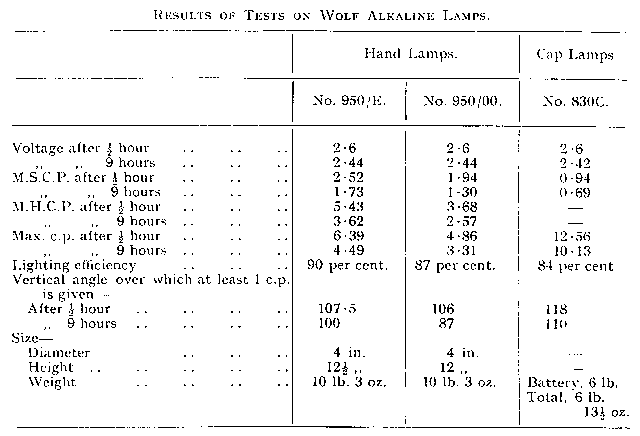
All the lamps are equipped with nonleaking bicycle-tube gas vents and electrolyte level testing devices, and are constructed to be served with automatic filling apparatus which greatly simplifies lamp room labour. The accompanying table gives the results of independent tests on these three lamps.
Drawings and Photographs accompanying the article


Article reproduced from a copy of the magazine held at National Mining Museum Scotland, Newtongrange, Midlothian.




 Contains public sector information licensed under the

