


 |

|

|

|
|
 |
 |
|||
| Colliery Engineering | December, 1934 |
Protector Lamp and Lighting Co. Ltd.
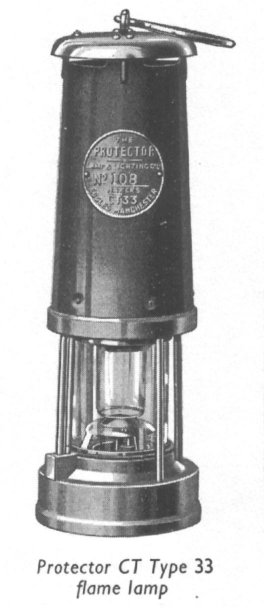
PROTECTOR CT TYPE 33. — The new "Protector" combustion-tube flame lamp illustrated herewith is of a two-piece design that necessitates only one screwing for dismantling and assembling. Time is consequently saved in cleaning, and as the gauzes have to be removed before the glass can be cleaned, it is impossible for the inspection to be skimped. The lamp burns mineral colza, and all the parts are made to accurate sizes to ensure interchangeability. It is claimed that this lamp provides an angle of light of at least 90°, thus affording a minimum of ground shadow. Tilting, it is stated, does not cause the glass to be fouled. The combustion-tube holder is a patented feature as, also, are the fine adjustment wick regulator, the diffusing and reflecting ignition plate and the lock-which can be supplied on either the magnetic principle or the lead rivet type. A further alternative in choice lies in the number of standard pillars supplied, either four or five being provided, according to individual requirements.
The lamp weighs 3¾ lb. and has a height of 12½ in., the candlepower being stated by the makers to be 3-4 with a clear glass, 5-6 with a silvered reflector and 10 with an outside reflector.
BRITISH ALKALINE. — The alkaline lamp manufactured by this firm is a two-piece unit secured by a square threaded screw. Two types of battery are supplied, tubular positive plates being provided in the K4 lamp and flat plates in the K3 lamp. Apart from this difference the two lamps are similar in all respects. A moulded ebonite lid insulates both poles of the battery and carries electrolyte level testers which indicate the correct level by means of a simple electrical device. The terminals are designed for hanging on the racks and are so constructed that they cannot be placed in the charging contacts in the wrong polarity. A feature of the contact block, which is of patented design, is that it is held in suspension by flat springs which do not, however, act as electrical conductors, this construction permits the use of rigid battery terminals which ensure a perfect contact without any possibility of flickering. When the lamp is locked two separate and distinct contacts are obtainable by rotating the lantern. The bulb-holder keeps the bulb in complete suspension by means of opposing springs and thus eliminates shock to the filament. A bayonet-joint bulb fitting has been adopted and a prismatic well glass. The contact block-complete with ring and bulbholder-and the well glass are quickly assembled as one unit and the bulb can be charged ill a few seconds. The magnetic lock is totally enclosed on the outside and is only accessible by means of a screwed cap inside the lock ring. Should it be necessary to renew the lock spring, therefore, all that is required is to unscrew this cap, and there is no question of removing and replacing rivets. Gas vents are provided in the lantern, thus eliminating any possibility of any gas under pressure accumulating around the battery terminals. The battery has a capacity of 20 amp-hours and a charging rate of 25 to 3 amps. A 25-volt 1.5-amp.. bulb is provided, and gives (makers' figures) a maximum horizontal candlepower of 3.35 at the commencement of the shift and 255 at the end of 9 hours. The mean spherical candlepower is given as 1.50 at the commencement and 1.15 at the end of 9 hours. The height of the lamp is 11½ in. and the weight, when fully charged, is 9½ lb.
The electromagnet used in conjunction with this lamp is provided with special jaws, which support the entire weight during the unlocking operation; both hands are thus left free. An electrolyte level tester and a very convenient topping up device are also supplied by this firm.
Drawings and Photographs accompanying the article


Article reproduced from a copy of the magazine held at National Mining Museum Scotland, Newtongrange, Midlothian.




 Contains public sector information licensed under the

