


 |

|

|

|
|
 |
 |
|||
| Colliery Engineering | December, 1934 |
Hailwood & Ackroyd Limited
HAILWOOD TYPE. A.D.C.3. — Mr. Hailwood has always been a firm believer in the flame safety lamp; he is also a believer in good light, and the Type A.D.C.3 lamp is the outcome of these beliefs. This lamp has been developed from the Nos. 1 and 2 A.D.C. lamps, which although they gave an efficient light and were light in weight were inconvenient in several respects. For instance they were too tall, too sensitive to high velocities of air- especially when travelling in the shaft- and there was some difficulty in seeing the cap in making tests for gas. Also objection was made to the square air control chamber carried by the No. 1 lamp. All these points have been corrected in the present lamp, which is illustrated herewith. The height has been reduced to 10½ in., the same height as the firm's old 01B. lamp. Also the air chamber is now fitted with a screw-down cut-off plate, which is capable of adjustment within fine limits, and can completely cut off all the bottom air feed when the lamp is travelling in strong air currents. At the coal face, with the air feed opened, it is claimed that the lamp will give a constant illumination, of agreeable tone, throughout the shift, of from 4 to 5 candlepower. The upper air feed has been moved close to the top of the lamp so that when the bottom air-feed regulator is closed it is possible to detect a very thin layer of gas next to the roof. To enable gas caps to be readily detected the dome of the burner has been split in two, and the front half can be lowered, thus fully exposing the wick tube. By operating the thick electric igniting pin the shape of the flame can be regulated at will. Guarded, non-return outlets are provided in the lamp top to prevent reverse air currents from entering, and when the air chamber is closed the lamp gives an excellent light for travelling, even in the high air velocities. It is also claimed that the flame is extraordinarily resistant to being jerked out. The colliers' type lamp weighs 5 lb., but deputies' and officials' lamps can be fitted with aluminium parts.
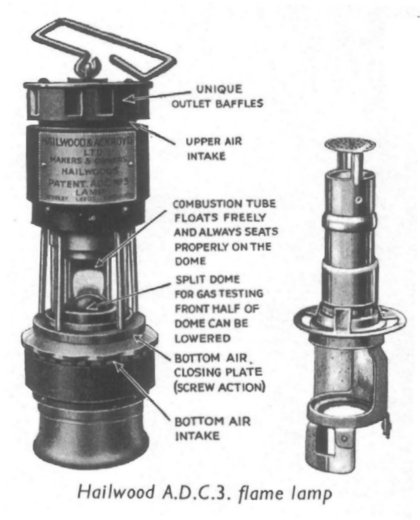
Drawings and Photographs accompanying the article


Article reproduced from a copy of the magazine held at National Mining Museum Scotland, Newtongrange, Midlothian.




 Contains public sector information licensed under the

