


 |

|

|

|
|
 |
 |
|||

September, 1933
New Fan Installation at Seaham Colliery
An interesting fan installation has recently been supplied to Messrs. the Londonderry Collieries Limited to ventilate the working of their pits at Seaham. The fan, which is a "Sirocco" single inlet unit manufactured by Davidson & Co. Ltd., of Belfast, is shown on the left-hand side of the accompanying illustration. The equipment to the right of the picture is also a Sirocco fan, of the double inlet type direct coupled to a Bellis & Morcom steam engine, and supplied by Davidson & Co. Ltd. some twenty years ago.
Early last year, as a result of the general electrification of the colliery, a new mine ventilating plant was decided upon, and, due to the altered conditions underground, the duty required of it was less than that for which the steam driven fan had been designed. In designing this new plant, future requirements were borne in mind, and with a view to increasing the speed, and consequently the output, when necessary, a rope drive was adopted.
The new plant consists of a No. 80-140-in. diameter standard single-inlet "Sirocco" fan housed in a steel casing, provided with a steel evasée chimney and completed with the necessary damper for reversal of the air stream in compliance with the Mines Regulation Act. The fan is rope-driven from a three-phase 50-cycle motor of the General Electric Company’s manufacture, having a continuous rating of 325 B.H.P. To meet present requirements the fan is arranged to run at 158 r.p.m, and at this speed handles a volume of 280,000 cu. ft. per minute against 4.45 in. W.G.
Following completion of erection, exhaustive tests were carried out by the fan makers and the colliery officials to determine the efficiency of the installation. The following is a summary of the results obtained :–
| Fan speed (r.p.m.) | 158 |
| Volume of air exhausted (c.f.m.) | 280,000 * |
| Total pressure in fan drift (in W.G.) | 4.45 |
| Equivalent orifice (sq. ft.) | 53.10 |
| Air horse-power output | 196 |
| Electrical horse-power input (to motor) | 334 |
| Motor efficiency (per cent.) | 90 |
| Motor power factor | 0.85 |
| Rope drive efficiency (per cent.) | 95 |
| Brake horse-power input to fan shaft | 250 |
| Mechanical efficiency of fan (per cent.) | 78.40 |
| Guaranteed efficiency of fan (per cent.) | 75.0 |
|
* This volume represents the average of six four minute readings with the Fan Makers’ and Colliery company’s anemometers, which had been previous recalibrated.
| |
From the foregoing results it will be seen that the guaranteed efficiency was improved upon to the extent of 3.40 per cent., from which it will be observed that with properly designed centrifugal mine fans, mechanical efficiencies of the order of 80.0 per cent. are quite practicable.
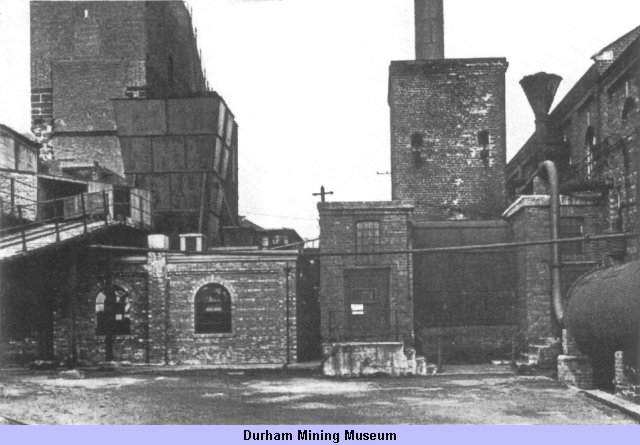
The accompanying illustration reveals the congested nature of the site. In planning the layout of the new plant it was necessary to place the motor house and rope drive underneath the overhead gangway, in order to make as little disturbance as possible to the existing working arrangements.


Article reproduced from a copy of the magazine held at National Mining Museum Scotland, Newtongrange, Midlothian.




 Contains public sector information licensed under the

