


| Cemetery Location |

|
Cemetery Location | ||
 |
 |
|||
Information on:
St. Margaret of Antioch Churchyard, Tanfield
Location: OS Map 88, Grid Ref NZ187554
 streetmap.co.uk to see the location on a map
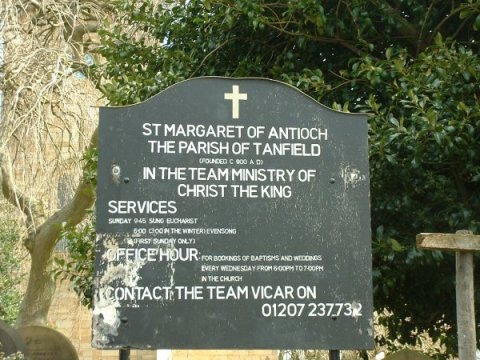
Image Ref: T-02843-05-0064
The Church is a picturesque stone building, dedicated to St. Margaret, and occupies a pleasant situation east of the village. It is of very ancient foundation, being one of the early chapelries of Chester-le-Street. The church was almost entirely rebuilt in 1749, and has since been several time restored and improved, so that of the original chapel there remains only portions of the chancel and the north wall. During the restorations of 1877, an ancient piscina was discovered, and is now built into the north wall of the chancel. The church consists of nave, aisles, chancel, and massive square embattled tower, the latter being added in 1853, by the late John Eden, Esq. The roof is cieled, and the nave divided from the aisles by five pointed bays, of three chamfered orders, which died away into the circulat pillars by which they are supported., there being no capitals. The restoration is 1877 was effected at a cost of £4000, and included the raising of the arcades. The style is chiefly that of the late sixteenth century. There are lancet lights in the chancel, the east window being formed of a group of three filled with stained glass. The stained window, representing St. James and St. Andrew, with a scene in the life of St. John the Baptist, and the calling of the sons of Zebedee, and the one in the soutn wall, are exceptionally fine. The former is a memorial to Robert Clark, Esq., and the latter to John Eden, Esq., of Beamish Hall. The window at the east end of the north wall is to the memory of John and Edward Joicey. The parish register has been lost or destroyed up to 1719. The seating provided for is 800. The living is a vicarage, in the gift of the Bishop of Durham; nett value, £300, and held by the Rev. Thomas Hewan Archdall, M.A. The vicarage adjoins the church on the north. There is a burial-ground to the church.
 |
 |
| Sources | |
|
|
- Church/Cemetery photograph (T-02843-05-0064) © Bob Dunn
- History, Topography, and Directory of the County Palatine of Durham by Francis Whellan. Second edition published in 1894.
- Ordnance Survey Maps



 Contains public sector information licensed under the

