


| Cemetery Location |

|
Cemetery Location | ||
 |
 |
|||
Information on:
Silksworth - St. Matthew's Churchyard, Sunderland
Location: OS Map 88, Grid Ref NZ380531
 streetmap.co.uk to see the location on a map
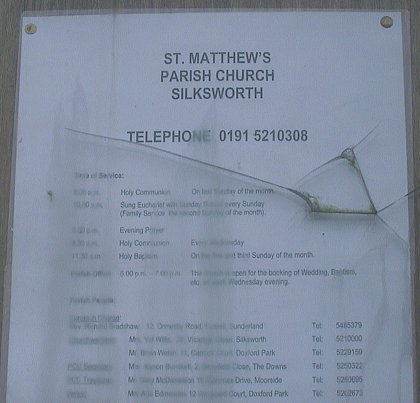
Image Ref: T-00618-01-0002
The Church is situated on the road between the two villages, within a spacious burial-ground, and was erected in 1870. It is a handsome stone structure in the Early English style, dedicated to St. Matthew, and consists of nave, chancel, and aisles, with vestry and organ chamber on the north side of the chancel. The interior is well designed and of pleasing aspect. The nave arcades, of four arches of simple agee mould, are well proportioned, and rest upon plain cylindrical pillar with shallow circular moulded caps. The chancel arch springs from plain shafted corbels, and is of two moulded orders. The east window, of Decorated style, is filled with richly coloured stained glass, representing the Crucifixion, the Resurrection, and the Ascension, in memory of the late W. R. Robinson, Esq., by his tenants and friends. The windows of the aisles and clerestory are trefoil-headed, those in former being triple and the latter double lights. The church will seat 470, and cost originally £2000. But was enlarged by the addition of aisles in 1879, at a further cost of £1200. The living is a vicarage in the gift of the Bishop of Durham, and valued at £320, held by the Rev. Arthur T. Dingle, M.A. The vicarage, a good residence, is well situated close to the church.
 |
 |
| Sources | |
|
|
- Church/Cemetery photograph (T-00618-01-0002) © Kev Duncan
- History, Topography, and Directory of the County Palatine of Durham by Francis Whellan. Second edition published in 1894.
- Ordnance Survey Maps



 Contains public sector information licensed under the

