


|

|

|

|
|
 |
 |
|||
St. Helen's Auckland Colliery
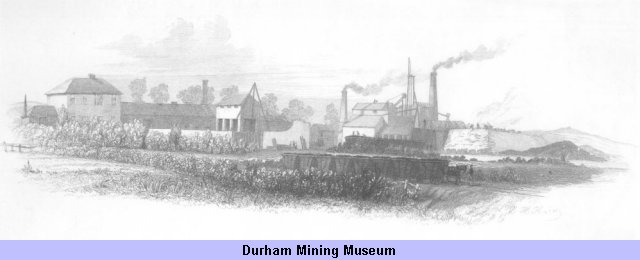
St. Helen's Colliery
 We now proceed to notice some of the collieries which export their coals from the Tees, and which occupy a long-neglected district of the Durham coal-field.01
The colliery of St. Helen's Auckland is one of those which would never have been called into existence, but for the formation of the Darlington and Stockton Railway. It is said that when the estate passed from the Milbanke family to the Musgraves, the coal was not valued. It is now the property of Sir George Musgrave, Bart., and a portion of the royalty belongs to Sir T. J. Clavering, Bart., and the Rev. Matthew Chester. The sinking was commenced by Joseph Pease, Esq., (late M. P. for South Durham), and Partners, in February, 1830; and after passing through eleven small seams, one 3 feet 9 inches thick was come to in January, 1831. The Main Coal seam, from 5 feet 6 inches to 6 feet thick, was sunk down to in March, 1833.02 The engine pit is 80 fathoms deep; and the engine is of 100 horse power. The drawing engine is a high pressure of 50 horse power. The distance of this colliery from the shipping place on the Tees is 26¼ miles; and to facilitate the transmission, 533 coal waggons are used. The coals were formerly mostly shipped for London and coastwise; but latterly a considerable quantity have been sent foreign. A large depot trade is also carried on, by which the coals are sent as far south as York; and the coke manufactured here is used by most of the railways for 60 miles south.03
01 Vavasour's mine on Cockfield Fell, mentioned in 1375, is the first inland colliery on record; and since that time coals have been constantly wrought to a limited extent in that district. "On Cockfield Fell," says Hutchinson, in his History of Durham, "are many lines and entrenchments, a plan of which, communicated by Mr. Bailey, was published in the Antiquarian Repertory." It is, however, probable, that these mounds are nothing more than the refuse of old coal workings. Hutchinson himself says, "The upper seams of coal, under the common, or fell, as it is called, are said to be exhausted; but there is adjacent ground yet to work under." He adds, "The expense of an engine to drain the great seam would exceed the profits of a confined inland sale." Since that time, however, the improvements in machinery, and the ease with which the coals, when worked, are transported 20 or 30 miles to the sea (a distance which was formerly an insurmountable barrier to their exportation), are circumstances the operation of which are now rendering the whole of the mineral treasures of this district available. We have been favoured with the following interesting account of the Auckland Coal District by Joseph Lawson, Esq., of St. Helen's Auckland
"This district may be said to commence at Coundon, a little east of Bishop Auckland, and extends westward to Butterknowle Colliery, a distance of 10 miles: it is in average breadth about 7 miles, and will contain not less than 70 square miles of surface, under which, in most of the collieries, it has been ascertained there are two, and under some of them three and even four, workable seams, var in in thickness from 3 feet 6 inches to 6 feet, and equal in quality to any coal wrought in Great Britain. The present working seams lie quite at a moderate depth from the surface; that at Saint Helen's Auckland being not more than 80 fathoms, and the shallowest at Butterknowle at a depth of from 10 to 15 fathoms. Within the last 20 years, considerably under one hundred coal-workmen were all that were engaged in the district getting coals; and the whole of the produce of this important coal-field was carried away, and a portion of it to very distant markets too, either in carts or on the backs of mules or asses. Large numbers of them, taking the bye-roads in order to secure a little of the scanty herbage, and avoid the payment of gates, were, in those days, to be met, carrying two or three bags of coals each. They frequently found their way to a distance of 50 miles from the pits, where, from the excellent quality of the coal, a ready market was secured. Various plans were proposed in order more fully to open out the coal-field, amongst which were sundry lines of railway, and, at one time, by means of water conveyance. Want of means and die strong opposition of the proprietors of the soil, &c., however, prevented those proposed schemes from being carried into effect, and the district continued locked up until the Stockton and Darlington Railway Company was formed, consisting of a body of individuals who, with a determination and perseverance almost unconquerable, possessed the requisite funds for carrying into effect this stupendous undertaking. After a determined opposition from land-owners, coal-owners of different districts, and others, actuated by little else than sheer prejudice, they succeeded in obtaining an act of parliament for making a line of railway from Stockton by Darlington to Witton Park Colliery (a distance of 25 miles), with sundry branches to other collieries; and after surmounting difficulties of a peculiar nature, it was opened in September, 1825. The opening of this railway effected quite a revolution in the value of property, and in every branch of trade in the district. In many cases land through or near which the railway passed was doubled in value; but in nothing did such a change take place as in the value of coal and the coal-trade. Extensive estates, under which beds of coal of great thickness were known to exist, but which, on account of the distance of the district in which it lay from any market of consequence, had been rendered almost valueless, had passed from one proprietor to another, by sale or otherwise, without any value whatever being affixed on account of its existence; but they now at once became of great importance. Collieries since then have been opened out on a much more extensive scale and improved style than formerly, and are now daily raising and vending very large quantities. And as the coal drawn from these mines is of different qualities and suitable for any purpose, it is now shipped from the Tees for all the coasting and several foreign markets. The export of coals from the Tees, which commenced in 1825, for the first full year amounted only to 18,589 tons; but it had increased in the year 1841 to 498,092 tons from the staiths belonging to the Stockton and Darlington Railway Company; besides 163,955 tons from Port-Clarence, the shipping place for the Clarence Railway. Large quantities of coals are likewise sold at the various depots at Darlington, Yarm, Stockton, and Middlesbro, by landsale; and by the opening of the Great North of England Railway from Darlington to the city of York, in January, 1841, this portion of the trade of the district has increased considerably. Coals are now selling at Northallerton and Thirsk full 75 per cent, below what they were formerly sold at; and in the city of York, the price of excellent coals from this coal-field, after having been carried from 55 to 60 miles, is now 10s. per ton. Coke of quality suitable for founders, maltsters, or for locomotive engineering purposes, is manufactured at various collieries in large quantities, and not only used in the neighbourhood, but likewise on the southern railways very extensively.
"Besides the Stockton and Darlington Railway, the coals going down which are now shipped at the new dock at Middlesbro-on-Tees, the Clarence Railway has a branch to Sim Pasture, which takes off a portion of these coals to Port-Clarence; and from the Clarence there is a branch to Hartlepool, where likewise a small portion of the coals sent from the neighbourhood of Auckland are shipped. A few new collieries also send their coals down the West Durham Railway to the same shipping places, at which every convenience for the purpose of shipping the coals expeditiously have been provided.
'The Auckland and Weardale Railway, which leaves the Stockton and Darlington near to Shildon, is now in progress, and has for its object, besides the opening out of several new collieries situated on the banks of the river Wear, the causing of a direct communication from the coal-pits to the shipping p laces without the intervention of other power than horses or locomotive engines and by which the great delay, besides the injuries to the waggons and coals, caused by the stationary engines on the inclined planes, will be avoided. In an admirable account of the opening of a tunnel forming a part of this line, which was published in the Durham Chronicle of January 14, 1842, it is stated, 'That this is the only tunnel, properly so called, in the county of Durham. It is 1300 yards long, or nearly three-quarters of a mile. Its height is 23 feet 4 inches, and its breadth 21 feet at the point where the arch springs. The greatest depth from the surface is about 20 fathoms. The tunnel is constructed for two lines of railway, and during its formation has been worked by seven shafts from the surface. It passes principally through the coal stratification of the neighbourhood, penetrating the main-coal seam, which has been already worked, and passing also through two unexplored seams which lie beneath the main-coal, but all of which ascend to day in the immediate vicinity. A considerable quantity of white post stone was obtained in three of the shafts, and in the southern open excavation to the tunnel, which was rendered available for the construction of the works. The sides of the tunnel are formed of stone, and the beautiful span of the arch entirely of bricks, upwards of seven millions having been employed in the work. The operations of sinking, &c., were commenced on the 22nd April, 1839; 21 months only have been occupied in the construction of the tunnel itself, which forms a junction between the Stockton and Darlington Railway and the Bishop Auckland and Weardale Railway, now in progress up the Wear valley to Crook.' In another portion of the report, it is stated, that this tunnel was completed at an expense of £100,000. Thomas Storey, Esq., of St. Helen's Auckland, was the engineer of this great undertaking." [Return]
02 A specimen of "rolled stone," similar to those found in a portion of Cockfield Fell Colliery, about 2 miles to the south-east, was found here a few years ago. Mr. Witham exhibited some specimens of these stones and a fragment of quartz at the meeting of the British Association at Newcastle-upon-Tyne in 1838. He stated that the portion of Cockfield Fell Colliery in which they are found is comprised in about 3 acres on the north side of the trap dyke, which does not seem to have influenced the position of the stones, as these are found in many instances 400 yards from it, and occasionally at greater distances. Similar specimens have been also met with on the south of the dyke as far as the outcrop of the coal. In the coal, which is altered by the dyke for about 25 yards on each side, only one solitary specimen has been found, though they are abundant in the solid coal adjacent. — Notices of the Proceedings of the British Association, 1838, p. 79. [Return]
03 The following casualties have occured here :— On May 26, 1830, just after the sinking of the colliery had commenced, the man at the jack-roll, whilst winding up what he expected to be merely the rope itself, brought up on the point of the hook a wooden tub called a kibble, which, on striking against a projecting part of the top of the shaft called the little boards, fell off the hook point upon the head of a man named William Hodgson, and killed him on the spot.
On November 14, 1832, Jonathan Dixon was killed, by falling down the shaft. It was given in evidence before the coroner, that the rope he was on had got to the bottom, and that he had come so far back again, and then dropped off. The supposition was, that in going down the pit he had fallen asleep, and gone to the bottom clinging to the rope in that state; and that, when coming up, in the act of awakening he had fallen off.
On February 22, 1837, John Snowdon had, with several other putters, left their work before it was finished. The overman, in order to induce them to re-commence, gave orders to the banksmen that they were to be sent back again. Whilst going down, Snowdon sprang from the descending rope, and caught hold of the ascending one; but having his foot fast in the chain attached to the one descending, he was dragged down with its weight, fell to the bottom, and was dashed to pieces.
Explosions have been of rare occurrence in this district; some, however, on a small scale, have occasionally taken place. At this colliery, on the 11th July, 1839, whilst in the act of removing a portion of pillars, a fall of the roof took place, when a man named James Lister approached the fall with a naked candle, and caused an explosion by which 7 men and boys were severely burnt, of whom 4 died in a few days. [Return]





 Contains public sector information licensed under the

