


|

|

|

|
|
 |
 |
|||
Broomside Colliery
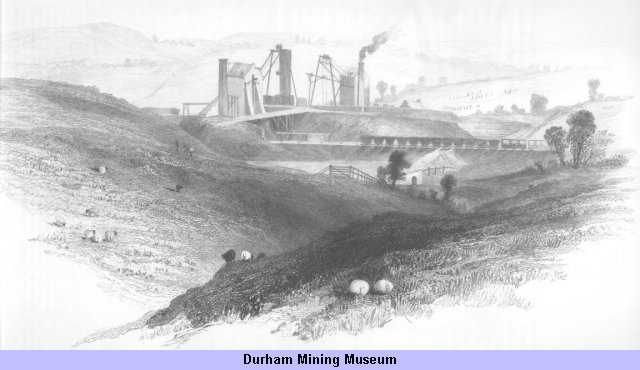
Broomside Colliery
 Broomside Colliery, situated near to the Durham and Sunderland Railway,01 about 2 miles west-south-west from the Letch Pit, is also the property of the Marquis of Londonderry. It was sunk about 10 years ago, and is 51 fathoms deep to the Hutton seam, which averages about 4 feet in thickness. A "trouble" has recently been met with in the workings, which throws the coal down about 13 fathoms; and a stone drift, 360 yards in length, is now being constructed to reach the seam. The principal engine, used both in pumping the water and drawing coal, is about 30 horse power, and there is another drawing engine of about 18 horse power. The shipping place is Seaham Harbour, distant about 10 miles.
01 The importance and utility of a railway between Durham and Sunderland having been suggested, successive meetings were held at the latter place in furtherance of that object; and the sum of £81,600 (four-fifths of the estimated expense, £102,000) being subscribed with unprecedented facility, in shares of £50 each, an act was passed, and received the royal assent, August 13, 1834, entitled, "An Act for incorporating certain Persons for the Carriage of Goods and Commodities, by means of a Railway, from the City of Durham to Sunderland near the Sea, with a Branch to join the Hartlepool Railway, in the Township of Haswell, all in the County of Durham." By this act, the subscribers are incorporated into a company, under the name of "The Durham and Sunderland Railway Company," with power to make and use a railway, with staiths, wharfs, and shipping places, in the following townships:— "Gilligate otherwise St. Giles, Sherburn, Pittington otherwise Pittington Hallgarth, Moorsley, Moorhouse, West Rainton, East Rainton, Hetton-le-Hole, Little Eppleton, Great Eppleton, M urton otherwise Murton in the Whins otherwise East Murton, Haswell, Dalton-le-Dale, Seaham, Seaton otherwise Seaton cum Slingley, Houghton-le-Spring, Wardenlaw, Burdon, Silksworth, Tunstall, Ryhope, Bishop Wearmouth, and Sunderland near the Sea." The act provides that fifteen directors and three auditors shall be elected by the proprietors to manage the business of the company; and that if locomotive engines are used on the railway, turnpike roads shall be crossed by bridges or tunnels of specified dimensions. The whole of the transit, however, is effected by means of stationary engines, inclined planes, &c. The striking effect produced by this and other railways in this neighbourhood is thus described by Mr. Hewitt :— "It is a mining country, and its great objects of notice on all sides, are the tall engine-houses of its collieries, and its trains of coal-waggons, or corves, as they call them [a mistake, the corves being the baskets by which the coals are still, in some places, drawn up the shaft], running up hills and down dales, as if of their own accord. The sights and sounds were altogether such as must strike people from the south, that is, those who have not been accustomed to a coal country, as very strange . . . . Here and there, you saw careering over the plain, long trains of coal-waggons, without horses, or attendants, or any apparent cause of motion, but their own mad agency. They seemed, indeed, rather driven or dragged by unseen demons, for they were accompanied by the most comical whistlings and warblings, screamings and chucklings, imaginable. When you came up to one of those mad dragon trains, it was then only that you became aware of the mystery of their motion. They ran along railways, and were impelled by stationary engines at a distance, which stood often in valleys quite out of sight. A huge rope running over pulleys raised a little above the ground in the middle of the railway; and these pulleys or rollers, all in busy motion on their axles, made the odd whistlings and warblings that were heard around. In truth, the sight of these rollers twirling, and the great rope running without visible cause, was queer enough. Amid all these uncouth sounds and sights, the voice of the cuckoo and the corncrake came at intervals to assure me that I was still on the actual earth, and in the heart of spring, and not conjured into some land of insane wheels and machinery possessed by riotous spirits." [Return]





 Contains public sector information licensed under the

