


|

|

|

|
|
 |
 |
|||
Collingwood or Burdon Main Colliery
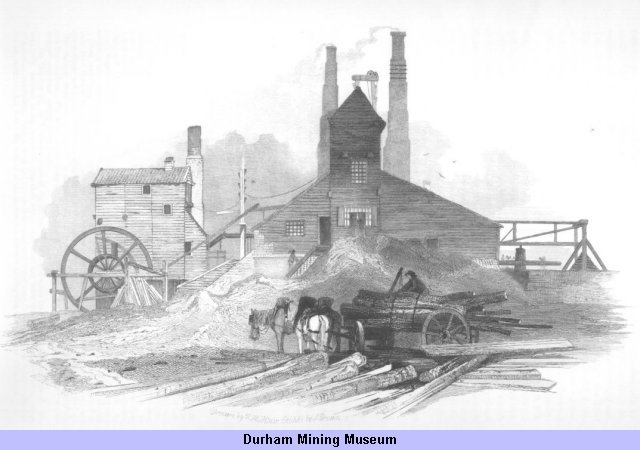
Old Pit, Burdon Main Colliery
 This colliery is the easternmost on the north bank of the Tyne, and is situated in the township of Chirton,01 which forms the western suburb to the town of North Shields. It was commenced in 1811, by Messrs. Bells, Robson, and Co.; and the extent of its influence, connected with that of the neighbouring colliery of Messrs. Lamb and Co., may be estimated by comparing the following statements of the population of the township, at the respective periods specified :—
| In | 1801, | the number of inhabitants was | 1152. |
| 1811, | 3116. | ||
| 1821, | 4351. | ||
| 1831, | 4973. |
Coals, however, had been worked here during the last century; and on opening one of the old shafts in the year 1814, the skeleton of a man was discovered at the depth of 30 fathoms.02 The Old Pit, situated near the banks of the Tyne, has not been used for drawing coals for some time; that operation being performed at the A Pit, at some distance to the west, and also at the West Chirton pit. At a depth of about 13 fathoms, lies "the 70 fathom post," but which is here only about 40 yards thick. A black stone succeeds, beneath which is "the main post ;" under which, at a depth of about 50 fathoms from the surface, lies the High Main Coal seam, averaging about six feet thick, but now worked out. The Metal Coal seam, about 28 yards lower, is not workable. The next seam, "the Yard Coal," is, in reality, about seven feet thick; but the upper part of it is so mixed with extraneous matter as to be useless. Eleven fathoms lower is the "Bensham seam," now worked out. What is called "the Five-quarter Coal" is here scarcely discernable; and the next seam, "the Low Main," is, indeed, the only one now worked, being of excellent quality. This, at the West Chirton pit, is about 110 fathoms below the surface; and, at the A Pit, 120 fathoms. Its average thickness is about five feet. The workings extend beneath the bed of the Tyne to about low-water-mark. The Old Pit and the Hopewell, the latter situated at a considerable distance to the north, are used as upcast shafts, which, together with an excellent system of ventilation, facilitated in one instance by a furnace consuming about a chaldron of coals per day, produce such a current of fresh air through the workings as to render the use of lamps almost unnecessary. Indeed, the comparative cleanliness of the mine may be inferred from the appearance of the men when drawn up from their work. The coals are brought to bank by an engine of 30-horse power; and are conveyed to the spouts at North Shields by a railway, the greater part of which is an inclined plane.
The following is the return of ships and coals from this colliery in the London market in the respective years :—
| Ships. | Tons. | Shipping Prices. | Market Price. | ||
| In 1836, | 93 | 31,629 | 9s. 6d. | ||
| In 1837, | 102 | 36,904 | 9s. 3d. | 20s. 3d. |
An explosion, which occurred here in 1815, is thus described by G. Johnson, Esq., in his evidence before the Parliamentary Committee on Accidents in Coal Mines :— "The accident happened in consequence of an overman, with deputies and others, having gone down the pit to endeavour to secure the timber and iron, and other materials, that were likely to be lost in consequence of a sudden creep having come on that part of the mine; they were then working with candles, the inflammable gas exploded, and those poor men lost their lives." The mine did not previously appear to be in an inflammable state.
01 It was at this village that the celebrated Ralph Gardiner wrote his curious work, entitled, "England's Grievance Discovered, in Relation to the Coal Trade," which was printed in 1 655, and dedicated to the Protector Cromwell. Its expositions, not only with respect to the Coal Trade, but also on many other subjects — as the disgraceful trials and executions of persons then accused of witchcraft, and the grotesque punishments of the "Newcastle Cloak" for drunkards, and the "Branks" for scolds, (the latter instrument still in existence) — are extremely interesting; whilst the satirical descriptions of the ancient burgesses of Newcastle and their dames are coloured with the pencil of a master. Gardiner, however, paid the usual penalty of discontented persons who presume to arraign the conduct of those above them. His motives and actions were alike traduced; and it was even said, though it appears without sufficient authority, that his career was terminated by the hangman at York.
In the village of Chirton is a good mansion, which was the property of one of England's best and bravest defenders, Admiral Lord Collingwood, and which was inhabited by Lady Collingwood till the death of his lordship, which occurred March 7, 1810, whilst on duty off the island of Minorca. We cheerfully resign to abler hands the task of doing justice to the merits of that truly great and amiable man.
The estate of Chirton is recorded to have been for many years the property of a branch of the Lawson family of Cramlington. The singular manner in which it passed from them to Mr. Cardonnel has been thus related :— "Being acquainted with old Lawson, he (Mr. Cardonnel) called on him one day, when Mr. L. informed him that he had just been making his will, and, to prevent any future litigation, he had entailed his estate on every relative he had to his knowledge; and that in fourteen families on whom he had entailed it, there would always be some one to heir it. Cardonnel, after some conversation, laughingly told him that he might put him in at the end of the entail; which Mr. L., seeing very little chance of his getting any thing by it, did." Yet, it is added, in less than eleven years after Lawson's death, the whole of the above fourteen families became extinct, and Cardonnel succeeded to the estate, assuming the name of Lawson. He was a man of considerable talent, and an able antiquary, as may be inferred from his publications, "Numismata Scotae," (containing a series of Scottish coins from William the Lion to the Union), and the "Picturesque Antiquities of Scotland," which was embellished with numerous etchings executed by himself. On the commencement of the colliery, in 1811, Adam Mansfeldt de Cardonnel Lawson, Esq., the then proprietor of the estate, removed to Cramlington, and the family mansion was pulled down. [Return]
02 "And thereby hangs a tale." During the reign of William III., the profligate Duke of Argyle came to reside in the old mansion at Chirton; and, amongst other irregularities, kept a mistress, for whom he built a small house, of undressed stone, which stood in a shrubbery. Various rumours and conjectures would naturally be afloat at the time relative to the unfortunate creature thus immured in solitude, and destined to waste her attractions in the gratification of a heartless libertine; and she would therefore excite a large p roportion of both the pity and the censure of the inhabitants of the neighbourhood. Suddenly she disappeared altogether; and when her death was announced to the public, a suspicion that she had been murdered became very prevalent. Many were the surmises and opinions put forth; but, as nothing further could be elicited, the matter might have died away, had it not been for the superstitious feelings at that time, and long thereafter, prevalent amongst the multitude. The spirits of the murdered were supposed to have the privilege of returning to the scene of their destruction — that the lady in question had met her death by unfair means was firmly believed by many — how if she should be again permitted to "revisit the glimpses of the moon !" It required but a little further stretch of the imagination to suppose that she did so; and hence it came to be firmly believed, what many asserted, and perhaps imagined they had seen, that the beautiful victim, "dressed in brown silk," nightly glided along the then lonely paths in the vicinity of her late habitation. For many years this continued to be one of the prevailing superstitions of the district; and its recital often carried terror into the domestic evening circle. It caused the stout heart of many a bold miner to flutter as he nightly passed any spot noted as the haunt of the phantom; whilst the feelings of his lonely spouse, in the interim, may perhaps be described in the playful language of the comic bard
| "Full closely to the fire she drew; | The clumsy kitchen clock, too, click'd; |
| Adown her cheek a salt tear stole; | A certain sign it was not down. |
| When, lo! a coffin out there flew, | |
| And in her apron burnt a hole. | "More strong and strong her terrors rose ; — |
| Her shadow did the dame appal ; — | |
| "Spiders their busy death-watch tick'd; | She trembled at her lovely nose, — |
| A certain sign that Fate will frown: | It look'd so long against the wall." |
Relative to the Duke of Argyle, the following extract has been quoted from the register of baptisms in St. Nicholas' Church, Newcastle :— "1701, November 18th. Archald, son of Mr Andrew Kennedy, vintner; Barbara Ux. — Archbald duke of Argile, Bartram Stote, Esq., and Mrs. Ann Potts. ff markt." The three lastmentioned persons were sponsors of the child, which had been named after the nobleman. Mr. Stote is supposed to have belonged to the family of Stote, of Stote's Hall, Jesmond. "ff markt" means the Flesh Market where, it is inferred, the father of the child resided. In 1 705, the duke was so severely bruised in a night brawl or revel at a brothel in North Shields, to which he was in the habit of resorting, that he died shortly after. In corroboration of the deeds of darkness su posed to have been committed at this place, two skeletons were disinterred near its site at different times. After the death of the duke, the retreat he had erected for his concubine, above noticed, became the haunt of Cyprian nymphs, and was long known by the name of Cushat Halt. Its lonely situation rendered it a fit theatre for many a scene of fraud and violence. About the year 1784, a young seafaring man disappeared, and was never more heard of. One of the girls of this "establishment" remembered a young man being rudely taken away from her by three men on the Newcastle road, and he was supposed to have been thrown down the pit near the house. The pit was then being filled up by order of the owners; and the rubbish had reached to within about 30 or 40 fathoms of the top. Subsequently, the whole was filled up. The skeleton mentioned in the text is conjectured to have been that of the youth in question. Several of the ribs were broken. The soles of the shoes were very perfect. Cushet Hall was pulled down immediately on the present proprietor coming to the estate.
On October 30, 1818, the workmen of the colliery, in cutting a water level, came to the remains of a human body, enclosed in flag-stones set upon their edges, about four feet below the surface, and covered by others of a similar description. Only a skull and two or three mutilated bones were found, which, on being exposed to the air, crumbled into dust: the bottom of the enclosure contained nothing else, except some white sand. [Return]





 Contains public sector information licensed under the

