


|

|

|

|
|
 |
||||
 |
 |
|||
Note A.
 The following extract from the Durham Chronicle, of 8th October, 1880, describes one of the records found up the West incline in the Maudlin Seam :—
Much public interest has been felt about the touching messages found recorded by some of the victims of the explosion. One of these is reproduced in the following fac-simile drawing of the tin bottle, on which the miner,. Michael Smith, scratched with the point of a rusty brattice nail the farewell letter to his wife, the size being reduced one-half
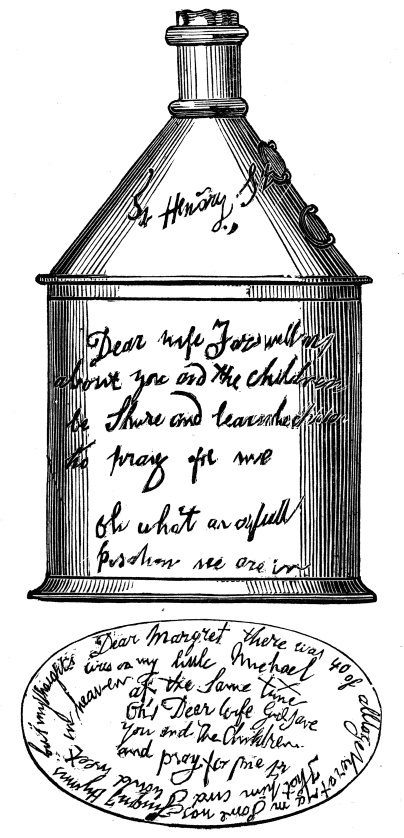
It is necessary to explain that the address of Smith, which appears in heavier and more distinct writing on the upper portion of the flask, had been marked there f or some time, and grown rusted. On the other side, which was greatly battered and bent, appeared, also in old writing, the man's name in full, with the date distinctly and firmly traced, "Anno 1880," this being also bitten in with rust. Under this inscription be had scratched the words "Look at the bottom ;" his obvious reason being that the plain flat surface afforded a better ground for writing upon. When he had filled up this oval space, he continued the letter, as seen above, on the less battered side of the flask; and it would appear that the last words, "Oh what an awful position we are in," were added sometime afterwards, probably not long before his death. They are less firm than the rest of the writing; but every line seems to indicate the perfect self-possession of the poor fellow, and his heroic calmness in presence of a cruel death. Michael Smith, who was thirty-seven years of age at the time of this fatality, was the son of a schoolmaster in this county. He was evidently a good writer, and could also play the violin fairly well. Two of his children are living, the "little Michael," so touchingly named in the letter, having died on the day of the explosion. The poor widow was nursing her sick child when she heard the dull thud that bore the message of a more terrible deprivation. In dying, Michael Smith clasped this bottle so closely under his right arm that it escaped the notice of the explorers, even when the body had been brought to the surface; and it was the afflicted wife and mother who herself made the discovery of this sad relic, which she now treasures with the greatest affection. No more pathetic memorial of human love and faith overcoming mortal anguish could be preserved.





 Contains public sector information licensed under the

