


|

|

|

|
|
 |
||||
 |
 |
|||
Introduction.
 The writers propose to consider the subject of explosions in coal mines from the basis of experience gained by direct investigation. Six explosions will be particularly described, and reference will be made to others.
The six explosions may be classified thus :—
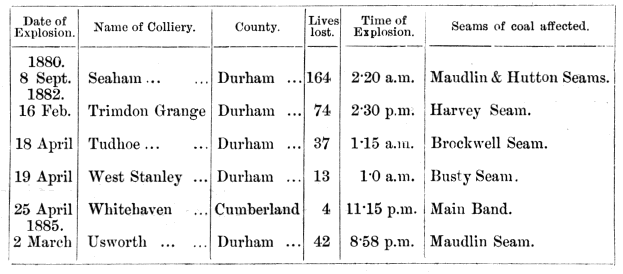
All these explosions were confined in their effects, so far as loss of life, and practically so far as force exhibited and burning were concerned, to one plane or set of workings. In all the cases there were workings on other planes or levels, connected by vertical approaches only, with the planes of explosion, which were not affected; that is, the explosions only extended in a more or less horizontal direction; in no case ascending or descending vertically so as to continue the explosion on another plane. This statement is made in order to explain the omission of plans showing the unaffected portions of the mines. The fact of the explosions not ascending or descending vertically has, however, a significance which will be referred to later.
In the Seaham explosion all the main haulage roads for some distance from and on both sides of the downcast shaft were affected. At Whitehaven the explosion did not affect the shafts. In the other cases the explosions extended to and damaged the downcast shafts, but did not cross them so as to extend itself on the opposite side: some little damage observed across the shafts in these cases was caused by the explosion on the other side. This statement is made to explain the omission on the plans of the workings, on the same level across the shafts, into which the explosions did not extend. This fact has also a significance to which further reference will be made.
The following is a general description of the mode of working large collieries, such as those under consideration.
The shafts, always two in number, and sometimes more, are usually sunk in close proximity. This is done in order to have the whole surface establishment compact, and to enable the system of ventilation to be completed as. soon as possible. The completion of the ventilating system is effected by connecting the shafts in the scams or beds to be worked by passages driven in the coal. A seam or bed of coal, having two shafts connecting it with the surface, and these shafts being connected underground, the conditions necessary, so far as shafts are concerned, are complete.
The working of the coal may be carried out by two methods: the "board and pillar" or the "longwall." The board and pillar system of working coal is to form, in the first instance, pillars or blocks of coal of the size shown on the plans, and in a second working to remove these pillars in slices. The passages completed in the first or "whole" working, as it is termed, are called "boards" and "walls." The coal is, as a rule, more easily detached by the hewer when working at right angles to the cleavage, and advantage is taken of this to work in the first or whole working most of the coal out of passages driven at right angles to the cleavage, and called boards; these passages are usually 5 yards wide. The walls are places driven at right angles to the boards and parallel to or with the cleavage, and are more for the purposes of ventilation and carriage of the coal than as a source of mineral; they are usually driven 2 or 3 yards wide. In many deep pits, and in some of those under notice, the cleavage is so little defined, that all the passages in the first working are driven the same width, viz., from 3 to 5 yards.
The first or whole working is succeeded by the second or "broken" working, which removes the pillars and leaves a part of the mine called "goaf," from which all the coal is taken. Sometimes the second or broken working is prosecuted behind an advancing face of whole working; this is called "following the whole with the broken;" leaving pillars of coal next the main intake and haulage road to protect it and the necessary return air ways. The broken working having followed the whole to the extremity of the royalty, the last operation is to remove the pillars left on each side of the haulage road.
The longwall method of working coal is to remove the seam in one working only, the roadways being carried through the goaf or space from which all coal has been abstracted.
Certain modes of working coal are modifications of these two general systems. Thus the roadways are sometimes protected by pillars of coal; longwall being prosecuted on each side of such protected roads either away from the shafts, or, as in the Lancashire system, where the practice is to form by pillar workings, roadways to the extremity of the royalty, and then work longwall home or back to the shafts. At the collieries under notice, the board and pillar system was in operation, with the exception of a small district of longwall at Seaham colliery, and a modification of longwall in one district of Trimdon Grange colliery. The mode of working does not appear to have had any direct bearing on the causes of the explosions.
Each hewer can detach and fill into tubs from 3 to 5 tons of coal per day, and in order to obtain a sufficient quantity of coal, many working places have to be provided. In the whole or first working, each man is placed from 10 to 40 yards apart, and in the broken or second working, from 5 to 20 yards. This necessitates long lines of working face. The carriage of the coal from the working face is performed by ponies in the first instance, drawing a single tub, then by horses taking several tubs, and finally by engine power, or if the road inclines sufficiently to the shaft, by self-acting inclines. It is found convenient and economical to limit the distance travelled by ponies drawing single tubs to about 150 yards, and in order to do this it is necessary to have, at suitable distances apart, main roads traversed by horse or engine power.
The general direction of the main roads of a colliery are influenced by the inclination of the seam, shape of royalty, and presence of large dislocations.
The ventilation of the mine requires that each district shall have two roads connecting it with the shafts, so as to allow a current of air to pass this current is induced by a furnace at the bottom of the upcast shaft, or by a fan on the surface.
The foregoing general description of the internal economy of a coal mine is sufficient for the purposes of this paper; but will require amplification in some respects.
It will be seen that the mine can be divided into the following sections :—
| Shafts. | |||
| Roadways. | |||
| Working faces. | |||
| Abandoned parts (goaf and pillars awaiting removal). | |||
| Shafts are maintained for the following purposes :— | |||
| Fresh air entering the mine, and return air leaving the mine. | |||
| Drawing minerals by winding engines. | |||
| Passage of men and materials. | |||
| Pumping and drawing water, and transmission of power. | |||
| Roadways are maintained for the following similar purposes :— | |||
| Ventilating the mine. | |||
| Intake air ways. | |||
| Return air ways. | |||
| Face ventilation. | |||
| Haulage of mineral. | |||
| Roads traversed by ponies. | |||
| Roads traversed by horses. | |||
| Roads traversed by engine power. | |||
| Roads forming self-acting inclines. | |||
| Passage of men and materials. | |||
| Water roads and roads used for the transmission of power. | |||
Plans No. 1 show the workings and ventilation of the parts of the collieries affected by the explosions. The roads traversed by the fresh or intake air currents are coloured blue, and these were, with some few exceptions, also the main haulage and travelling roads.
The working faces are shown by thick black lines.
The return air roads are coloured red.
Pillars formed and awaiting removal are shown by thin black lines.
The intakes, where used also as haulage and travelling roads, are usually from 6 ft. to 9 ft. wide and from 5 ft. to 7 ft. high; where only used as intakes, or intakes and travelling roads for men and horses, the size is usually somewhat smaller.
These roads are, where necessary, made of sufficient height by taking away part of the roof stone or floor of the seam. They are made of a suitable gradient for haulage, and at many points leave the coal altogether, as when crossing dislocations, or where the coal sinks into a trough and rises again. They are securely timbered, and in places where the roof stone is especially bad, arched with bricks. They are kept up to within as short a distance of the face as possible. The coal is hauled over the greater parts of these roads by engine power.
The air current is carried forward by "stoppings" or doors placed in all the side openings. The stoppings, with the exception of those near the face. are of brick or stone and are built with mortar; they are frequently stowed with loose stones behind the mason work or on the return side. The stoppings near the face are constructed of wood or canvas ; the wood stoppings are sometimes pointed with mortar at the joints. At points where it is necessary for men and horses to pass from the intake, doors are provided, usually of wood, and in the case of important doors, which if left open would deflect the air current from large areas of workings, they are in duplicate, and near the shafts even trebled. At points where men only pass from the intake into the return, smaller wooden doors, called man-doors, usually kept locked, are provided. Double doors are provided not only to double the security when not in use, but also to admit the passage of men and horses past them without air, one only being opened at once. They are in fact air locks.
In less important situations one wood door and a sheet of canvas are used, sometimes one wood door only or two canvas sheets are provided, and at points of least importance one canvas door only is hung.
It will be seen that the principle adopted in the ventilation is to carry forward the air along single roads with as little leakage as possible, the vigilance being somewhat relaxed as the face is neared and less resistance has to overcome by the air current before reaching the working places.
The air current before reaching the workings is closely confined, because, after reaching the bottom of the downcast shaft, it always has a tendency to take the easiest route to the bottom of the upcast shaft, and the object of stoppings and doors is to make the only route, by the face.
It has been found advantageous to divide the current of air: by allowing separate currents from the main air current to traverse the branch roads the friction of each current is lessened and a larger quantity of air is obtained in the aggregate. The friction of the air against the sides of the roads is the principal resistance to be overcome by the ventilating power; the force necessary to give motion to the air being small compared with that necessary to overcome the friction. The friction of air against the sides of the passages varies as the square of the velocity of the air; by splitting the air current the velocity is reduced and the friction lessened by a greater ratio, and the same ventilating power is enabled to circulate a larger volume than if the air had been confined to one passage only.
The various currents of air are called "splits." When the air is split it is often necessary to have two currents of air crossing each other, and air crossings are provided for this purpose. When the return air passes above the intake, the crossing is sometimes called an "overcast ;" when the return air passes under the intake it is sometimes called an "undercast." These crossings are usually made by building a brick arch in the intake, closing the upper ends of the arch, and making above it a road for the return air. Sometimes a wooden bridge closed at the sides is used, In some instances the crossing of the air currents takes place at points where the intake and haulage road has left the seam of coal and is separated from it by some thickness of rock, the return air road being in the seam above or below the intake. Such crossings may be called natural crossings.
In splitting the air into two or more currents, the resistance to be overcome by each being often unequal, or more air being required in one current than in others, artificial resistance is resorted to in the shape of "regulators," so as to secure to each split the required quantity of air. These regulators, usually sliding doors partly open, are places where the flow of air is checked by a contraction of the air way. They are placed in the returns out of ordinary workmen’s reach, but can be opened so as to permit the passage of a man. Regulators may be a brick taken out of a stopping, a hole in a brattice stopping or in a door, or simply leakage through doors. When the current is allowed to deflect from an intake through a regulator it is usually called a "scale" of air.
The air current, having reached the face, is conducted past the various working places; and into the face of them when necessary, by means of canvas or wood brattice. Sometimes brick brattice or air boxes or tubes are used. After leaving the working places it passes into the return air way.
The return air ways are separated on one side from the intakes by the stoppings and doors already described; on the other side they are not so protected, but are open to the goaf and pillars. The air, having left the last working place, is no longer rigorously confined to one road, but is allowed to pass to the upcast shaft along the return air roads and through such places in the pillars us may be open. One or more roads for the passage of the return air from each district is always kept open and travelled frequently. The roof of these roads is supported by stone pillaring and timber; pillars of stone are preferred in return air roads the stone is usually available from the falls of roof that take place, and timber is not always at hand at points in the return distant from doors.
Timber also is more subject to rot in the return air ways than in the intake. The return air roads are, on the average, smaller than the intake air ways; in the case of main returns they are, however, often larger than the intake.
For convenience of access and examination, and for removal of fallen stones when necessary, the return air ways are, as far as possible, maintained next to the intake air ways, being separated from them by one pillar of coal with the stoppings and doors already described.
Requirements connected with the system of working make it generally necessary to have the return air ways parallel to and near the intakes. The air always has a tendency to pass from the intake into the return and not from the return into the intake.
It is usual in some cases to ventilate one district by a current of fresh air and then conduct this air to another district and ventilate it by the same air. This is called ventilating "by return air ;" that is, the air, after leaving the first district, is return air so far as it is concerned, but is intake air so far as the second district is concerned. It is usual in such cases to allow a scale of fresh air to pass through the doors on the haulage road of the second district and join at the face the return air from the first district.
In mines subject to fire-damp it is an almost invariable rule not to use the return air roads for the haulage of coal, and this principle was observed at all the collieries under notice.
Fire-damp or light carburetted hydrogen existed in the coal and stone at all the collieries under notice, and issued constantly from the freshly exposed surfaces in the working places; the ventilation, however, was such that gas was not frequently seen on the lamp in the working places or return air roads. It was quite expected that, after the ventilating current had reached the working face, and from thence to the upcast shaft by the return air roads, gas might be seen at any time, and these parts of the collieries were worked exclusively with locked safety lamps.
Gunpowder was used in working the coal in parts of the Trimdon, Tudhoe, and West Stanley Collieries, the shots being fired by officials after an examination of the place and its surroundings as regards gas.
It was not considered probable that any gas would be seen on the main haulage roads traversed by large volumes of fresh, air, their surfaces having long exhausted themselves of gas. The best test as to the feeling of security on these roads is to consider the position of the "caution boards." These are points on the intake where workmen’s safety lamps are examined, locked, and re-lighted when necessary. They are shown by a red C on Plan 1.
The practice as to the use of safety lamps and open lights varied to some extent at the different collieries.
At Seaham, Trimdon Grange, Tudhoe, and West Stanley Collieries open lights were used on the intake air ways up to the caution boards, which, in several instances, were more than a mile from the shafts. Repairers and stonemen, whose work lay on either side of the caution boards, used safety lamps, even when working on the out-bye side of the caution boards.
At Whitehaven Colliery only safety lamps were used in the district of the explosion.
At Usworth Colliery the use of safety lamps was enforced, except in the immediate neighbourhood of the downcast shaft. Workmen’s lamps were examined and re-lighted when necessary at the points marked C on Plan 1.
At some collieries, where the issue of fire-damp is of very limited quantity, it is the custom to use naked lights on the haulage roads and in the whole or first workings, safety lamps being used in the broken or second workings and in all the return air roads.
"Blowers" or sudden issues of fire-damp were sometimes met with in the first or whole working, the gas on a few occasions coming off in sufficient quantity to show on the safety lamp over a district, and in the return air ways heading from it; under such circumstances work was suspended until the gas cleared away. In the broken or second working the ventilation is more difficult, and gas was frequently seen near the edge of the goaf. After a slice of coal has been removed from a pillar of coal, the timber put in to support the stone is withdrawn, and heavy falls of roof occur, exposing new surfaces above the level of the seam; gas issues from the newly exposed surfaces, and being lighter than air, remains in the cavities formed, and is difficult to remove.
The gas issuing both in the first and second workings is carried by the ventilating current into the return air ways, and the writers know of no case where gas issuing from the working faces bas shown any considerable distance against the air current.
The goaf of a coal mine is sometimes looked upon as a reservoir of gas, and in inquiries into the cause of explosions, loose statements as to gas issuing from goaves are very common. The writers believe that in all the six cases under consideration, gas contained in the goaf did not play any part in the explosions; all the indications of direction of force and flame showing that the explosions had travelled towards the various goaves and not in a single instance from them. The goaf is not open, except at the edge next the face of the second or broken working, where new falls are constantly taking place, and gas issues after such falls; so far in the goaf would be found to be almost close and the exposed surfaces exhausted of gas. In the longwall system of working, the main roads are carried through the goaf, and it is found to become comparatively close away from these supported roads in a short space of time. That gas issues from goaves and sometimes in large volume is admitted, the gas passing into the returns. The distance for which goaves remain more or less open, and the time necessary for them to consolidate, depend chiefly upon the nature of the roof and floor.
The return air of the collieries under notice rarely showed any indication of gas near the upcast shaft. In one or two instances gas was so seen.
It is necessary to explain how far the flame of a safety lamp may be taken as an indicator of fire-damp.
Mr. Galloway, in the Transactions of the Royal Society, Vol. XXIV., gives the result of experiments made by him to test "the accuracy of the means by which the presence of fire-damp is usually ascertained in mines."
A Clanny lamp, or lamp with glass surrounding the flame, was used, and the wick carefully trimmed and pulled down "until the flame presented the appearance of a small blue hemisphere about in. high by in. diameter at the base, and having a conical speck of yellow in the middle near the top ;" this flame was then exposed in mixtures of fire-damp and air, the proportion of each being known.
He gives the following table :—
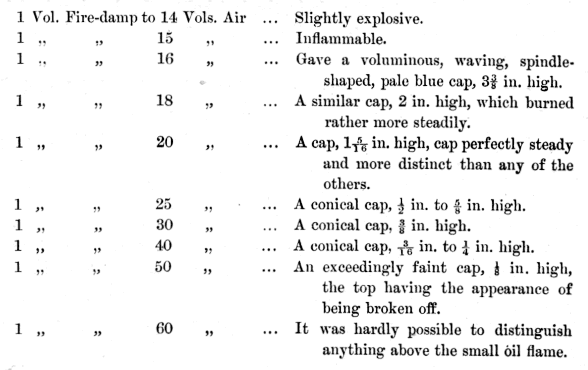
It will be seen that the miner speaks of air containing no visible appearance of gas when there is less than 2 per cent. of it in air. The return air of all the collieries under notice, as a general rule, contained less than 2 per cent., the actual amount of fire-damp normally issuing from the mines may, therefore, be put down as less than 2 per cent, of the air current entering the upcast shaft.
The lire-damp actually contained in the return air at the upcast shaft is practically what enters it while passing the working faces, and while skirting goaves, and passing through the old pillars in the return air ways. It is assumed that the air is free from fire-damp on the main haulage roads. This may not be absolutely true, traces of it may be present in the air on such roads, but in minute proportions.
A rough calculation may be made as to the probable percentage of gas in the air on such roads in this way.
Assuming that there is 2 per cent, of fire-damp in the return air at the upcast shaft, we might fairly say that half of this fire-damp entered the air current at the working face, the remaining half, or 1 per cent., must be divided between the intake and return air ways ; the return air ways are open to and connected with the goaves and old pillars, while the intake is a single road with the pressure of air from it on both sides ; if, therefore, we say that the air while in the return picks up of the remaining 1 per cent., it might, in the writers’ judgment, be an approximately fair division. The intake air on reaching the first working place would, by this estimation, contain 1/5 per cent, of fire-damp, most of this would enter the air near the end of the intake, and where the coal and stone had not had so long a time to drain of gas, thus in an intake air way one mile long, it would be fair to assume that 2/3 of the 1/5 per cent. of fire-damp would enter the air in the last half mile, leaving 1/3 of 1/5 or 1/15 per cent. of gas present in the air at the end of the first half mile, or 1 volume in 1500.
It cannot be doubted that even in fiery mines the air before it has passed over any working places is nearly free from fire-damp. If 2 per cent, of gas entered the air current in those roads where the issue of firedamp has practically ceased, the return air at the upcast shaft would contain at least 10 per cent., and be in a constantly explosive condition; a state of things negatived by observations extending over many years.
Blowers or sudden outbursts of gas were never met with on the main intake or haulage roads, except when these roads formed part of the working face. In a few cases in the North of England, an issue of gas has been met with on a main road when first driven, and the issue has not at once exhausted itself, but has continued coming off for years, generally decreasing in volume and often varying with the barometer.
At none of the collieries under notice was there any such permanent issue of gas on the main roads.
The writers know of no example of a blower of gas appearing on a main road after it has been formed for some years. Falls of stone occasionally took place on the main roads of the collieries under notice, but in no ease was a large volume of gas suddenly liberated by such falls. Cases are known on old roads where gas has collected in the cavity formed by a fall of stone. The gas in these cases was not observed to have come off as a sudden outburst, but to have accumulated in the cavity in the roof where it was out of the direct current of the air.
The only agent, other than fire-damp, ever suggested in connection with explosions in coal mines as capable, when mixed with air, of causing these calamities, is coal dust, either alone or in conjunction with fire-damp.
It was found that the parts of the Seaham, Trimdon Grange, Tudhoe, West Stanley, and Usworth Collieries affected by the explosions were those in which coal dust was present in considerable quantities. The locality where the Whitehaven explosion occurred was quite free from coal dust, the surroundings being all damp or wet. This was a pure fire-damp explosion, and the most extensive of its kind that has come under the writers’ notice.
There are two conditions necessary before coal dust can accumulate in mines, the first is that the mine must be a dry mine, and the second is that the coal must be of a dusty nature.
The dryness of the air in a mine depends upon the temperature of the mine and its freedom from water. The temperature of the earth’s crust increases with its depth; at 50 feet from the surface the temperature is 50 degs. F., and below that depth the temperature rises 1 deg. for every 60 feet. Deep mines are therefore warmer than shallow mines.
Virgin coal and rock, even at great depths, is often charged with moisture. When this is the case, and gas issues freely from the strata, a hissing noise is heard, called "singing," and when the moisture is so abundant as to form drops of water on the newly-exposed surfaces it is called "bleeding." After a time the singing and bleeding cease, and the coal becomes dry. Sometimes the coal and surrounding strata are dry when first exposed, so far as can be observed, and then no singing is heard.
In deep and warm mines, where large volumes of air are constantly circulating, any limited amount of moisture such as this is soon absorbed.
The capacity of air for holding moisture in the form of aqueous vapour increases as its temperature rises, unless, therefore, air circulating in a deep and warm mine absorbs moisture in its passage through the mine, its dryness increases with its rise in temperature. The moisture accompanying the issue of gas ceases in a short time, and main roads and old roads in the pillars may be looked upon as free from this source of moisture.
In the absence of permanent issues of water in a deep mine the working face of the whole or first workings is the main source of moisture the pillar workings being in coal, already partly drained, do not afford the air much moisture.
The shafts are rarely dry, the main feeders of water are usually tubbed off, but sufficient moisture appears to be present in most shafts to nearly saturate the air in its descent.
The current of air, as it approaches the working faces of deep mines, rises in temperature and assumes at the face its normal degree of heat — a temperature approximating closely to that due to the depth; if the main intake and haulage road is free from large permanent sources of water, the air on this road becomes drier as it nears the face. While passing the working face, and especially in the first working of the board and pillar system and longwall faces, the air picks up moisture from the coal, and enter the return air road more humid than on its arrival at the face.
In deep mines the normal temperature is above that on the surface, except during part of the hottest days of summer; during these periods the air is reduced below the temperature of the mine during its descent of the downcast shaft, rising again in temperature as it traverses the intake air ways.
In shallow mines, during warm weather, cooling takes place both in the shafts and intake air roads; and in such pits, roads that are comparatively dry in cold weather, when the normal temperature of the mine is in excess of that of the surface, exhibit the following phenomenon during warm days. The air being reduced in temperature while passing along the intake air roads, deposits moisture, which collects in large drops on the roof and sides. Shallow mines are much troubled with falls of stone on the intake air ways during warm weather, as the water deposited by the air getting into the crevices of the stone loosens it.
Notwithstanding the large currents of air passing along the intakes of deep mines for years, and absorbing heat from the rock and coal, the temperature of the air on such roads does not appear to fall much as time proceeds.
During cold weather the air enters the intake air roads at a lower temperature than in warm weather, and as it ultimately attains the same degree of heat on its approach to the working face, its drying power is greater during the colder months, and greater during the night than during the day.





 Contains public sector information licensed under the

