


|

|

|

|
|
 |
 |
|||
Plate XV.
The East Riding, or Wolds Waggon.
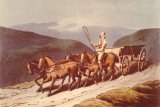
The account given of this carriage by H. Strickland, esq. in his late excellent publication on the agriculture of the East Riding of Yorkshire, is so perfectly descriptive of the annexed Plate, that we here take the liberty of quoting it verbatim.
"Little can be said in favour of the waggons which are in general use here: they are high, narrow, and long; an inconvenient form for the purposes for which they are intended, that of carrying a top-load, particularly in such parts of the country as are irregular; and they have but one peculiarity in their construction which seems worthy of more general adoption. This is a strong chain on each side of the waggon, of which one end is fixed to the back of the fore axletree, and the other to the under side of the body, of such a length as just to prevent the opposite wheel from locking against the side of the waggon in turning; by which means the body may be set much lower between the wheels, without being weakened by cutting the side to admit the wheel (as is sometimes done), and the waggon may be turned within a much smaller space. The mode of yoking the waggons also, in great part of the East Riding, appears to be a practice nearly peculiar to that district, and is deserving of imitation. The four horses are yoked two abreast, in the same manner as they are put to a coach, two drawing by the splinter-bar, and two by the pole; those at the wheel drawing also by a swinging bar; which the wheel horses of every carriage ought to do, as they thereby obtain considerable ease in their draft, and are less liable to be galled by the collar than those which draw by a fixed bar. The driver then being mounted on the near-side wheel horse, directs the two leaders by a rein fixed to the outside of each of their bridles, they being coupled together by a strap passing from the inside of each of their bridles to the collar of the other horse. In this manner, when empty, they trot along the roads with ease and expedition; and when loaded, the horses being near their work, and conveniently placed for drawing, labour with much greater ease and effect than when placed at length. Were the waggons indeed of a better construction, the team would be excellent."





 Contains public sector information licensed under the

