


|

|

|

|
|
 |
||||
 |

|
 |
||
Should the purchasing of established Iron works be entertained, great care and judgment are required; for, although they may have the prestige of a good name for success, and although furnaces, engines, buildings and machinery, tramways, &c., may be in fair condition, and the terms of the lease favourable, yet large outlay may be needful in opening up a further supply of minerals, or the minerals may be so nearly exhausted as not to warrant a further employment of capital in winning them; or even if the quantity of mineral is considerable, great cost may have to be incurred in consequence of their not having been fairly and judiciously worked.
Under ordinary circumstances, manual labour enters into the cost of the various minerals and manufactured products to the extent of 88 to 90 per cent. of the outlay; the cost of production is therefore higher or lower according to the value of labour in the market. The cost of producing crude Iron in the newer districts will depend on the price of labour and the facilities for supplying the requisite quantity; in the older districts it is principally dependant on the richness and facilities for obtaining a sufficiency of the raw material. The cost of producing bar Iron is subject to great irregularities, independent of those arising from the prices of labour and raw materials, and apparently is caused in part by the qualities of the crude Iron, but to a greater extent by the degree of perfection attained in the forge and mill operations. In 1850, for instance, the price of Glasgow pigs was £2 3s. 6d.; of bars, £5 15s. 0d.; whilst at the same time Staffordshire pigs was £3 5s. 0d., and bars, £6. To arrive at the very lowest cost of raising minerals and manufacturing Iron, the time best selected will be at a period when the trade was under a general depression; when wages were extremely low, and the greatest economy necessarily practised to meet the low prices of the day. The year 1843 is quoted by Mr. Truran as a period of great depression, when crude and manufactured Iron were produced at costs considerably below those of any antecedent or subsequent date. At Merthyr Tydval in July of the year selected, the cost, for example, of raising Coal per ton, reduced from the expenses attending a monthly extraction of 36,089 tons, was 3s. 2.5d.; the cost of raising the ore per ton, from a monthly extraction of 15,728 tons from pits and levels, was 8s. 0.1 d.; cost of quarrying and delivering limestone on furnace yard, attending at extraction of 8,023 tons, was 0s. 8.5d., and the cost of manufacturing Pig Iron from a mixed burden, taking the monthly production of 5,546 tons, was as follows :—
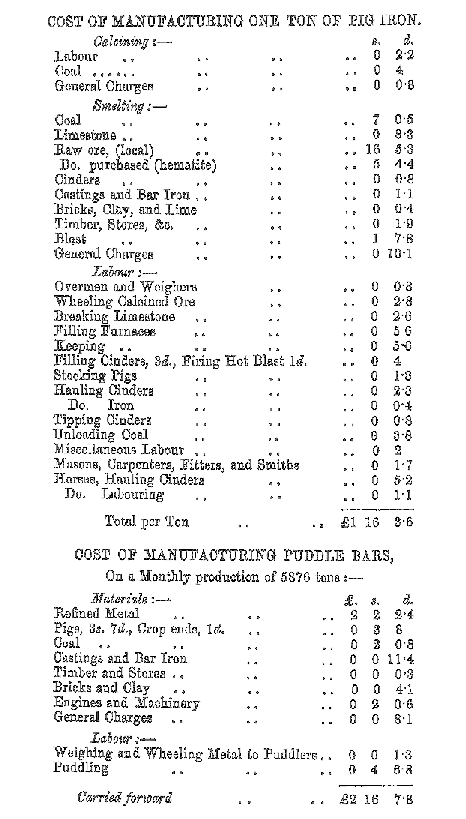
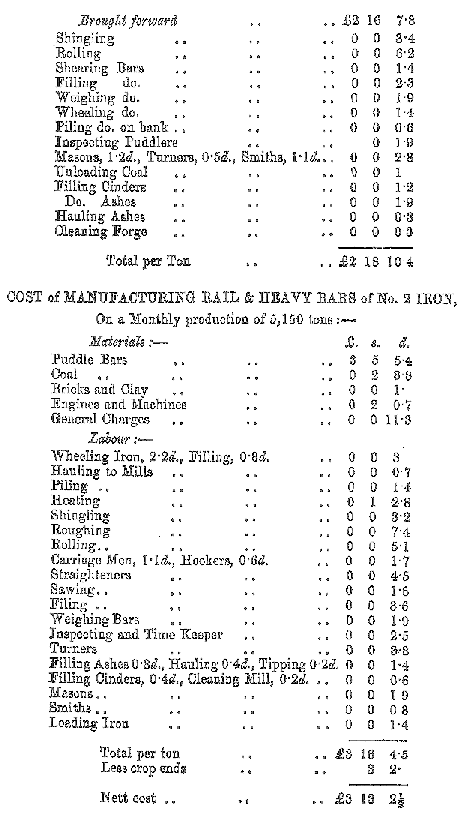
At the same period, the cost of generating the blast per ton of pig Iron made by blast furnace, was 1s. 7.8d.; and the expenses of maintaining the forge engines and machinery per ton of puddle bar and finished Iron made, were 2s. 0.7d. The cost of raising ores in Dean Forest, with rates of wages considerably higher than the foregoing, amounted to 7s. 2 ½d. Pig Iron may be produced in Scotland from the carbonaceous ores, at prices considerably under those prevailing in Wales: the


Please Note: These web pages retain the original pagination from the publication




 Contains public sector information licensed under the

