


|

|

|

|
|
 |
||||
 |

|
 |
||
flows past Sheffield, rise in bold masses the Wharncliffe rocks, which may be followed along the out-crop in a north and south direction, dipping with the rest of the measures towards the east, and forming the base of that portion of them which yields the Ironstones and Coals of the tract under consideration. From Park Gate, near Rotherham, over Lord FitzWilliam's fine property of Wentworth, to Tankersley, and on to the west of Barnsley, may be traced in succession many of the more important bassets of Ironstone. The more important of the Ironstones employed in the West Riding are interstratified in about 1,000 feet thickness of measures, which intervene between two well-marked beds of Coal, the Barnsley Thick Coal, and the Silkstone, and are known as the Swallow-wood, the Lidgate, Tankersley, Thorncliffe Black Mine, Thorncliffe White Mine, and Clay-wood Mine. The Thorncliffe, or Old Black Mine, yields about 1,500 tons per acre; the White Mine of Parkgate yields about the same quantity; the Clay-wood Mine, a brownish gray ore, produces 1,500 to 1,600 tons per acre; and the Tankersley, or Musselband Ironstone, yields on the average about 2,000 tons to the acre.
ANALYSIS.-Ores of this part of Yorkshire have been analysed by Mr. John Spiller, with the following results, fair average samples having been taken from each mine. No. 1 is from the White Bed Mine, Bierley; No. 2, from the Black Bed Mine, Low Moor; No. 3, from Thorncliffe or Old Black Mine, Parkgate; No. 4, from Thorncliffe White Mine, Parkgate ; and No. 5, from Black or Clay Wood Mine, Parkgate.
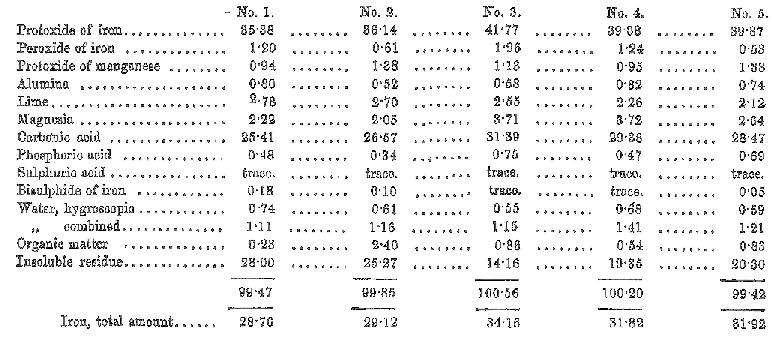
There are thirty-three Iron Works having Blast Furnaces in Yorkshire, besides those already noticed in the Cleveland district, namely :— Beeston Manor Iron-works, one blast furnace, owners, Messrs. Harding and Co.; Bierly, four, and Low Moor five, belonging to Messrs. Hind, Dawson and Hardy; Bowling, five, Messrs. Sturge and Co.; Chapeltown, two, and Thorncliffe, three, Messrs. Newton, Chambers and Co. ; Elsecar, two, Messrs. Dawes and Co.; Farnley, four, Messrs. Armitage and Co.; Holmes, two, and Park Gate one, Messrs. S. Beale and Co.; Milton, two, Messrs. Davies and Co.; Thorpe Hall, one, Messrs. T. and H. Hains; Worsbro' Dale, one, Messrs. Field, Cooper and Co.
Ores and Iron Works of Durham, Northumberland, Cumberland, and Lancashire.
The principal mass of the carboniferous or mountain limestone of the Iron-producing districts of Durham and Northumberland emerges from beneath the Coal-measures on the east, and is bounded by a steep declivity overlooking the vale of Eden on the west. It reaches a culminating point in the long mountain ridge of Cross Fell, and forms the vast tract of moorland, which, near Alston, extends for some 25 miles in width, and in the high desolate region adjoining the Scotch border, stretches across almost from sea to sea. After an interval of some miles towards the west, the same formation rises again from beneath the new red sandstone of Penrith and the Coal-measures of Workington and Whitehaven. The structure of the central highland differs materially from the contemporaneous formation which occurs further south in England and Wales, and which consists principally of uninterrupted beds of limestone to a vast thickness. In the north the actual limestone plays but a subordinate part, and alternates with strata of gritstone and shale, locally termed hazle and plate. Certain ores of Iron are interstratified with these beds; nodules of clay Ironstone, the argillaceous carbonate, are met with in some of the bands of shale, the mode of aggregation being analogous to that of the similar ores of the Coal-measures. These were used at the Ironworks erected at Hareshaw, Ridsdale, and Haltwhistle. Masses of brown Iron ore appear in some instances to form regular layers, although their presence is probably in close relation to the veins of metallic minerals which in great numbers intersect the rocks in and around Alston Moor.
A bed of the carbonaceous Iron ore, termed blackband, was discovered a few years ago, and worked till within a recent period, about a mile and a half north-west of Haydon Bridge, near the Newcastle and Carlisle Railway; it ranged from 1½ to 4 feet in thickness, and being calcined on the spot, was proved at the Shotley Bridge furnaces to be a very valuable ore, but its cropping out on the west, and disturbances of the ground on the east, limited its exploration. The majority of the mineral veins or lodes of the Alston district, celebrated for their productiveness of lead ore, range nearly from east to west, intersecting the whole of the previously mentioned beds, but yielding their riches far more abundantly in certain strata than in others. Some of these lead veins, in a part of their course, are charged with brown Iron ore instead of the usual veinstone of fluorspar and quartz and its concomitant lead ore. Thus, the rich lode of Rodderup Fell, where it crosses the valley of the Tyne above Alston, and known as the Craig Green or Bracken Syke vein, is seen in the so-called "scar" limestone, as a vein of brown Iron ore from 16 to 20 feet in width. Hitherto, however, from the remote position of the district, these repositories of an ore so well calculated to produce a good quality of Iron have been very little explored, though since the late extension of a branch railway to the town of Alston certain of the lodes, apparently producing


Please Note: These web pages retain the original pagination from the publication




 Contains public sector information licensed under the

