


|

|

|

|
|
 |
||||
 |

|
 |
||
The Stockton and Darlington Railway derives great advantages from the discovery of Ironstone in this district, In the year 1845, its mineral traffic was 936,757 tons; in 1851, 1,859,207 tons; and in 1856 it increased to 2,952,202 tons; and the increase of mineral traffic on the Middlesbro' and Guisbro' Railway is thus shown in the company's books :— Received for minerals from Nov. 11 to end of 1853, £329 18s. 1d.; for the year 1854, £4,224 5s. 7d.; for 1855, £8,594 11s. 1d.; and for 1856, £12,916 11s. 3d. — A railway to connect Rosedale mines with the North Yorkshire and Cleveland is in the course of construction ; already 150,000 tons per annum of this stone are arranged to be delivered, and thus a series of connecting lines for the district will be completed in a few months.
The Ironstone deposits of Cleveland have, on different occasions, engaged the attention of mining engineers and Ironmasters at meetings of the North of England Mining Institute. In addition to the able document presented by Mr. Marley, papers have been read upon this important subject by Mr. Bewick and by the President of the Institute, Mr. N. Wood — the latter "On the deposit of Magnetic Ironstone in Rosedale," in Feb. 1859. — Mr. Bewick stated: First, that the Iron ore of Rosedale instead of being a large mineral field as was at first asserted, and still believed to be so by many, was nothing more than a volcanic dyke; and, secondly, that the Ironstone lately opened out in this locality was not, as it is reputed to be, the main seam now being worked in Cleveland and Grosmont districts, but in his opinion, it was the top seam. — Mr. Wood gave an account of the operations concluded by Professor Phillips and himself towards the investigation and development of this bed of Ironstone. The first discovery of this deposit, he said, was at a quarry on the south-west side of the valley of Rosedale, about a mile south from Rosedale Abbey. When this quarry was opened out it was found to consist of apparently a confused mass of Ironstone boulders of an ellipsoidal structure, and of gigantic size, often 3 or 4 feet in diameter; but the great characteristic difference of composition between this Ironstone and the top and main band of Cleveland is, the entire absence of shells, the structure being entirely of an oolitic character, composed of small round concretions of Iron ore, cemented together with extremely thin silicious or arenaceous films, and in its magnetic properties exhibiting polarity, and likewise in its greater richness than the ordinary Ironstone of Cleveland. This quarry has been excavated, so as to form a face of 60 feet in thickness; to which must be added, 11 feet of blue magnetic stone, 2½ feet of red Ironstone, slightly magnetic, bored down below the bottom in magnetic stone, and 3 feet of shale. Soon after the quarry was discovered, it was thought advisable to drive a drift into the side of the hill, to ascertain the extent of this deposit, the quarry being about 600 feet from the bottom of the valley, and about 300 feet below the utmost level range, or plateau of moors, lying on the southwest side of the valley. Since then it has been driven to a much greater distance, and three bore-holes have been put down from the surface to the Rosedale bed of Ironstone. The following are sections of the strata passed through in these bore-holes:
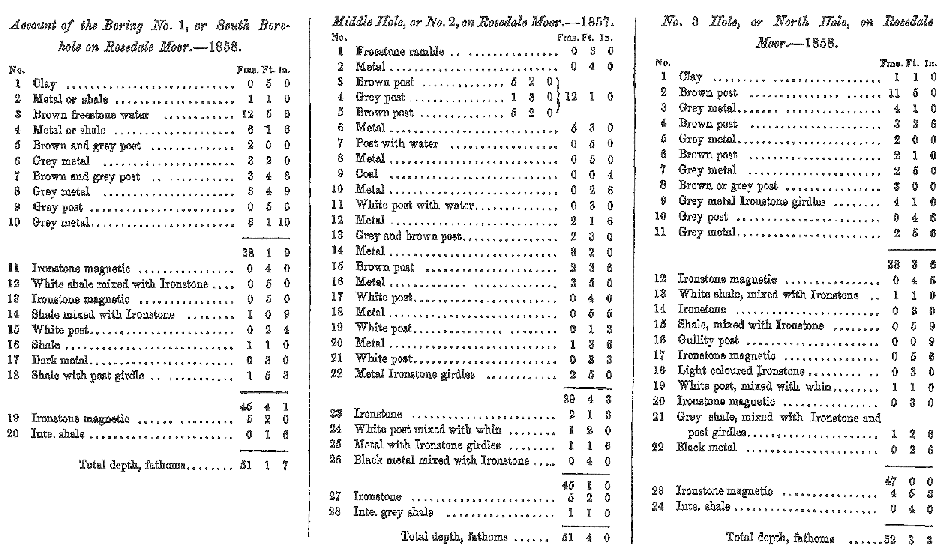
These borings and sections show two distinct beds of Ironstone stratified with great regularity, and they prove most conclusively that neither of them are at all like what Mr. Bewick terms "nothing more than a volcanic dyke." The analysis given by Mr. Marley of the Rosedale stone being upwards of 50 per cent. of metallic Iron, while the top seam and main band are about 32 to 35 per cent.; and the produce of a large quantity smelted at Consett Iron Works gave 55 per cent. from the calcined ore, and 45 per cent. from the raw stone. Whatever opinion may therefore be formed of the cause of this deposit, we have a bed of Ironstone highly magnetic, of an almost entirely uniform thickness, totally different in its mineralogical character from the ordinary stone of the district, and yielding in produce nearly 20 per cent, more Iron in the furnace. To what extent this bed may exist beyond that already proved, will be the subject of further investigation; but the importance of such discoveries are of too great interest in the district, and too valuable in a commercial point of view, to remain long unexplored. — Mr. Marley observed that if the magnetic stone is a bed, it is extraordinary so large an extent of country should give no trace of it, as at Grosmont and other places we have not the slightest trace of it.


Please Note: These web pages retain the original pagination from the publication




 Contains public sector information licensed under the

