


|

|

|

|
|
 |
||||
 |

|
 |
||
E. M. Noble, John Prince, and F. S. Stokes, London; C. Barrett and John Barr, Darlington. Secretary — W. Bedford. The Company continued its operations for some years, but the undertaking was a failure, and the subscribed capital almost entirely lost. Its affairs were wound up in 1852, the shareholders receiving a return of £5. 5s. per share. — Another similar proprietary, but one proving more disastrous in its results, was the Northern Coal Mining Company, with a proposed capital of £500,000, in £25 shares. After an expenditure of the whole of its proposed capital in opening out various collieries, the concern was placed under the Winding-up Act, and the further claims upon the shareholders amounted to a sum nearly equal to the amount of the original capital. The directors were — Messrs. Gee. Faith, Hunter Gordon, J. C. Ord, S. Travers, and J. M. Wood, London; R. Botcherby and T. Brown, Darlington; T. C. Gibson, Newcastle; W. Kirk and H. Panton, Sunderland; and J. Ord, York. — One of the most important of the projects of this period, was the Newcastle and London Coal Railway, with a proposed capital of five millions. The object of this undertaking was to form a railway between London and the Northern Coal Mines, exclusively for the carriage of Coals, thus rendering the accumulation of large stocks of Coal unnecessary by a continued regularity of supply; and the most important results might possibly have accrued, had not the commercial panic of 1845, induced the promoters of the scheme to abandon it. — But the most utopian project in connection with the Coal Trade was that introduced to the public in 1847. The scheme was no less than the joining of all the collieries in the counties of Durham and Northumberland into a Joint Stock Co.! capital, £16,000, 000 — profits not to exceed 10 per cent. Fortunately for the public, excepting a paragraph upon the subject going the round of the newspapers, nothing more was heard of this gigantic chimera. Some of the collieries opened out by the above parties being entirely abandoned, and others falling into the hands of private individuals, the trade eventually settled down into a more regular system.
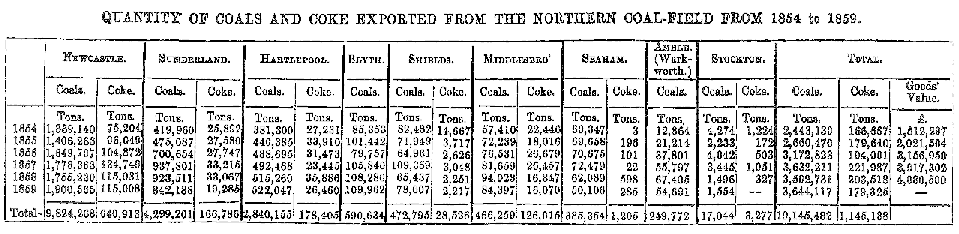
The number of voyages performed, or cargoes comprised in the Coals and Coke shipped from Newcastle, in the five years, 1854 to 1858, were 34,543 — foreign vessels carrying 18,022 cargoes, and British vessels 16,521 cargoes; Sunderland 13,304 cargoes — 5,827 by foreign and 7,477 by British vessels; Hartlepool 12,248 — by foreign vessels 1,008, by British 1023; Blyth 2,779 — by foreign vessels 1523, by British 1256; Shields 1,333 — by foreign vessels 474, by British 859; Middlesborough 3,264 — by foreign vessels 2,069, by British 1,195; Seaham 2,041 — by foreign vessels 1,018, by British 1,023; Amble, or Warkworth, 1028 — by foreign vessels 262, by British 766; Stockton 177 — by foreign vessels 148, by British 29. The total number of cargoes amount to 70,717 — foreign vessels carrying 36,759, and British vessels 33,958.
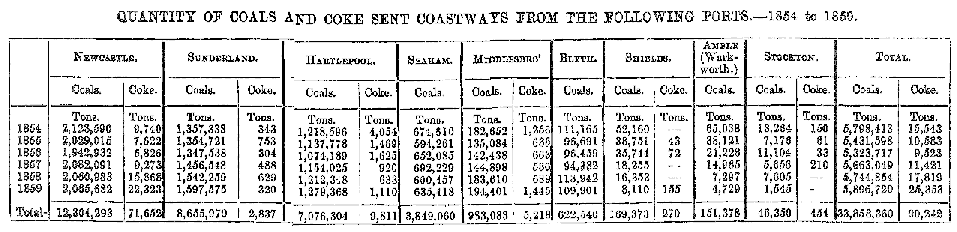
From the above it appears, that in 1859 there were 9,745,524 tons of Coal exported and sent coastways from the counties of Durham and Northumberland.


Please Note: These web pages retain the original pagination from the publication




 Contains public sector information licensed under the

