


|

|

|

|
|
 |
||||
 |

|
 |
||
Of Iron ore, it appears that in the United Kingdom 9,573,281 tons were raised in 1857, producing 3,659,447 tons of pig iron. The value of this at the furnace was estimated at £3 per ton, showing a total value of £10,978,341. The quantity of Coal produced in the same year was 65,394,707 tons, valued at £16,348,676 at the pits' mouth, and at nearly £30,000,000 at the places of consumption, independent of the worth of the large quantities consumed in the colliery districts for the manufacture of Iron. In this department of our home produce, the capital invested by colliery owners in the United Kingdom, amounts, it is calculated, to about £45,000,000; and in connection with the Coal trade, a further sum of £47,000,000 may be added as the value of shipping engaged in the conveyance of Coal, including a proportionate share of the cost of railways, canals, and docks, used alone for purposes of Coal traffic. These sums form a grand total of £92,000,000 sterling sunk in respect to the production of Coal, and may be thus apportioned (See Transactions of the Northern Mining Institute, Dec. 6,1855):—
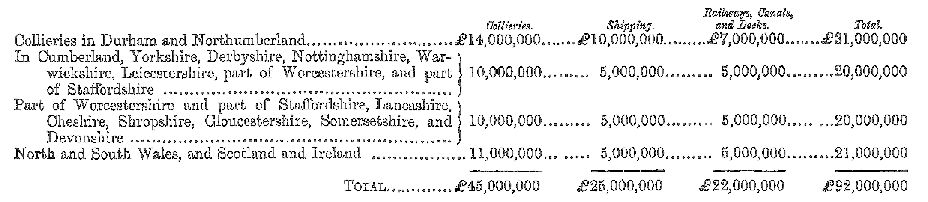
The value of Coal for the year at the pits' mouth being £16,348,676, or at the places of consumption £30,000,000, it follows that it requires the value at the places of consumption of full three years' produce to equal the amount of capital invested. By far the largest proportion of the amount of capital appears to be sunk in the Newcastle Coal-field; Mr. Buddle, in his evidence before a Committee of the House of Lords in 1829, estimated the capital invested in collieries on the Tyne and Wear, exclusive of river craft, at £2,200,000, but the amount it appears has now reached the enormous sum of £14,000,000 Indeed, this will not be matter of much surprise, when it is considered that in winning and working some of the large colliery undertakings in this district, a sum equal to half a million pounds sterling has not unfrequently been invested in single undertakings by such proprietors as the Marchioness of Londonderry, the Earl of Durham, the Great Hetton Co., the South Hetton Co., the Haswell Co., &c. These large concerns may comprise from six to twelve separate mines, and all the requisite engines, waggons, horses, &c. The second rank collieries, as regards capital, such as Wingate Grange, belonging to Lord Howden and Partners, has cost about £200,000; Thornley Colliery, the same amount. The third class may be reckoned single pits, with capitals of from £40,000 to £60,000 ; and the fourth and most numerous class, from £8,000 to £25,000, the produce from which supply the local manufactories, and form a portion of the coasting trade. There are still smaller undertakings, but they are chiefly for land sale, and do not enter the general markets. The great extension of demand for steam Coal has so revived several collieries north of Newcastle (which thirty years ago were considered utterly worthless, and on some of which £50,000 or £60,000 had been spent), as to make them now clear a fair amount of profit. The Hetton Coal Co., one of the largest and most powerful in the trade, is believed to average a profit of from £35,000 to £45,000 per annum. Two or three of the other large establishments average about the same sum.
But some of the colliery establishments which must be ranked amongst the first class, from the quantity of Coal produced, may have cost considerably less than £500,000, owing to various favourable circumstances attending the winning and working, and the district in which they are situated, and so far are more profitable; whilst several amongst the second class may have cost much more than £200,000, the capital for the last twenty years not even paying interest, and in this respect can only be considered as third or fourth class concerns; for if offered for sale at the present time, they would not realise 1-10th of the amount they have cost the different owners.
Admitting the successful issue of some of the undertakings alluded to, and beyond doubt throughout the various Coal-fields there are many that adequately pay the proprietors, still, as an investment, there is not, on an average, a fair return of profit for the risk incurred and the amount of capital required. The opening of a mine is a very expensive and hazardous operation, and of very uncertain result. Collieries are exposed to an infinite number of accidents, against which no caution can guard. Besides explosions, and other contingencies, mines are very liable to be destroyed by creeps, or by sinkings of the roof; and by drowning, or the eruption of water from old workings, through fissures which cannot be seen, and consequently cannot be guarded against. So great, indeed, is the hazard attending this sort of property, that it has never been possible to effect an insurance on a Coal work against fire, water, or any other accident.
The owners of the Coal lands, no doubt, have accumulated large fortunes from the rental of their Coal in the mine, wayleaves, &c., yet it does not appear that the operative miner, and those who have become the adventurers, have been equally fortunate. Instead of the business of Coal mining being, generally speaking, an advantageous one, it is distinctly stated to be the reverse; not only as regards individual adventurers, but to all those who were so unfortunate as to become shareholders in Joint Stock Coal Companies. Sometimes, no doubt, large fortunes have been made by individuals and associations engaged in this business; and parties may have entered upon mining operations at times of great depression, purchasing lease, plant, &c., as bargains, and ultimately realizing enormous profits, but this has been effected at the expense or ruin of their predecessors.
Mr. N. Clayton, as early as 1800, in giving evidence upon this subject before a Parliamentary Committee, stated :— "I have possessed the means, and have had frequent opportunities of adventuring in speculations (in Coal). I have ever declined doing so upon the principle that the average profits resulting from these adventures, were inadequate to the employment of so much capital as they require, and the risk attending them."
Mr. Buddle's opinion before a Committee of the House of Lords, in 1829, was, that — "Although many collieries in the hands of fortunate individuals and companies, have been, perhaps, making more than might be deemed a reasonable and


Please Note: These web pages retain the original pagination from the publication




 Contains public sector information licensed under the

