


|

|

|

|
|
 |
||||
 |

|
 |
||
the respective districts into which it was brought; the duties on Belgian Coal was at the same time reduced from 2s. 6d. to 10d. and 1s. 3d. per ton.
The number of mines in operation in 1835 is stated to have been 223, worked by 19,484 hands, including those above and below ground, averaging about 87 men to each mine; the total production was about 2,506,416 tons; each mine would thus average a yield of 112,400 tons, being nearly 126 tons to each working man in the year.
The total extraction of native Coal in 1841 amounted to 3,410,200 tons, from 256 mines then in operation, giving an average yield from each mine of 13,321 tons. The number of workmen employed was 29,320 (22,595 in the pits, and 6,725 above ground); so that on an average each man produced 116 tons. Cost of production, 7s. 9¼d. per ton. The total value of Coal this year was £1,326,361.
In 1849, there were 270 pits, the extraction from each pit was about 15,000 tons, and the miners averaged 125 tons per man. In 1850, there were three more mines in operation, and 571 additional miners. The extraction from each mine was 16,240 tons, and the quantity worked by each individual was 131 tons. In 1852, the number of mines increased to 286; an addition of 711 miners was added, but the individual extraction was only 107 tons. in 1856, the production was 7,740,317 tons, and the consumption 12,810,316, the difference being supplied from other countries, as may be seen by reference to the following table :—
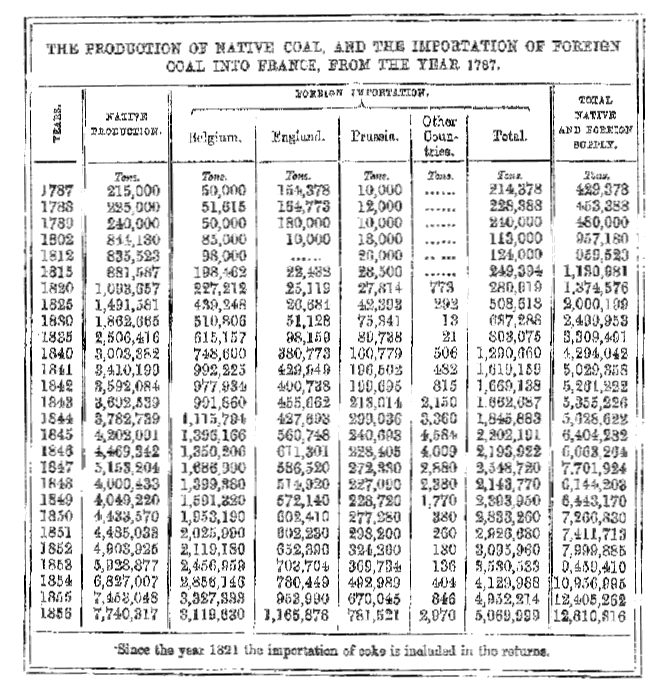
There are six varieties of Coal produced in the French Coal-fields; and of these varieties, in no one instance are all six found in one department. The six varieties are thus classified :— Free-burning smithy Coal, yielding about 70 per cent. of coke when calcined in a close oven; close-burning Coal, yielding about 60 per cent. of coke; common smithy Coal, producing full 70 per cent. of coke; and the hard Coal, which gives as much as 75 per cent. of coke. Of the different varieties, the greatest quantity produced is of free-burning smithy Coal, valued at 7s. 4d. per ton.
The French, where they are acquainted with the comparative qualities of Coal, give a marked preference to the English production; but the duty levied is a check to their general use. Belgian Coal pays a uniform duty to Government of 1s. 6d. per ton, and English Coal a duty of 3s. per ton, except when delivered south of Sables d'Olonne, where the duty is the same as the Belgian Coal. Besides these duties, a charge of 6s. per ton is levied by the municipal authorities, for purposes of local improvement. The total amount of duties levied by Government on English, Belgian, and Prussian Coal, was in 1851, £249,223; 1852, £306,902; 1853, £285,256; 1854, £248,171; 1855, £333,550; 1856, £362,878.
PRUSSIA. — The extent of the Coal formations of Prussia has not yet been particularly defined. In 1836, 2,000,000 tons of Coals were produced. In 1840 there were about 752 mines or pits, anthracite and lignite, in operation. These employed 24,024 miners, and produced 3,245,607 tons, of the official value of £793,860 sterling. In 1845 there were 3,500,000 tons produced, valued at £856,370. Of the quantity of Coals raised this year, Prussia exported into France 237,200 tons; and some idea of the increase of her production may be formed from the fact of her having in 1856, raised her exportation into France to 781,521 tons — See the above table. A work on the collieries and Coal trade of Prussia has


Please Note: These web pages retain the original pagination from the publication




 Contains public sector information licensed under the

