


|

|

|

|
|
 |
 |
|||
National Coal Board
Northumberland & Durham Division
Horden Colliery
August, 1966
Foreword
The Annual Holidays just ended mark the end of four years' work, which since August, 1962 has been directed towards the modernisation of Horden Colliery. The commencement of skip-winding at the North Shaft marks the beginning of a new phase in the life of Horden based on substantial reserves of coal undersea.
On this important occasion I would like to pay tribute to the strenuous efforts made by all officials and workmen employed at the colliery in carrying through the reconstruction scheme and to offer an assurance of the board's earnest support and goof wishes in your efforts to build a secure future for your colliery.
Area General Manager
12th August, 1966.
Location
Horden Colliery is situated on the coast of South East Durham about 7 miles north of Hartlepool. The colliery adjoins the West Hartlepool-Sunderland line of British Rail which provides excellent railway facilities.
History
Shaft sinking commenced in 1900, the shafts passing through 425 feet of water bearing limestone. Sinking of the North and South Shafts, each 20 feet in diameter was completed in 1904 and the East Pit, 17 feet in diameter, in 1908.
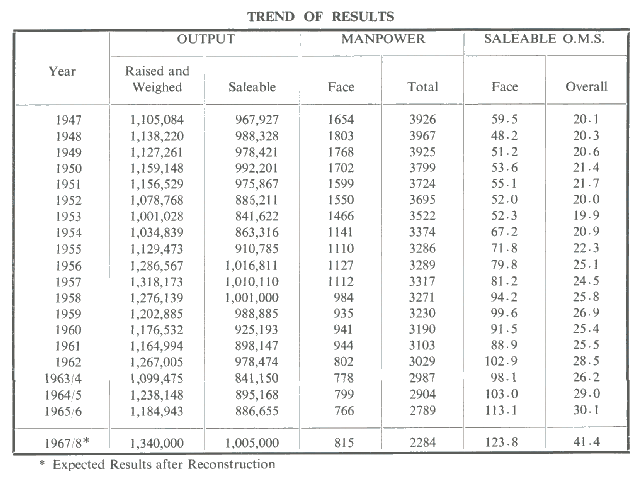
Since 1947 raised and weighed output has never fallen below 1,000,000 a year and in 1957 reached a peak post war output of 1,318,173 tons. The face O.M.S. has risen from 49.5 cwts in 1947 to 113.1 in 1965/6 with a corresponding increase in overall O.M.S. from 20.1 to 30.1 cwts.
Reconstruction
In the last four years a reconstruction of the colliery has been carried out to modernise the mining, underground transport, winding, and coal handling facilities so as to bring Horden into line with the most modern collieries in the country.
The scheme is being completed in two stages :—
- The equipping of the North Shaft to wind all the output in skips to be completed by the holidays of 1966.
- The equipping of the South Shaft to wind stones and materials in mine cars, initially programmed for the holidays of 1967, but now due for completion early in 1967.
North Shaft
The first stage of the reconstruction is now complete. The North Shaft, with new 2,700 H.P. winder with 2 motor drive, winder house, new headgear and 12½ tons skips, is equipped to wind the whole of the output. A completely new shaft bottom circuit has been driven to feed the coals to the skip shaft and a tunnel three quarters of a mile long has been driven to connect this shaft bottom with the undersea workings.
South Shaft
Early in 1967 the South Shaft will be equipped to wind stones and material in 2½ tons mine cars. This shaft will also serve as the min-riding shaft and will be equipped with a 1,350 H.P. clutch drum winder so that both cages can be set to wind from any of the three main levels.
Surface
New screening, conveying and coal storage bunkers handle the coal between the skip-winding shaft and the coal preparation plants. The colliery will be completely electrified superseding the steam boiler plant.
A New Surface Fan
During 1967 a new surface fan capable of giving 550,000 c.f.m. at 19.5" W.G. will be installed in a new fan house on the site of the old North Shaft winder house and the North Shaft will be converted to upcast.
Underground.
Some 5,500 yards of new roadways have been driven, all except 800 yards by N.C.B. labour. This includes a completely new pit bottom circuit and the extending of the existing locomotive haulage road back to the new pit bottom.
The North Shaft has been deepened by 179 feet, the South Shaft by 180 feet and the shaft staple by 164 feet.
Future
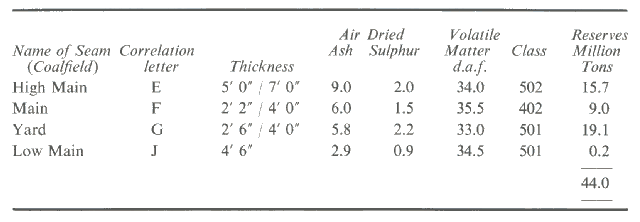
After the reconstruction is complete, production will continue for a short time from the Low Main Seam (J) but eventually production will be from the top three seams the High Main (E), Main (F) and Yard (G) only.
All east side output will be conveyed to the existing No. 1 staple and loaded at the staple bottom into 2½ ton mine cars which will be hauled by locomotives to the tippler station at the new pit bottom feeding the skip shaft. West side coals will continue to be conveyed to the shaft staple and be fed to the conveyor system feeding the skips.
As the working extend Eastwards in the three seams, the locomotive haulage roads will be driven eastwards to cut each of the seams in turn. Thus, by extension of the trunk belt conveyor systems and the locomotive haulage the reconstruction will allow coal to be won from the furthest corners of the take without additional haulage systems.
Results
The scheme will provide the following improved facilities :—
- Concentration of all coal transport to one shaft.
- Main Haulage by mine cars and locomotives instead of several rope haulages and tubs.
- Concentration of workings in the upper seams with larger and fewer faces.
- Enhanced ventilation capable of serving the exploitation of the substantial undersea reserves.
Reserves
The following table gives the seam thicknesses and qualities in situ :—





 Contains public sector information licensed under the

