


|

|

|

|
|
 |
 |
|||
National Coal Board
South Durham
Easington Colliery
Circa. 1973
Situation
Easington Colliery lies on the Durham coast half a mile from the sea and nine miles north of Hartlepool from which some of the output is shipped.
History
Shaft sinking commenced in 1899 and was much delayed by water encountered in the 500 feet of limestone which overlies the coal seams. The sinking was suspended for a period owing to financial difficulties and coal drawing eventually began in 1910 and by 1929 a peak output of 1,053,453 tons was reached.
In 1951 a reconstruction scheme was commenced, being substantially completed in 1957. In the year before starting reconstruction the annual output was 828,427 tons at an O.M.S. of 24.6 cwts. Output for the year 1972 was 901,445 tons at an O.M.S. of 43.3 cwts.
Surface Plant
Winding
There are two shafts, each 20 feet diameter and 1,585 feet deep. Output is wound at both shafts in double-deck cages carrying 2 mine cars each of 3.2 tons capacity. Each shaft is served by 2,5000 h.p. Met. Vick/Markham electric winder on the Ward-Leonard system.
The North Shaft (Downcast) serves Seams E and F, the South Shaft (Upcast) serves Seam J.
Surface Fans
A 180" diameter Backward Aerofoil Bladed Radial Flow fan by Aerex Ltd. was installed in 1962. It is driven through a gearbox by a Mather and Platt 1,600 h.p. Synchronous Motor. The present fan speed of 375 r.p.m. gives 620,000 c.f.m. at 12½" W.G. This fan now acts as standby.
In 1969 a 172" diameter Backward Aerofoil Bladed Radial Flow fan by Sirocco was installed. It is driven by a 2,500 h.p. Variable Speed A.C. motor made by Brush Ltd. The maximum performance of this fan is 750,000 c.f.m. at 18" W.G. This is now the main ventilating fan.
Methane Drainage Plant
Methane drainage operates in most of the working districts, the pipe range being coupled, via the shaft range, to the surface extraction plant. The gas is used for fire a new boiler which serves the heating needs of the surface buildings and pit head baths.
Extraction is by means of L6 Nash Hytor Exhauster pumps, three of which are installed, one running at any one time. A visible and audible alarm is given if the methane purity drops to 50% and the plant is automatically shut down if the purity drops to 40%. These and other safety features prevent the possibility of an explosion in the plant of the boiler.
The current rate of drainage is 400 c.f.m. of methane mixture equivalent to some 200 c.f.m. of pure methane.
Coal Preparation
Coals from the two shafts are tipped, screened and bunkered separately. The controller mixture of High Main and Low Main seams to form the feed to the washery is shortly to be replaced by a fully automatic blending system to maintain a consistent blend of the seams.
The Washery is a Simon Carves 500 tons per hour Baum plant equipped with Froth Floatation, Centrifuges and Classifying Screens.
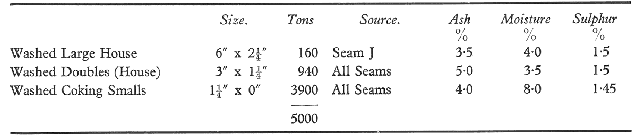
A typical patter of the products made on a recent day is :—
Dirt disposal is by Aerial Ropeway to the sea.
Underground
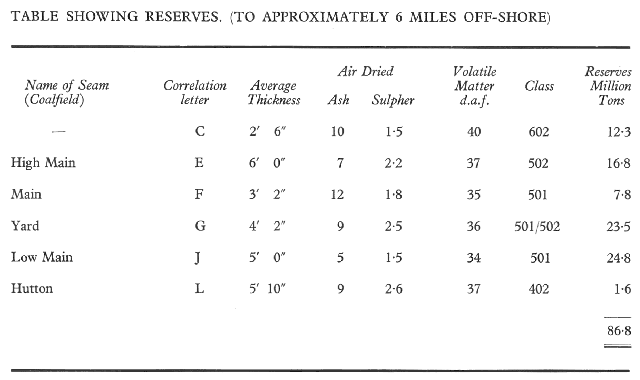
There are five principal coal seams which extend under the sea. The lowest, the Hutton is virtually exhausted and not now worked. At present output is concentrated mainly into two seams, seam (E) (with some seam(F)) and seam (J).
All of the current output is obtained from under the sea, the furthest coal face being 4 miles from the coast. The general dip of the strata is to the East and the deepest workings at Easington are at a depth of 1,800 B.O.D. or some 1,700 ft. below the sea bed.
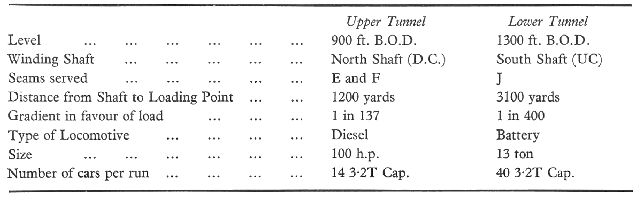
Underground Coal Transport is by belt conveyor systems to two mine car loading points situated at different levels. The upper loading point in Seam E is situated on the 900 level. The lower loading point in Seam G is situated on the 1,300 level.
Upper Level Conveyor System
The loading point for Seam E and F is fed by two East Trunk Conveyors, the outbye conveyor being 42" wide and 1,800 yards long with a capacity of 450 tons per hour against a gradient of 1 in 21. The inbye conveyor, installed in 1969, is 42" wide and 2,100 yards long. These conveyors deliver to a 250 tons capacity Butterley moving car type bunker. Final delivery from the bunker to the loading point is by a short 42" belt conveyor.
Conveyor System at Lower Level
Coal from the Low Main Seam is conveyed to the loading point on the Locomotive Haulage Road, which at this point is in Seam G, by a system of 6 conveyors with a total length of almost 3 miles and a vertical lift of 500 feet.
A moving car type bunker with a capacity of 200 tons is installed at the delivery end of the inbye conveyor.
Production
Production at Easington has for several years been completely mechanised, current output is from six longwall faces and seven continuous miners.
In Seam E, six feet thick, some 3,000 tons per day is produced from two retreating faces and five continuous miners. The retreating face 100 yards long and equipped with Powered Roof supports and Anderton Shearer Loaders each produce around 1,000 tons per day at an O.M.S. to 20 to 30 tons saleable. This coal, together with the coal from an advancing training face in Seam F equipped with Anderton Shearer loader, is loaded at the Seam E loading point.
Five continuous miners in Seam E are used to drive roadways, to preform the roadways for the retreating faces and to extract areas of coal.
In the Low Main Seam J, 5' 0" thick, two advancing longwall faces with shearer loaders and powered roof supports produce together 1,000 saleable tons per day. Much of the development work is done by Continuous Miners and Doscos.
To serve the East Low Main a high speed man-riding system has been installed. Man riding is in special cars hauled by tandem diesel locomotives on continuously welded track. This man rider operates at present over a distance of 6,800 yards and will extended as required. The existing tandem locomotives are to be replaced by specially built bogie type locomotives capable of higher speed and more stable operation.
The following table gives the figures for seam thickness and qualities in situ :—





 Contains public sector information licensed under the

