


|

|

|

|
|
 |
 |
|||
The method of working at Wearmouth and Silksworth Collieries
Extract from "The Colliery Managers Handbook" by Caleb Pamely. Published in 1893.
The method of working the Maudlin Seam, Wearmouth Colliery, Sunderland, is by Pillar and Stall. The colliery has been working coal since 1835, but sinking operations were commenced there in 1826. There are two shafts, an upcast 11 feet 6 inches in diameter, and the downcast 12 feet. Both are winding shafts, and together in 1881 they raised 2,000 tons a day, the day here consisting of 24 hours. The tubs used carry 8 cwt. each. Two 4-decked cages run in each shaft. Two tubs are placed in each deck, so that the cage carries 8 tubs. The furnace which helps to produce the ventilation is not placed at the bottom of the upcast, but in the Maudlin Seam, 44 yards from the bottom, it has a firegrate area of 144 square feet, and is greatly assisted by the furnaces of 6 boilers. The total quantity of air varies from 180,000 cubic feet per minute to 200,000 cubic feet, being highest in the winter months, when the natural ventilation is greatest.
The shafts prove the Maudlin and Hutton seams at a depth of 530 yards and 574 yards respectively, both seams being worked. They lie almost flat, the dip to the East being so slight as to cause no inconvenience in carrying roads in any direction. The working faces in most of the districts are from 2 to 3½ miles distant from the shaft, and the coals are brought out along engine planes. The tail-rope system of haulage is adopted, and there are more than 20 miles of steel-wire rope in daily use in the pits. In one of the longest engine planes, where the empty train is taken in at the same time that the loaded one is brought out, there are 126 tubs on the road at one time.
A section of the Maudlin Seam is shown at Fig. 192.
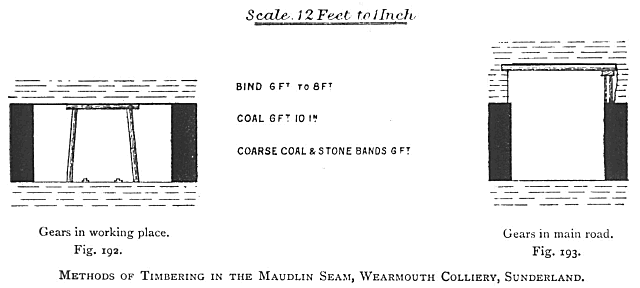
The openings in the coal are 12 feet and 9 feet wide, the pillars left being 40 yards square. No holing under the coal requires to be made by the workmen, as the coal is tender, and the workmen "scallop" it, that is, they hack it out with picks while standing upright. In the screens used the bars are an inch apart, and 55 per cent. of the coal got passes through the screens. There is no objection to this, as the coal is used for gas making. The colliers do not place their own timber at the working faces. This is done by the deputies, unless in cases of emergency, when the collier puts up timber, which is left in his place for the purpose. In the solid working, sets of timber are placed in the roads every 3 feet. The props are 3½ inches in diameter, 6 feet high, 5 feet 6 inches apart at the bottom, and 4 feet 6 inches apart at the top, as shown at Fig. 192. The rails are laid in the centre of the roads between the two upright props. The collars are made of 5-inch props split through the middle, and the half-round side is placed next the roof.
The props are put in by the deputies as the places are being driven, and remain in until another end is through. The deputies then draw them, after which the roof usually falls to a height of 2 or 3 feet; but sometimes the fall is sufficient to fill the place up. The pillars crumble off at the sides, owing to the tender nature of the coal.
The Broken is worked by splitting the pillars, and bringing back the jud on both sides, A deputy attends about 12 men, and they send out about 60 tons a day.
The collier receives 10d. a ton for hewing and filling, in the whole mine.
The roof over the coal is good, the cost for timbering being 1¼d. per ton in the roads and solid places, and 2d. in the pillar working.
The main roads are timbered, as they require it, with props, or sets of timber. At some parts the sets are placed 3 feet apart, and are 6 inches square and 9 feet long. The props in the main roads are 4½ inches in diameter, 8 feet long, and have hard wood lids 6 inches x 7 x 2½. Where the sides are good one side of the collar is notched 6 inches into the roof, and receives support on the other from a short prop 3 feet long, this prop being placed in a notch prepared for it in the roof over the coal, see Fig. 193. The timbering of the main roads is done by a special class of men called stone-men. They work in pairs, and receive about 1s. for a 9-foot "balk" or collar, but the price varies according to the difficulty of the task in fixing it. Two stone-men working together can put in 10 sets of 9-foot timber in a shift.
The workings are dry generally, although a little water is found in some of the swamps, and this water is very salt, containing as much as 21 ozs. of salt to the gallon. The roads get very dusty; they are watered regularly, and the dust cleared up once a fortnight.
At the Silksworth Colliery, near Sunderland, the same seams are worked as at Wearmouth Colliery. Silksworth Colliery is comparatively new, and consists of two shafts, one of which is 16 feet 6 inches in diameter, and the other 14 feet. Both shafts are sunk to the Hutton Seam, at a depth of 580 yards, the Maudlin being passed at a depth of 540 yards. 2,000 tons of coal are landed daily. Only the larger shaft is used for winding, and it is fitted up with 4 cages. Two of these wind coals from the Hutton, and two from the Maudlin Seams. There are two pairs of winding engines, each having 48-inch cylinders and 6-foot stroke. The engines winding from the Maudlin Seam have 25-foot cylindrical drums; the other pair of engines, winding from the Hutton Seam, have a scroll drum 13 to 28 feet in diameter. One pair of engines was made by Barclay of Kilmarnock, and the other by the Grange Iron Co., Durham. Both are fitted with a very simple and effective automatic variable expansion gear. Mr. Daglish, the chief viewer, in a paper read before the North of England Institute of Mining Engineers, has fully described this expansion gear. The cages are arranged as at Wearmouth Colliery to have 8 tubs on 4 decks, but are here loaded and unloaded at two levels, both at the surface and underground. The smaller shaft is used only as an upcast. A furnace is placed in the Maudlin Seam which has 90 square feet area of firegrate. The total quantity of air passing up the shaft is 195,000 cubic feet per minute. This reaches the shaft by three main returns, one 100 feet area, passing 45,000 cubic feet a minute; one 124 square feet, passing 80,000 cubic feet a minute; and that in the Hutton Seam, 100 feet area, passing 70,000 cubic feet. The dip is not uniform throughout the workings, varying from 1 in 18 to 1 in 6.
The following is a section of the Maudlin Seam :—
| ft. | in. | |
| Blue Metal (Roof) | 1 | 8 |
| Coal | 5 | 8 |
| Sagger (Fireclay) | 0 | 2 |
| Bottom Coal | 0 | 10 |
| Sagger | 0 | 8 |
| Coal | 1 | 6 |
| Blue Metal | 3 | 0 |
The method of working is by Pillar and Stall, the pillars being formed 50 yards square, the openings round them being 12 feet one way, and 8 feet the other. The 12-foot wide places are commenced 8 feet wide, and after going in 9 feet they are widened to their full width, and are carried on so till they are nearly through. When within 9 feet of being through they are reduced to a width of 8 feet, and carried to the end that width. The working is in the feet 8 inches of coal in the above given section. The roof consists of a "blue metal" 20 inches thick, over which are 3 fathoms of post and blue metal mixed. Below the 5 feet 8 inches of coal is a thin bed of sagger, then 10 inches of bottom coal, followed by 8 inches of sagger, then 18 inches of coal, all of which are taken out in the main roads to make height, but the coals are inferior and unmarketable, and so are left on in the ordinary working. Below come 3 feet of blue metal, and then 3 or 4 fathoms of sandstone. The workings of the Silksworth pit are within half-a-mile of those at Wearmouth, and although the Maudlin Seam is not quite so thick at Silksworth, the coal is very similar at both places. The main roads are timbered as at Wearmouth.
Fig. 194 shows the usual method of working the pillars at Silksworth, First the 50-yard square pillar is split by means of an 8-foot place. From this split, and also from the ending parallel to it, lifts are taken out. These lifts are 6 yards wide, and each is carried 20 yards to the rise and yards to the dip. In the two lifts being driven at the low side of the pillar in Fig. 194, it is seen that the portion of yards to the dip, belonging to those lifts, is not taken out. That operation would follow the completion of the rise portion of the lift. The lifts are kept "stepped."
Fig. 195 shows the practice of working the pillars at Silksworth, where the roof is good. Here the lifts are driven half-way up the pillar from both sides without splitting it. The place is commenced 6 feet wide, leaving 4 yards of solid coal between the road and the goaf, and is continued this width for a distance of 4 yards, after reaching which it is widened out to the waste. This leaves a "stook" or small pillar, of 4 yards square, between the road and the goaf. The lift is carried half-way across the pillar, or 25 yards, after which the props are drawn by the deputy, and the roof allowed to fall. Two men work in each lift in each shift, there being a fore and back shift. They are paid 8d. a ton for hewing and filling the coal. As a fact, the lifts are taken off the pillars on both sides of the split, as shown in Fig. 194, but Fig. 196 shows how they might be arranged to be worked from one side only. The workmen "scallop" the coal, there being no holing, and therefore no spragging. Props and "sets," the same as at Wearmouth, are used, the sets being arranged with the rails between them in the lifts, and placed about 18 inches apart. On the waste side of the road three rows of 6-inch props are placed about a yard apart, as shown on Figs. 194 and 195. There is no rule in force as to the distances apart these prop. are to be placed, but there is an understanding that they are not to be more than a yard, The deputy sets them, and when the lift is finished he draws the props out, commencing at the inside. The hewers are out of the pit when the deputies draw props. The 4-yard "stook" is then worked off and the props drawn. In cases where the deputies cannot draw the whole of the timber without assistance, timber drawers, who are always spare deputies, are put on to help them. These men receive 8d. and 10d. a score for taking out the props, but this price is paid only on whole timber, unless the broken timber is required, in which case two broken props count as one whole one, A deputy attends to 10 or 12 men, his duty being to set and draw timber for the men, and see that all the ventilating arrangements are right. He works an 8-hour shift, the same as the colliers, and during his shift visits each place twice. He receives a daily wage.
The whole-mine workings are the same as at Wearmouth. The roof over the coal is good, the cost of timber being 2½d. per ton.





 Contains public sector information licensed under the

