


|

|

|

|
|
 |
 |
|||
from The Illustrated London News, October 5, 1844
Third Day - Wednesday.
The inquest was resumed this morning. The whole day was consumed in taking the evidence of Robert Thompson, master waterman of the pit, which went to corroborate that given on the previous day. His testimony went to show that nothing more could have been done to prevent the accident. After some discussion if was agreed to adjourn the inquest till Wednesday in next week ; and in the meantime the jury begged the coroner to request Mr. Nicholas Wood and Mr. George Hunter to examine the mine and report their opinion to the jury,
Additional Particulars.
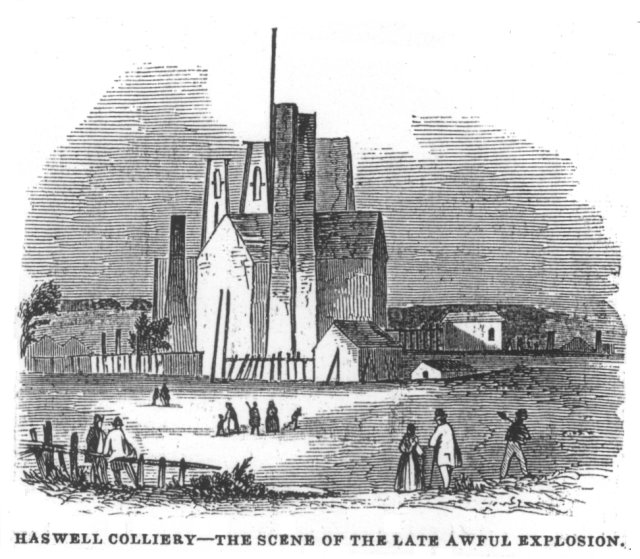
Haswell colliery is one of the most extensive in the county of Durham. It employs upwards of three hundred men and boys, and it is celebrated for the very superior quality of its coal. The pit, though essentially one, is divided into separate workings called respectively the Big-pit and the Little-pit. The explosion took place in the latter. The number of men and boys usually employed in this part is about one hundred, and when the explosion took place there were ninety-five down - ninety-five of whom have perished. The other four would also, without doubt, have suffered, had not the course of the explosion been interrupted by some wagons laden with coals, in what is called a "rolley" way - a railway used for the purpose of conveying the coals to the bottom of the shaft to be drawn to the bank. The four men who escaped were at the end of these wagons nearer to the shaft. They saw the flame approaching, having the appearance of forked lightening, when it fortunately struck the wagons referred to. The horse attached to them was killed, and thrown completely over in the form of a somerset, falling on his back.
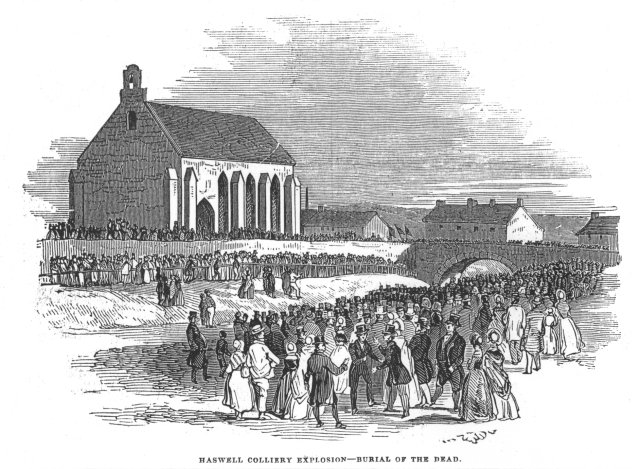
About fifty of the unfortunate sufferers were interred on Monday, and the remainder on Tuesday afternoon. The funerals were very decently conducted, and the spectacle was a most touching and melancholy scene. The neighbourhood may truly be said to the be scene "of lamentation and mourning an woe," as the calamity has entered the abodes of almost every inhabitant in the district, and some families have been bereaved of their only earthly support and protectors.
Our engravings represent the colliery, the scene of the awful catastrophe ; and South Hetton Church, where the greater number of the dead were buried, in trenches on Monday afternoon:
In far Golcond, or Oman's sea,The seeker for vain luxury
may lose his life, and Pity shed
A few cold tear-drops o'er his bed;
But here, where hundreds for our good,
Are undermining life for food,
Most hardly earn'd, how should we weep
To see at one ungenerous sweep
So many beings snatch'd by Fate -
So many too, left desolate!
How many ties were broken there,
How many hopes chang'd to despair!
Oh! This is subject to true grief,
Which ev'n in tears can't find relief!
And then, the solemn cavalcade -
The melancholy long parade,
That through the churchyard slowly wends,
With widows, orphans, sisters, friends,
Fathers, mothers, all in tears
Weeping o'er untimely biers :
This is a sight to wound the sense
Of heart with Pity's least pretence.





 Contains public sector information licensed under the

