


|

|

|

|
|
 |
 |
|||
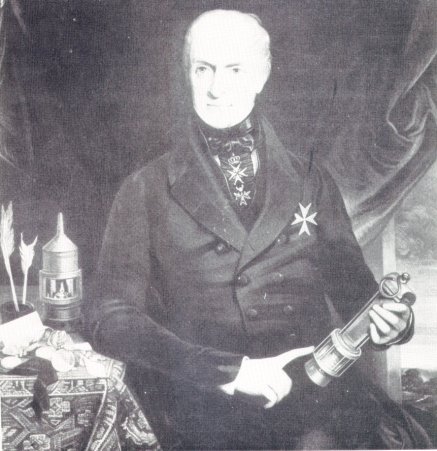
William Reid Clanny, M.D., F.R.S.
Document Extracts
1816, May 31st
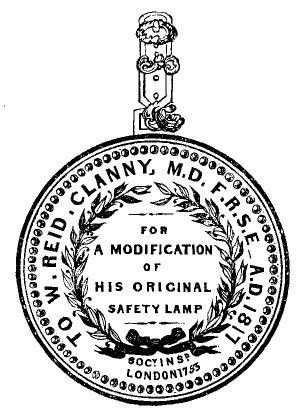 The society of Arts presented a silver medal to William Reid Clanny, esq., M.D., of Bishopwearmouth, for his safety lamps for coal mines. This society, in the following year, presented the doctor with a gold medal for a steam safety lamp.
1821, December 4th
At a numerous meeting of the Literary and Philosophical Society of Newcastle, Dr. Clanny, of Sunderland, presented for the purpose of being preserved in their repository, the original safety lamp, as it is described in the Transactions of the Society of Arts, for 1813, and which first called the attention of philosophers, and of the proprietors of coal mines, to the subject.
Source: LRS1831 - Cholera in Sunderland
The first outbreak of cholera in the British Isles was in Sunderland in the winter of 1831. The national epidemic which led on from this and the impact the new killer had on public opinion contributed much to the eventual winning of public health legislation and attempts to contain the problems associated with over rapid urban growth.
With an aggregate population of some 40,000, rising rapidly, appalling living conditions in the riverside parish of Sunderland particularly, and considerable trade links with the Baltic where cholera had blazed since June 1831, the town was, in retrospect, a likely candidate for the first outbreak. It is probable that the first victim was a river pilot called Robert Henry but it was the 12 year old Isabella Hazard who died on the 17th October, the famous "blue girl", who displayed the classic and unmistakeable symptoms of the disease in its extreme form. It was the death of the 60-year old keelman William Sproat on the 26th October which led the local Board of Health on the 1st November to inform the government of the presence of the "continental cholera". The upshot of this was the declaration of a fifteen day quarantine on the harbour.
So far the lead had been taken by the only two medical men in the town with any degree of independence and sufficient experience and knowledge. James Kell the garrison doctor had dreamt this nightmare once before on the island of Mauritius when he had been garrison doctor. William Reid Clanny, on the other hand, made up for a lack of specific experience with a wealth of theoretical knowledge. The chief physician at the Infirmary, he already possessed developed views as to the causes of cholera believing that it was due to atmospheric disturbances producing a gaseous miasma and the resultant "hyperanthraxis".
The problem was that cholera was no longer an academic medical problem. The local business community and the coal trade especially felt themselves threatened by the quarantine. Since there was no inland quarantine anyway the government action seemed inconsistent. Apart from anything else the new disease in its milder forms could be compared to other zymotic diseases. It was very debateable whether this was really the dreaded "Asiatic Cholera" or just commonplace old "English Cholera" born from the stench of backyard filth. If it was this latter there was no point in quarantine which would probably just lead to more unemployment and poverty.
This explains the discovery revealed to all on the 10th November by the Sunderland Select Vestry that "... the Town of Sunderland is now in a more healthy state than has been usual in the Autumnal Season ..!" so that the pernicious quarantine operated enthusiastically by a young naval officer was a waste of time. The next day local businessmen at a meeting in the Exchange Building attacked the letter of the 1st November as a "most wicked and malicious falsehood" and they insisted that transmission of such ill informed communications without consultation with the leading members of the community must cease.
Easily pulled into line by the representatives of that class which paid their fees the doctors met on the 11th November and recanted. Of course this put Clanny into a very difficult position. He was accused of duplicity although not in fact involved in the vote of the doctors and very concerned that the prevailing view should not obstruct proper remedial action. His own theories as to the cause of cholera also meant that he could see little value in the quarantine. The result was that on the 12th November he was able to draw the leading physicians and surgeons to agree to a compromise declaration that the disease was present but had not been "imported", that it was caused by environmental and dietary factors and that anything retarding the trade of the town would only make matters worse.
The disease raged on throughout November and December. A total of 418 cases were diagnosed and there were 215 deaths. Special ground was set aside in an extension of Bishopwearmouth's burial ground on Hind Street near the Infirmary for the burial of the victims. The magistrates took steps to regulate the communications between Sunderland and the surrounding towns and, with a somewhat exaggerated view of medical capacities, to encourage patients to allow themselves to be removed to hospital for treatment. By January however the disease had been loosed into South Shields, Newcastle and Gateshead. interestingly the barracks, although in the midst of the stricken area, suffered no victims at all. Dr. Kell attributed this to the closure of the gates from the 1st November and the implementation off a firm quarantine.
The effect of the affair was that Sunderland appeared in a very bad light. The London Medical Gazette remarked:
The good people of Sunderland appear in no very favourable light, it seems very clear that the public safety is in their estimation a very secondary object when brought into competition with the sale of coals.
In fact given all of the circumstances of the time the local reaction is less worthy of the opprobrium which the event attracted and when set against the panic responses to novel diseases in this century it is almost understandable.
Source: SRTP1839, August 19th
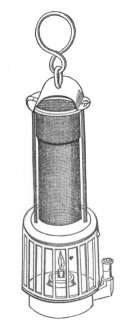 Monday, Dr. Clanny, of Sunderland, read an important paper in the hall of the Mechanics' Institution, South Shields, to the members of the Committee for the Investigation of Accidents in Mines, and their friends. It is due to this talented and scientific gentleman to state, that he was the very first to meet the difficulties of the mines by human ingenuity, and a lamp of his was in existence, and used in some of the mines on the Wear, long ere any attempt was made by any other person. The principle of construction may be readily understood by the annexed engraving. The flame is preserved in an upright state at all times, being surrounded by a strong cylinder of glass, through which five times the quantity of light is transmitted than that of the common Davy. The glass cylinder is guarded by a grill of polished brass. The great principle of this safety lamp is, that the admission of air is wholly from above the flame, and by this means the influence of currents acting laterally is in a great measure prevented. Another source of safety is that the wire gauze cylinder contains 1296 meshes whilst the Davy contains only 700 meshes to the square inch. The cylinder of glass is so cool that the safety lamp may be plunged into water after it has been giving out flame for hours - as has been repeatedly proved. This is truly a safety lamp.
1850, January 10th
Died, at Bishopwearmouth, in Bridge-street, suddenly, aged 73, William Reid Clanny, esq., M.D., F.R.S., &c. The deceased had practised in Sunderland for upwards of forty-five years with great ability and success. In 1812 he turned his attention to the cause of the disastrous calamities in coal mines, and in the course of his studies he conceived the idea of a safety lamp, greatly different, however, from that at present in use. On the 1st October, 1813, his lamp was exhibited before the Literary and Philosophical Society in Newcastle, and in 1815 it was tried in Merrington Pit with some success, but owing to its cumbrous form it never came into use. As, however, it was not until 1815 that either Sir Humphrey Davy or Mr. Stephenson commenced their investigations on explosive mixtures, it is clear that Dr. Clanny is entitled to considerable credit for his invention, and on February 3rd, 1848, he was presented with a testimonial, value £200, by the Marquis of Londonderry and other coal owners. The deceased contributed largely to medical literature, and for his valuable works in that department he received the ribbon of the Legion of Honour and many other badges of distinction. A few days before his death Dr. Clanny presented the Literary Society of Sunderland with portraits of George III, Archdeacon Paley, the Marquis of Londonderry, Baron Cuvier, and the donor himself, the latter being from a painting by Reay, in the Town Hall, presented to the deceased by the medical profession of Sunderland.
Source: LRLBrief Biography - Clanny, William Reid (1770-1850) (Physician and Inventor)
Clanny was born in Bangor. County Down, of Scottish Presbyterian background. Took a degree in medicine at Edinburgh where he also married Margaret. the daughter of Captain Mitchell of the East India Company. Served for a time as a surgeon in the Royal Navy and was present at the Battle of Copenhagen in 1801. Came to Sunderland and practised as a physician for 45 years although his contribution to the development of the community extended far beyond his professional duties. In 1813 he wrote an article entitled "On the means of procuring a steady light in coal mines without the danger of explosion", revealing the results of his preliminary research. In the same year he became a founder member of the Society for the Prevention of Accidents in Coal Mines. By 1816 when he published "Practical observations on safety lamps for coal mines" he had experimented in person with a safety lamp at the Herrington Mill Pitt. His lamp, and other improvements were, after some initial disputes, recognised for their true worth by his contemporaries including northern coalowners who presented him with a piece of silverware. George Stephenson acknowledged a debt to Clanny's researches and Davy invented his version of a lamp very soon after a visit le Sunderland in August 1815. In 1831. as the chief consultant physician at the Sunderland Infirmary, he was amongst the first to recognise the true nature of cholera. He was a "miasmatist". a believer in disease generated by an "atmosphere highly vitiated by carbonic acid". His book Hyperanthraxis (1831) was the first scientific treatise on the subject of cholera. Critics of Clanny at the time of the cholera outbreak regarded him as arrogant and ambitious but this must be assessed against the circumstances in which he was working. Clanny was also very active in cultural pursuits and was a founder and vice-president of the Sunderland Literary and Philosophical Society. He was the author of numerous papers end articles on medical and scientific subjects and a frequent contributor to the Lancet. He died on the 10 January 1850. His obituary in the Sunderland Herald singled out his lamp as his greatest achievement "... peace will be with the remains of him who has contributed to save thousands of the bare-headed sons of toil and industry from premature and violent death ... for which his memory ought to be dear to all".
Biography written by Stuart T. Miller citing the following sources:
- Brockie, W., Sunderland Notables (Hills, 1894) pp. 148-153
- Sunderland Herald 11 January 1850.
Sources
LHTB - The Local Historian's Table Book of Remarkable Occurrences Connected with the Counties of Newcastle-Upon-Tyne, Northumberland and Durham by M.A. Richardson. Published in eight volumes (five on history, three on legends) in 1844.
LRS - Local Records by John Sykes. Published in two volumes in 1833. Provides a "Historical Register of Remarkable Events", ordered by date.
LRL - Local Records by John Latimer. Published in 1857. Provides a "Historical Register of Remarkable Events", ordered by date - continues the work by John Sykes for the period 1832-1857.
SRTP - Sunderland - River, Town and People, A History from the 1780's to the Present Day. Edited by Geoffrey Milburn and Stuart Miller. Published in 1988 by Sunderland Borough Council. ISBN 0 947637 06 0





 Contains public sector information licensed under the

