


|

|

|

|
|
 |
 |
|||
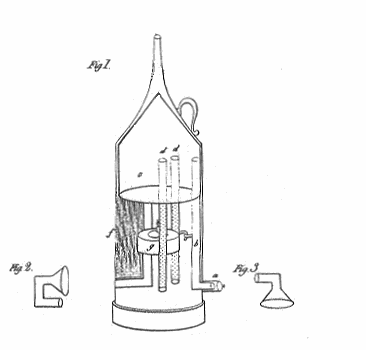
Fig. 1. a represents the short tube, by which the air enters into the tube σ, and this tube supports the water cistern c, at the top, being fitted into the tube a, at the bottom, so as to be taken out and replaced when the water is to be put into or removed from the cistern c. The air which ascends the tube b, mixes with the steam of the water cistern, and passes down the two lateral tubes d, d, to support the combustion of the flame, and afterwards ascends by the sides of the cistern through the chimney of the lamp. The perforations are useful in retarding the progress of the fire damp, that it may be properly mixed with the steam before it arrives to the flame. e, the bottom fitted air tight ; f, the glass ; and g, the oil lamp. These lamps are 12 inches in height exclusive of the chimney, 5 inches in diameter, and are very convenient and portable, and may be made by any tinman, for twelve shillings.
Fig. 2. represents a conducting tube which is to be put on at a, when the lamp is to be carried from one place to another.
Fig. 3. is another conducting tube, to be used with the aperture downwards when descending a shaft or staple, and it may be reversed when ascending.
These lamps should be cleared of water, &c. and well dried after they have been in use, that they may be rendered thereby more durable. When the lamp is first lighted, it is needful to establish a current, which is best effected by turning the lamp so, that the tube a may receive the advantage of the current of air whichever way it blows : this will be effected in five minutes, and the lamp will afterwards continue to burn regularly and uniformly.
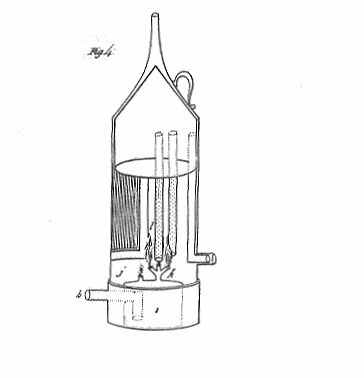
Fig. 4. represents the gas light lamp, which is intended and has been used for burning the fire damp in a coal mine, in lieu of oil, and thereby in a board infested with fire damp, or at a blower of tolerable magnitude, it will be the means of expending, most usefully, that hitherto noxious gas. These gas light lamps may be constructed of any size and power, and in any number, where a volume of fire damp is to be destroyed. This lamp is similar to the steam lamp just described, except at the bottom, where at p is a tube which passes through the bottom into the vessel i, which contains oil or water. j represents the oil lamp burning as in the steam safety lamp ; k the three small tubes for burning the fire damp ; l the three jets of the fire damp burning very briskly : but when the fire damp is to be burnt, the oil lamp is of course extinguished. The bottom of this lamp may be turned round so that the tube h, through which the fire damp is to be driven, may stand in any direction required.
With this lamp I have frequently burned fire damp in a diversity of ways in an explosive atmosphere, with perfect safety.
Bishopwearmouth, 20th August, 1816.





 Contains public sector information licensed under the

