


|

|

|

|
|
 |
 |
|||
1727 - Opening of Causey (or Tanfield Arch)
Extract from "Local Records" by John Sykes. Published in two volumes in 1833. Provides a "Historical Register of Remarkable Events"
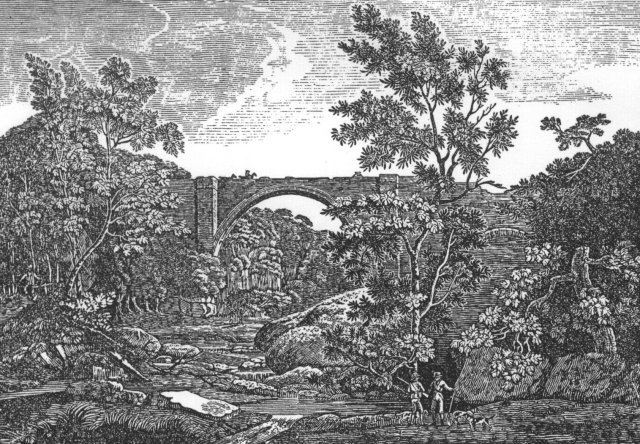
Tanfield arch, in the county of Durham, a remarkable structure, was built by Colonel Liddell and the Hon. Charles Montague, the founders of the partnership now vulgarly called The Grand Allies, to obtain a level for the passage of coal wagons. It is frequently called Cawsey Bridge, from its being built over the deep and romantic dell of Cawsey Burn, near Tanfield. The span of the arch is 103 feet ; it springs from abutments about nine feet high, and being semicircular, the entire elevation is about 60 feet ; it cost £12,000. The architect was Ralph Wood, a common mason, who having built a former arch of wood, that fell for want of weight, committed suicide from a dread of this beautiful structure experiencing a similar fate. On a sun dial, on one of the piers, is the following :- "Ra. Wood, mason, 1727." This arch was built for a wagon-way to a colliery, which was set on fire, and has been long unwrought. It has been many years neglected, and is falling to ruins.
Extract from "Annals of Coal Mining and the Coal Trade" by Robert L. Galloway. Published in two volumes in 1898.
Dr. Stukeley, who visited the Tyneside in the course of his northern tour, made in the year 1725, and who is the first writer to describe the railways here, after the brief notice of them by Roger North.
"The manner of conveying the coals from the pits down to the river side," he says (Itin. Cur., 2nd ed., Cent. II., pp. 68, 69), "is very ingenious: a cart-way is made by a frame of timber, on which the wheels of the carts run without horses, with great celerity; so that they are forced to moderate the descent by a piece of wood, like a lever, applied to one of the wheels.
"We saw Col. Lyddal's coal-works at Tanfield, where he carries the road over valleys filled up with earth, 100 foot high, 300 foot broad at the bottom; other valleys as large have a stone bridge built across, and in other places hills are cut through for half a mile together; and in this manner a road is made and frames of timber laid, for five miles to the river side, where coals were delivered at 5s. the chaldron."
The stone bridge referred to was the once famous Tanfield Arch, or Causey Arch, having a span of 103 feet and a height of 63 feet (Brand, ii. 306; Sykes's Loc. Rec., i. 143), built for the above railway from Tanfield to the Tyne by Colonel Liddell and the Hon. Chas. Montague — the founders of the partnership called the Grand Allies — at a cost of £1,200. The arch fell down after being built, but was rebuilt forthwith. The mind of the architect (a country mason) became so unhinged by the fear lest it should fall a second time, that he committed suicide by leaping from the top. It has long been disused, and exists now as a picturesque ruin. It bore date 1727. A view of it is given by Mr. T. Sopwith in his treatise on Isometrical Perspective.
Colonel Liddell's colliery at Tanfield took fire in 1739 (Sykes's Loc. Rec., i. 159); an accident attributed to the carelessness of some boys. The pit is described as having been changed into a terrible volcano, thundering out eruptions of hot cinders of considerable weight into the open air, to an incredible height and distance. The flames were extinguished by closing up the pits.
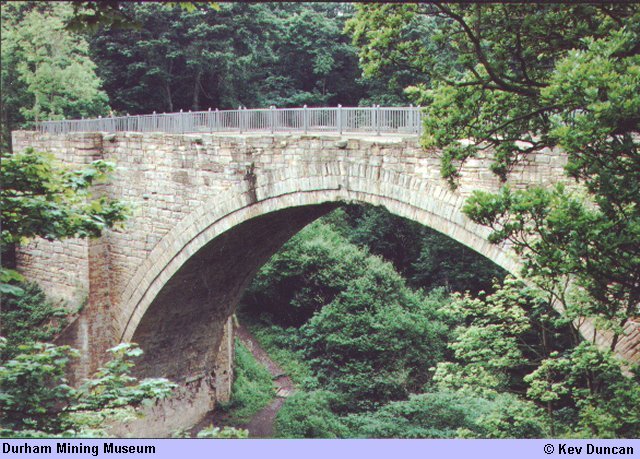
As you can see from the photograph above, taken in 1992, Causey Arch is no longer in ruins. It has been restored as a tourist attraction with an adjacent car park and picnic area, and displays around the arch describing its original use, its history etc. along with a wagon that would have been drawn by the horses over the wooden rails. As you can see from the photograph, railings have been installed along the edge of the arch and you can walk from one side over to the other. If you visit the arch look around the route of the wagon way and you can see where some of the small valleys have been filled with an earth bank so that the wagon way has a level path - only the drainage culverts at the bottom of the earth banks show where the original valley floor was.





 Contains public sector information licensed under the

