|
|
Gresford Colliery shafts sunk 1910 coal won 1911 Shafts 19ft 6ins diameter and 2,280 ft deep Downcast shaft or Dennis Pit north of Upcast shaft or Martin Pit. Shafts 200 ft apart. Producing just before disaster average 876 tons of coal every 24 hours or 9,400 tons per week. 3 seams worked:- Crank Coal Seam - 3 ft high household coal Brassey Coal Seam - very hard coal for commercial use - not gassy - seam varied in thickness Main Coal Seam - mainly in The Dennis Section - very gassy - seam 6ft to 7ft 6ins high - for industrial use Whole mine very hot,dry and dusty. In 1934 1849 employed underground working a 3 shift cycle At approx 01.50 a.m. on Saturday 22nd Sept 1934 an explosion occurred in the Dennis section while about 487 men were working underground of which 267 were in the Dennis Section. The rest were in the other section about 2 miles away and were unaware of the disaster for some time afterwards. The Dennis Section working area was about 1.3 miles from the shaft bottom down a slight slope at about 2,500 ft below ground. 261 men were lost and the inspector's report states that the general opinion is that they died instantly The working temperature was normally between 86 and 92 degrees Fahrenheit. The Formal Investigation into the disaster in pursuance of Section 83 of The Coal Mines Act 1911 opened on 25th October 1934, lasted 28 days closing on 14th December 1934. It was then adjourned to await re-opening of the colliery to enable on site investigation, but due to The Dennis Section remaining sealed to the present day the investigation was not re-opened. It was held by Sir Henry Walker His Majesty's Chief Inspector of Mines as The commissioner and a Mr John Brass and Mr Joseph Jones as Assessors. At The Inquest held by Sir Stafford Cripps K.C.in 1936 who was Counsel for The North Wales Miners Association ( Sir Stafford was later to become a cabinet member of Labour's first post-war Govt with Clem Attlee as P.M.) Officials were recorded as :- Manager - Mr. William Bonsall - held position since 1917 Under-manager - held by Mr Thomas Hughes until 1933 when he fell ill. He was replaced by 2 under-managers due to the 2 working areas being so far apart. The Dennis Section under-manager was Mr. Andrew Williams who was new to Gresford in 1934 but his previous work included 24 years at Hafod Colliery, North Wales followed by 9 years as Agent & Manager at Blaenhirwaun, Carmarthenshire. Colliery Surveyor - Mr. Sydney Erwin Hayes Assistant Colliery Surveyor - Mr. William Idris Cuffin The inquest heard that after the explosion the only survivors came from the 29's district of the Dennis Section. They were:- David Jones - Night-shift Deputy John Edward Samuel - Coalcutting Machineman Albert Samuel - Coalcutting Machineman Thomas Fisher - Collier Robert Edward Andrews - Collier Cyril Challoner - Collier Efforts to subdue the fire continued until Sunday afternoon but the fire was spreading out of control. There was no water available in the mine. In late afternoon all men were withdrawn from the mine and the shafts sealed by capping them. During the fire-fighting 7 bodies were recovered on the Saturday and one on the Sunday. All had died from burns and carbon-monoxide poisoning. Under-manager and Overman from the other section Mr Benjamin Edwards was recorded as the first person to see the fire at about 03.30a.m. About that time the first rescue team arrived and three died instantly. Two were recovered the same day but the third - Mr John Lewis was not recovered until 18th May 1935 when an unsuccessful attempt was made to access The Dennis Section. The 266th man to die was a surface worker who was close to The Dennis shaft when another explosion blew off the shaft cap and the man was killed by flying debris. During the Inquest on 8th June 1938 Assistant Surveyor Mr William Idris Cuffin admitted that the measurements of air in the ventilation system supposed to have been made monthly in accordance with The Coal Mines Act 1911 section 29 (2) were fictitious following instructions from The Manager Mr Bonsall not to take readings. However a couple of days after the disaster he was instructed to concoct a set of readings and record them in the record book. Sir Stafford Cripps concluded that the the disaster was caused by a shot being fired at the coalface which ignited a large pocket of Firedamp (Methane Gas) which had accumulated due to inadequate ventilation brought on by the lack of monthly readings contrary to sect 29 of The Coal Mines Act 1911 Conclusions were recorded that Deputy Harold Thomas sent The Rescue Brigade forward without a life line and without backup and was therefore guilty of Manslaughter in respect of the loss of 4 men of a brave Rescue Team. Only one member emerged alive. As regards The Manager Mr. William Bonsall who accepted full responsibility, the evidence clearly establishes that he was guilty of the following serious breaches of the General Regulations and of The Coal Mines Act 1911:- Failure to keep book,copies thereof - Section 24 Failure to maintain adequate ventilation - Section 29 (1) Failure to measure and enter quantity in every split - Section 29 (1) Failure to supply separate means of egress in top end of 14's Section 36 (3) Failure to cut off electric current in 14's face when over 1.25% of gas was present - Section 60 (2) Failure to comply with requirement regarding telephone apparatus - Section 60 Failure to comply with sub-section 5 of Section 62 (4) dealing with coal dust Failure to carry out instructions for withdrawal of workmen - Section 67 Failure to comply with Section 88 (b) to supply workmen with abstract Failure to enforce General Regulations 2 part 1 dealing with wafting gas Failure to observe Statutory Rules and Orders on Explosives Part 2 Failure to observe C.M.R. Limitations of hours etc 1908-32 He did not cause dust samples to be taken beyond 142's at any time He left matters involving breaches of law to his under-officials, and never attempted to inculcate respect for the law among the officials appointed by him to supervise the day-to-day operations of the men The under-manager and other subordinate officials, deputies and shotfirers have also been similarly guilty of flagrant and persistant breaches of The Coal Mines Act and The General Regulations, and all should be dealt with as the Law directs. 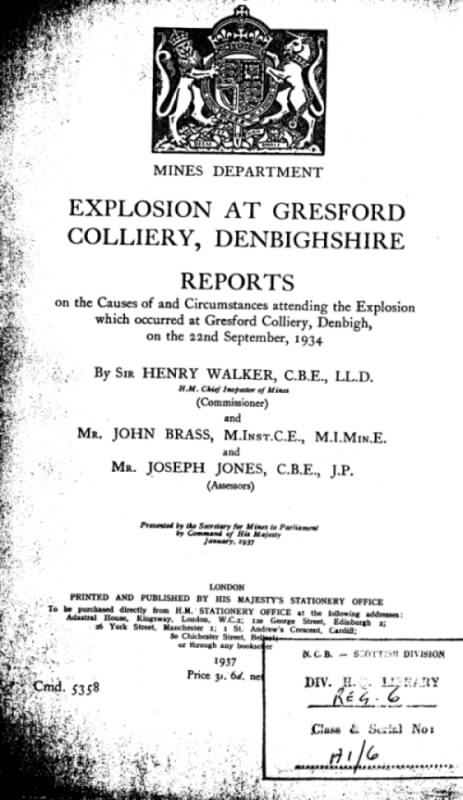 |
 |
|||||||

Mail: Webmaster |

Back |

Home |
www.pitwork.net pages copyright © by Bill Riley and his contributors
Website copyright © 1999-2017 by The Durham Mining Museum and its contributors Registered Charity No: 1110608
|

Search |

|
||